How AI Could Transform Health Care
We explore how artificial intelligence could influence drug discovery, health care services and data analytics.

Key Takeaways
Artificial Intelligence (AI) is influencing health care in three key areas: drug discovery, health care services and health care data analytics.
Reducing costs and improving efficiency may be among the most immediate benefits for health care organizations.
Companies that win over the long run may use AI with proprietary health care data, research platforms or specialized industry expertise.
AI could change how researchers develop drugs, how health care organizations deliver services and how clinicians use data to make decisions.
The potential impact is significant. U.S. health care spending is estimated to reach $6 trillion in 2026, and the Centers for Medicare & Medicaid Services projects it will total nearly $9 trillion by 2034.1 As costs rise, AI may help accelerate drug development, improve operational efficiency and support clinical decision-making.
What to Know About AI in Health Care
Here’s a quick look at how AI may shape health care and related investment opportunities.
What is AI in health care? AI in health care refers to the use of AI to support tasks such as analyzing data, developing treatments, improving workflows and informing clinical decisions.
Can AI lower health care costs? Possibly. One estimate from the National Bureau of Economic Research suggests AI could reduce U.S. health care spending by 5% to 10%.2
How can AI support drug discovery? AI can help researchers identify potential drug targets, design molecules, improve clinical development and assess the likelihood of success.
Where could AI create opportunities in health care? Companies involved in drug discovery, health care services and data analytics may benefit as AI adoption expands.
Why are investors looking beyond technology companies for AI opportunities? Health care companies with differentiated datasets, validated platforms and demonstrated real-world applications may be well-positioned to leverage AI effectively.
Why Is Health Care Spending Increasing?
In 2025, U.S. health care spending was projected to reach $5.7 trillion, or 18.4% of gross domestic product (GDP).3 By 2034, spending is projected to approach $9 trillion, an increase of nearly 58%. Health care costs are also expected to continue rising faster than general inflation.
According to the Committee for a Responsible Federal Budget, the near-term rise is largely driven by an aging population, increased utilization and higher prescription drug spending.
Figure 1 | Health Care Spending Outpaces GDP Growth in the U.S.
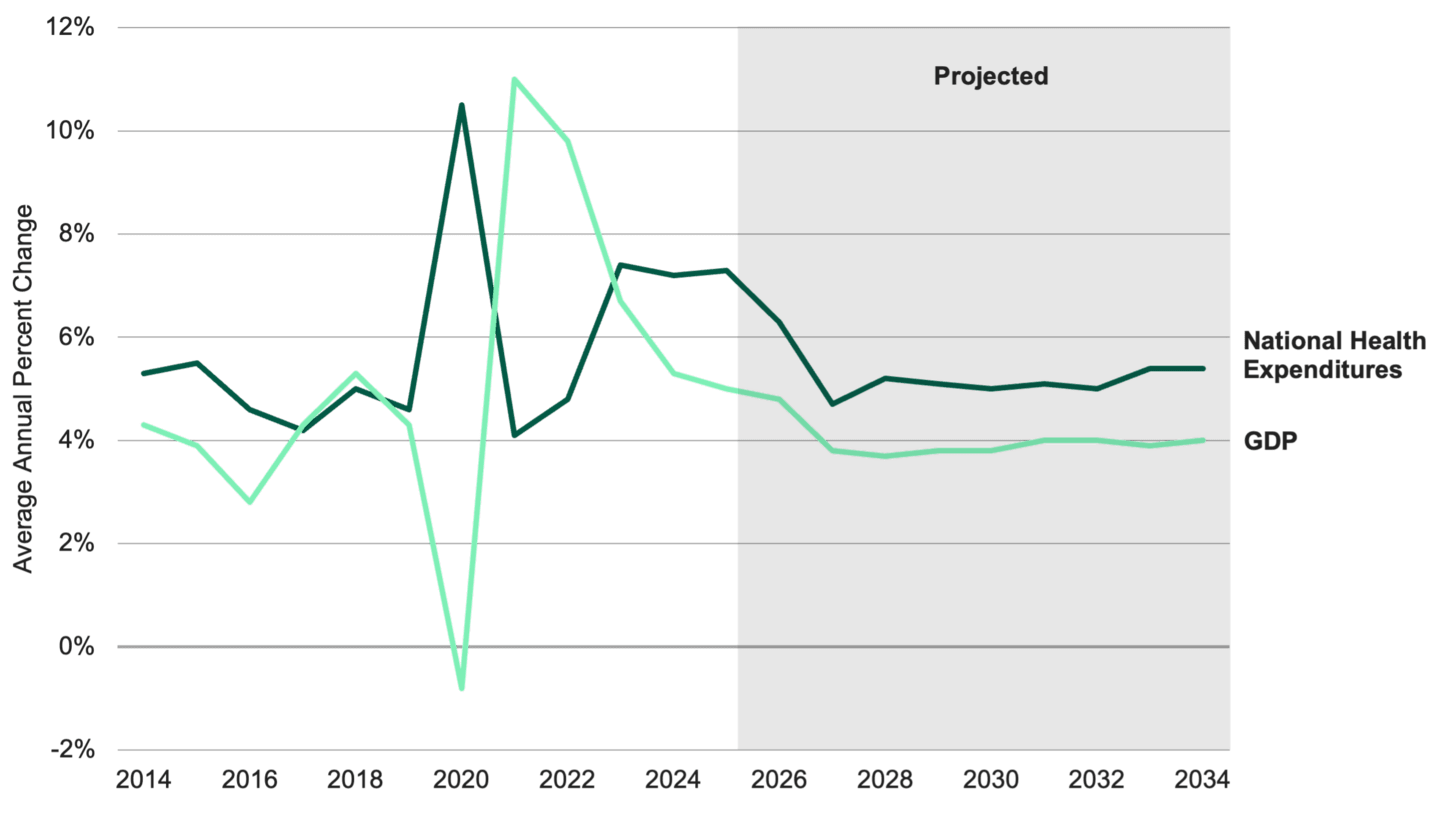
Historical data from 2013–2024. Projections from 2025–2034. Source: Centers for Medicare & Medicaid Services.
Where Could AI Improve Health Care Productivity?
AI’s potential in health care largely comes down to productivity: delivering better care while using resources more efficiently. Administrative costs, for instance, may account for nearly 25% of all U.S. health care spending.4
As spending continues to rise, AI could help improve productivity in several areas:
Regulatory document preparation
Medical information management
Clinical trial optimization
Health care workflow automation
Support for decision-making
AI may be especially influential in three broader areas: drug discovery, health care services and health care data analytics.
Figure 2 | Where and When Could AI Affect Health Care?
1. How Is AI Used in Drug Discovery?
Typically, biopharma research and development for a single drug takes years — even decades — as reported in an article presented at the World Economic Forum Annual Meeting.5 AI is redefining that standard.
The process typically consists of four phases: discovery, clinical trials, evaluation, and post-approval. AI can be utilized throughout research and development to accelerate and enhance trial design, patient recruitment and regulatory documentation.
However, it’s important to remember that AI has limitations, including data quality and ethical concerns.6
Real-world example: Insilico Medicine, an AI drug discovery company listed on the Hong Kong Stock Exchange, uses AI in its own research and in partnerships with biopharma companies. In one project, the company used AI and automated experiments to design a protein in less than a month — a process that previously may have taken years.7
How Could AI Drug Discovery Benefit Patients?
Several AI projects aim to help researchers identify and develop potential treatments more efficiently.
For example, Amazon Web Services and OpenAI have announced tools designed to support scientists and computational biologists in drug research. Both initiatives involve collaborations with pharmaceutical companies.
Advances in AI-driven drug discovery could help researchers develop new treatments more quickly, potentially leading to revolutionary breakthroughs for hard-to-treat diseases.
In financial terms, the stakes are high. Industry estimates suggest it takes 10-15 years and more than $2 billion to develop a viable new drug.8 Independent studies cut that figure in half.9 But a process that requires a billion dollars or more per drug over a decade is ripe for disruption.
AI-developed drug candidates must still undergo clinical trials to demonstrate safety and effectiveness. As a result, even a faster discovery process may take years to produce an approved treatment.
The potential effects could extend beyond pharmaceutical companies to businesses that provide research tools and services. Twist Bioscience, for example, supplies products used in drug discovery and is working to integrate its platform into therapeutic research workflows.
2. How Can AI Improve Efficiency in Health Care Services?
AI could help improve provider productivity, clinical workflows, patient monitoring and care coordination.
In the near term, AI may help automate administrative tasks, reduce administrative burdens and improve operational efficiency. Over time, additional applications could include tools that support caregivers, automate clinical documentation, improve medical coding, help patients navigate care and support population health management.
Broad adoption may depend on regulatory oversight, reimbursement policies, clinical validation and successful integration into existing workflows.
Real-world example: Large managed care organizations such as UnitedHealth Group have highlighted AI's potential to reduce administrative and medical management costs, while also improving care coordination and member engagement. These applications may help organizations operate more efficiently and expand access to care.
3. How Is AI Used in Health Care Data Analytics?
AI can analyze large amounts of health data to help clinicians make more informed decisions and researchers evaluate medical evidence.
Potential applications include the following:
Supporting diagnoses
Identifying treatment options
Matching patients with clinical trials
Supporting medical research
Summarizing new medical evidence as it becomes available
Real-world example: OpenEvidence provides a HIPAA-compliant AI research tool that health care professionals can use at no cost. The company estimated that 40% of U.S. physicians used its tool daily in 2025.10
AI’s Health Care Impact May Extend Beyond Tech Stocks
Over time, successful applications of AI in health care may share several characteristics:
Combining proprietary health care data with AI models to support clinical decisions
Reducing health care costs
Improving patient outcomes
Companies with differentiated datasets, validated platforms and demonstrated real-world results may be better positioned to use AI effectively.
Authors
Explore Our Large-Cap Growth Capabilities
Centers for Medicare & Medicaid Services, “National Health Expenditure Projections 2025-2034,” June 24, 2026.
Nikhil Sahni, George Stein, Rodney Zemmel, and David M. Cutler, “The Potential Impact of Artificial Intelligence on Healthcare Spending,” Working Paper No. 30587, National Bureau of Economic Research, October 2023.
Centers for Medicare & Medicaid Services, “National Health Expenditure Projections 2025-2034,” June 24, 2026.
Nikhil Sahni, George Stein, Rodney Zemmel, and David M. Cutler, “The Potential Impact of Artificial Intelligence on Healthcare Spending,” Working Paper No. 30587, National Bureau of Economic Research, October 2023.
Fiona Marshall, “Here’s How AI Is Reshaping Drug Discovery,” World Economic Forum, January 15, 2026.
Alexandre Blanco-González, Alfonso Cabezón, and Alejandro Seco-González, et al., “The Role of AI in Drug Discovery: Challenges, Opportunities, and Strategies,” Pharmaceuticals (Basel) 16, No. 6 (June 2023): 891.
Renan Gonçalves Leonel da Silva, “The Advancement of Artificial Intelligence in Biomedical Research and Health Innovation: Challenges and Opportunities in Emerging Economies,” Global Health 20, No. 1 (May 2044): 44.
Pharmaceutical Research and Manufacturers of America, “Research and Development Policy Framework,” accessed September 2, 2026.
Andrew Mulcahy, Stephanie Rennane, and Daniel Schwam, et al., “Use of Clinical Trial Characteristics to Estimate Costs of New Drug Development,” JAMA Network Open 8, No. 1 (January 2025): e2453275.
Kevin B. O’Reilly, “More Than 80% of Physicians Use AI Professionally: AMA Survey,” American Medical Association, March 12, 2026.
References to specific securities are for illustrative purposes only and are not intended as recommendations to purchase or sell securities. Opinions and estimates offered constitute our judgment and, along with other portfolio data, are subject to change without notice.
The opinions expressed are those of American Century Investments (or the portfolio manager) and are no guarantee of the future performance of any American Century Investments portfolio. This material has been prepared for educational purposes only. It is not intended to provide, and should not be relied upon for, investment, accounting, legal or tax advice.
Investment return and principal value of security investments will fluctuate. The value at the time of redemption may be more or less than the original cost. Past performance is no guarantee of future results.