Emerging Markets Are Reshaping Global Electricity Demand
Demographics, urban growth and infrastructure are driving a global shift in power use.

Key Takeaways
About 80% of the increase in global electricity demand through 2030 is projected to come from emerging economies.
Emerging markets (EM) electrification is reinforced by demographics, urbanization and government investments in grids, power generation and clean energy.
Limited legacy infrastructure lets many emerging markets leapfrog to smart grids, distributed power and off-grid solar.
Electrification in emerging markets is rapidly emerging as a compelling long-term investment opportunity, in our view. As urbanization and industrialization accelerate, demand for electricity is rising sharply.
Key data points help support this perspective:
About 80% of increased electricity demand through 2030 will come from emerging economies, according to the International Energy Agency.1
China alone is expected to account for nearly 50% of the increased demand through 2030, with an average annual growth rate of 4.9% (Figure 1). Demand from India and Southeast Asia is also expected to grow.2
Electricity makes up a bigger share of China’s final energy consumption compared to the U.S. and the EU — 27% versus roughly 20%, respectively.3
Figure 1 | China and Other Emerging Markets Drive Electricity Demand
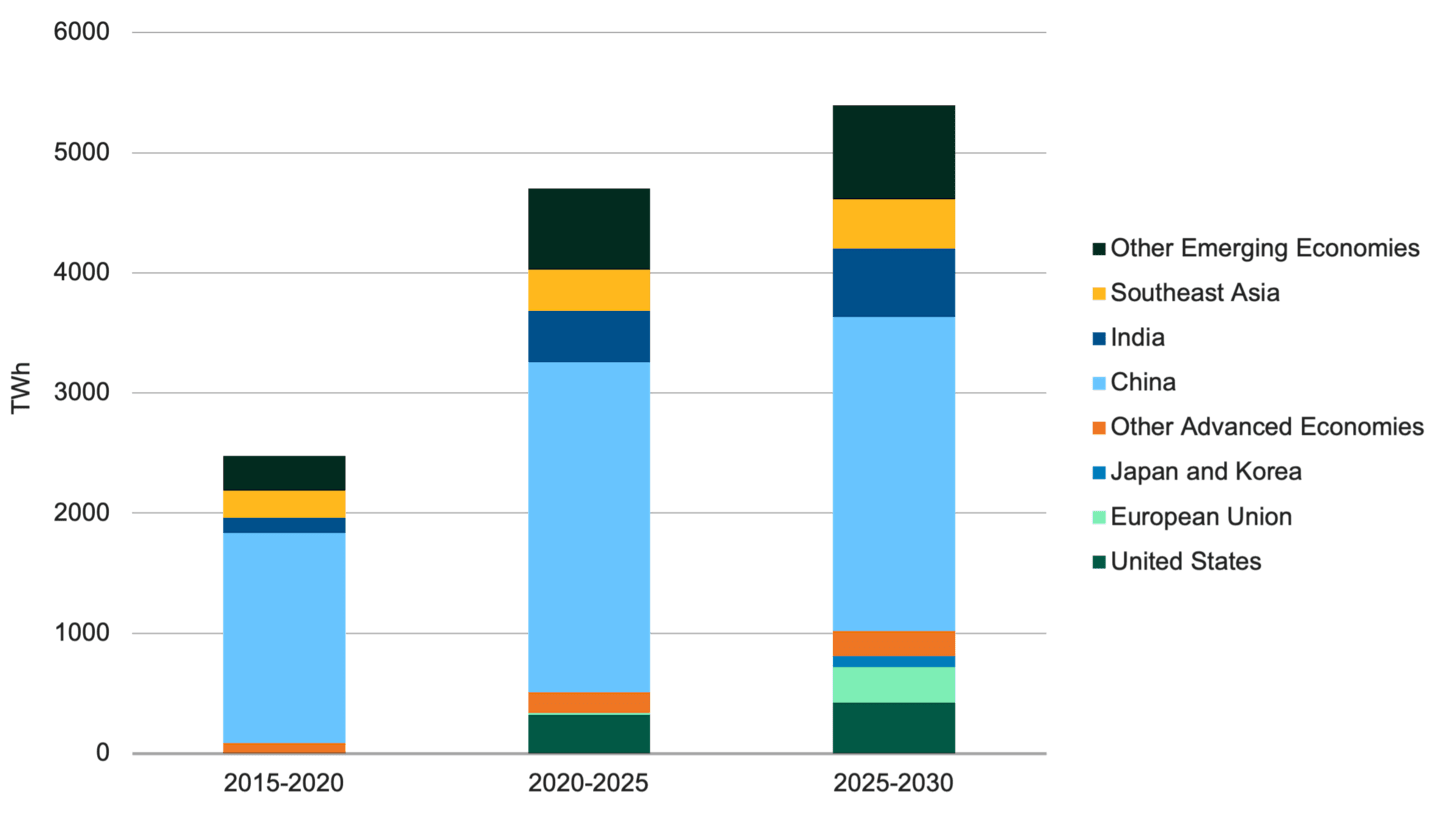
Data as of 1/30/2026. Source: International Energy Agency.
Changing demographics, rising incomes and proactive government policy all support this trend. We think EM companies across multiple sectors could benefit as demand continues to build.
Why Is Electricity Demand Rising in Emerging Markets?

Favorable Demographics and Economic Growth
Emerging markets are seeing significant population growth along with rising incomes, increasing demand for products like air conditioning and electric vehicles (EVs).
S&P Global predicts that EM countries will account for 65% of global economic growth by 2035.4 The middle class in these markets could double in size over the next decade, reaching 687 million people by 2034.5
This momentum is translating into greater purchasing power and higher electricity consumption.
Increased Urbanization
Urbanization is progressing rapidly in regions like sub-Saharan Africa and South Asia, outpacing growth in developed markets.6
Cities are economic growth engines, attracting industries that depend on reliable electricity. Urban residents typically earn more, and their spending on air conditioning, appliances and other goods further spurs electricity demand.7
Government Funding and Policy Support
Many EM governments support electrification through new policies and investments. They offer incentives for EV use and fund major construction projects.
China, for example, has put hundreds of billions into renewable energy production, grid expansion and infrastructure upgrades.
Much of this investment has come from state-owned enterprises, although the Chinese government is encouraging greater participation from private enterprises.8
Several countries also use tiered power pricing, where the largest energy users pay higher rates than residential customers. This approach could provide more funding for grid expansion and power generation.
Skipping Legacy Systems to Build Modern Grids
EM countries have less existing energy infrastructure. Instead of maintaining older systems, they have the freedom to adopt advanced technologies such as digitalized smart grids and distributed energy systems.
They’re also building off-grid systems that generate solar power near the people who use them. This makes it easier to electrify rural and remote areas.
Room for Expansion
Because they usually have less access to electricity, emerging markets have greater growth potential in this area.
In sub-Saharan Africa, for example, just over half the population had access in 2023, compared to essentially universal access in North America and Europe.9
Areas Linked to Electrification-Driven Growth
The electrification trend touches multiple sectors and industries, but in our view, the following areas stand out.
Power Generation and Grid Expansion
Meeting higher demand will require widespread investments, from power plants and distribution grids to rooftop solar and EV charging networks. Manufacturers of high-voltage transformers, cables and turbines are poised to benefit, along with engineering and construction firms.
According to an International Energy Agency forecast, China could account for almost 60% of the world’s growth in renewable energy capacity over the next few years. India’s capacity is expected to grow by 2.5 times over the same time frame.10
EVs and Battery Supply Chains
China leads the world in EV manufacturing, responsible for nearly two-thirds of production in 2024.11 Other emerging markets – like South Korea, Mexico, India and Thailand – are major producers as well.
China is also home to Contemporary Amperex Technology Co. Ltd., or CATL. The company’s batteries power almost 38% of the world’s EVs.12
Natural Gas and Power Reliability
Utilities and corporate customers need to ensure reliable access to power, and that isn’t always possible with wind and solar. This is creating greater demand for natural gas, particularly liquefied natural gas.
Natural Resource Demand
Increased electrification could create demand for resources such as lithium and copper, benefiting mining firms in Chile, Argentina and Peru. China is the dominant producer of rare earth metals, essential for electric vehicle batteries and other technologies.
Our Outlook on EM Electricity Demand
Emerging markets are leading the global surge in electricity demand as they experience greater economic growth, demographic shifts and more active policy support.
We believe that EM countries’ efforts to expand access and invest in infrastructure could create a range of opportunities for companies and investors.
Authors
Sr. Client Portfolio Manager
Explore Our EM Capabilities
International Energy Agency, “Electricity 2026,” February 6, 2026.
International Energy Agency, “Electricity 2026,” February 6, 2026.
Ibid.
Jose Perez-Goropze, Carlos Cardenas and Natznet Tesfay, “Emerging Markets: A Decisive Decade,” S&P Global, October 16, 2024.
Oxford Economics, “The Future of the Middle Class in Emerging Markets,” October 16, 2024.
World Bank Group, Urban Population Growth (Annual %), as of 2024.
International Labour Organization, “Employment and Wage Disparities Between Rural and Urban Areas,” February 2024.
International Energy Agency, “World Energy Investment 2025 – China,” June 5, 2025.
World Bank Group, Access to Electricity (% of Population), as of 2023.
International Energy Agency, “Renewables 2025 – Executive Summary,” October 7, 2025.
Frik Els, “Top 10 EV-Producing Countries by Battery Capacity Deployed,” Adamas Inside, March 7, 2025.
CATL, “CATL EV Battery Usage Ranks No. 1 Globally for Eight Consecutive Years,” February 12, 2025.
References to specific securities are for illustrative purposes only and are not intended as recommendations to purchase or sell securities. Opinions and estimates offered constitute our judgment and, along with other portfolio data, are subject to change without notice.
International investing involves special risks, such as political instability and currency fluctuations.
Past performance is no guarantee of future results. Investment returns will fluctuate and it is possible to lose money.
The opinions expressed are those of American Century Investments (or the portfolio manager) and are no guarantee of the future performance of any American Century Investments portfolio. This material has been prepared for educational purposes only. It is not intended to provide, and should not be relied upon for, investment, accounting, legal or tax advice.