The AI Boom Runs Through Emerging Markets
Artificial intelligence depends on semiconductors, memory chips and other critical inputs from emerging markets. For investors, that points to a broader story of EM innovation and long-term growth potential.
Key Takeaways
Emerging markets (EM) play an essential role in the AI supply chain, from advanced chips and memory to components and key materials.
Decades of investment have helped EM nations build deeper technology ecosystems and advanced manufacturing capacity.
As technology reshapes the global economy, EM equities may offer compelling opportunities for active growth investors.
Emerging markets have long been associated with commodities, low-cost manufacturing and cyclical goods. But the rise of AI highlights how dramatically the companies that make up this asset class have evolved in recent decades.
EM firms now hold high-value, hard-to-replicate positions in global supply chains for semiconductors, memory and other critical inputs. Last year, Asia exported over 60% of the world’s AI-enabling goods, surpassing North America and Europe combined. In Taiwan alone, roughly 80% of exports were related to artificial intelligence.1
While many advanced semiconductor and memory chips are designed in the U.S., they are primarily manufactured in Asia’s emerging markets.
Thanks to this leadership, emerging markets offer more than diversification. For growth-oriented investors, they now provide a way to gain exposure to some of the world’s most important technology and innovation trends.
We believe this is an enduring shift. Emerging markets have spent decades developing their edge in developing technology and advanced manufacturing capabilities. As EM companies build on these strengths, they may remain important contributors to global innovation and economic growth for years to come.
How Emerging Markets Power Artificial Intelligence
AI requires advanced semiconductors, memory, networking equipment and data center infrastructure. EM companies have become the dominant providers of many of these materials, supporting the global AI buildout.
Advanced semiconductor and high-bandwidth memory chips are particularly critical for AI servers.
TSMC (Taiwan) is the premier manufacturer of advanced semiconductors and AI processors for firms such as Nvidia, Apple, AMD and Broadcom. According to one estimate, TSMC captured nearly 70% of global market share for chip foundries in the second quarter of 2025.2
SK Hynix (South Korea) has established itself as a leading supplier of high-bandwidth memory, a key component in advanced AI systems. One analysis found that in the third quarter of 2025, it had more than 50% market share in high-bandwidth memory.3
Samsung Electronics (South Korea) produces semiconductors, memory and storage. During the first quarter, the company reported record earnings for its semiconductor unit, driven by sales of memory products.4
Executives at each company have noted that demand for their products is outpacing supply.5
The supply-demand gap looks particularly sharp for high-bandwidth memory. The CEOs of Samsung and SK Hynix both warned that it could widen in 2027.6
What Do Emerging Markets Supply Beyond AI Chips?
Beyond semiconductors and memory, emerging markets are home to a wide range of companies that can meet other specialized AI needs.
Firms such as Unimicron Technology (Taiwan) and Samsung Electro-Mechanics (South Korea) produce semiconductor packaging substrates. These substrates provide the electrical and mechanical interface between the processor and memory chips and the system’s printed circuit board (PCB).
Other companies specialize in advanced packaging, creating systems that integrate processors, memory and other components to operate even more efficiently. ASE Technology (Taiwan) is an example of a firm operating in this space.
AI-driven data center growth is also increasing demand for specialized components. Delta Electronics (Taiwan) makes power management systems and cooling solutions for these facilities, while Zhongji Innolight (China) produces optical transceivers that help move vast amounts of data through fiberoptic networks.
AI requires significant amounts of power. To meet this need, emerging markets in Asia have outlined plans to spend roughly $4 trillion on energy-related capital expenditures over the next five years.7
Across Asia and beyond, emerging markets also produce many of the materials used in chips, batteries, power cables, cooling equipment and other products.
Chile, Brazil and Indonesia, for example, were the world’s top copper exporters in 2025.8 The metal is critical for data center construction and power grid expansion.
These three countries are also major exporters of lithium, which is a crucial component in backup batteries for data centers.9
China produces a significant amount of magnetic rare earth elements – about 60% of global mined output and 91% of refined output in 2024.10 Meanwhile, other nations, including Malaysia, are also building their capacity.
How Is AI Accelerating Innovation in Emerging Markets?
Even if AI-related spending slows, we believe emerging markets’ advantages in technology and innovation will continue. The surge in AI investment has boosted existing tech ecosystems, manufacturing capacities, and research expertise.
Several developments suggest that technology investment and adoption continue to broaden.
In recent years, Amazon, Google, Microsoft and Oracle announced plans to spend more than $160 billion on AI infrastructure in the Asia Pacific region. Alibaba and ByteDance say they will deploy tens of billions as well.11
By 2030, APAC could represent nearly 34% of global data center demand, behind North America at 47%, according to one estimate.12
A McKinsey & Co. study found that APAC’s AI-related use is increasing, expanding beyond model training, as enterprises use it to digitize their operations.
Governments in many EM countries are also supporting innovation-led growth through incentives, research investments and workforce development.
China, for example, has put tens of billions into a state investment fund supporting the country’s domestic semiconductor industry.13 South Korea and Taiwan both offer tax credit programs designed to promote investments in R&D and facilities.14
India, Malaysia and Vietnam have all created national initiatives that offer incentives and support talent development programs.15
In our view, these investments could help EM companies play larger roles in developing and commercializing new technologies over time, moving them further up the value chain.
How Has Technology Exposure in Emerging Markets Changed?
Today's emerging markets offer significantly greater exposure to technology companies than they did a generation ago. The IT sector’s weight in the MSCI Emerging Markets Index has roughly tripled since 2016. See Figure 1.
Figure 1 | Technology Represents a Growing Share of Emerging Markets
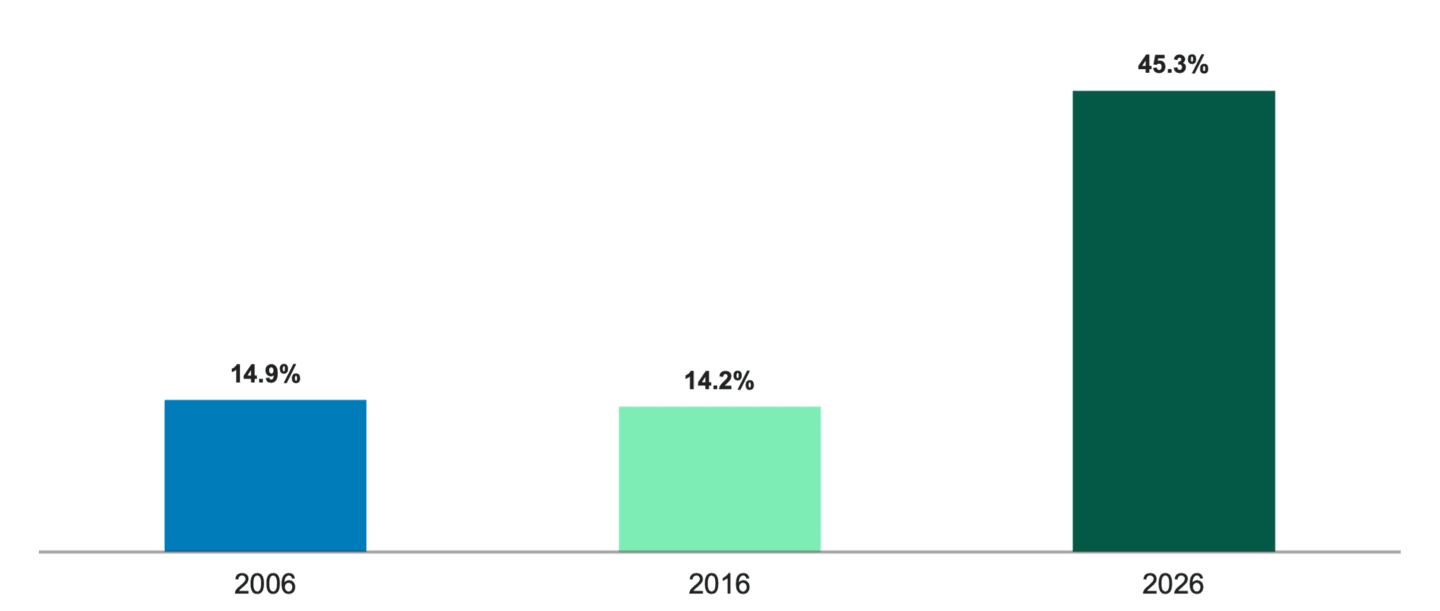
Data from 6/30/2006 – 6/30/2026.Source: FactSet, MSCI Index.
As shown in Figure 2, tech, which has historically delivered faster earnings and revenue growth, also accounts for a larger share of the EM benchmark than in developed markets.
Figure 2 | Emerging Markets Offered More IT Exposure Than Other Markets
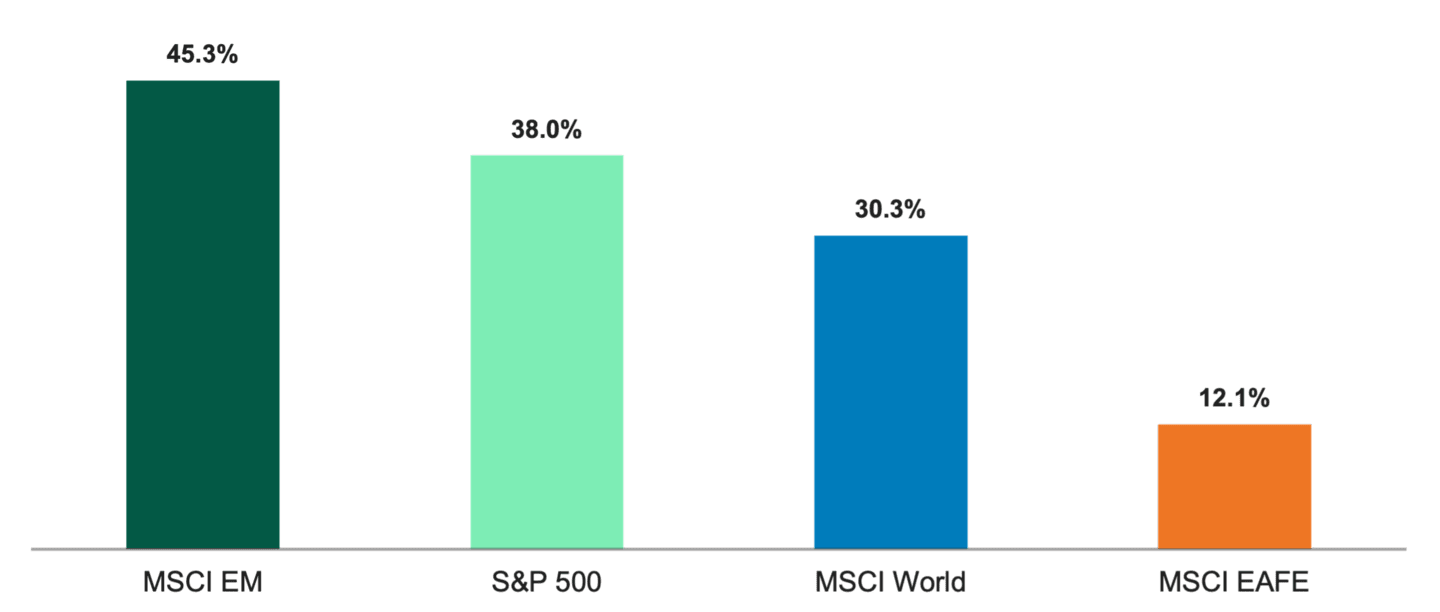
Data as of 6/30/2026. Source: MSCI, Standard & Poor’s.
Moreover, EM equities tend to trade at lower valuations than those in developed markets, which may increase their appeal for investors. See Figure 3.
Figure 3 | Emerging Markets Have Traded at Lower Valuations than Developed Markets
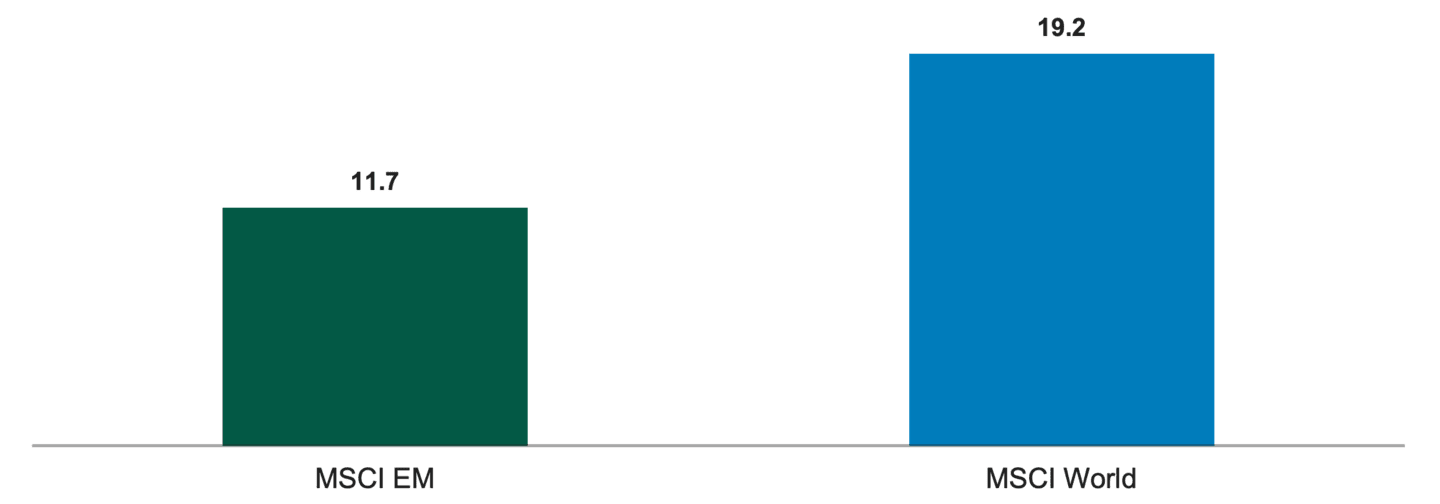
Data as of 6/30/2026. Source: MSCI.
From semiconductors to memory to advanced packaging and beyond, many of the companies essential to AI growth are concentrated in EM nations. Rather than simply benefiting from global growth trends, we believe emerging markets are now helping to drive them.
Authors
Explore Our EM Capabilities
Shanella Rajanayagam and Prachi Mathur, “Trade Without AI,” HSBC Global Investment Research, July 20, 2026.
TrendForce, “2Q25 Foundry Revenue Surges 14.6% to Record High, TSMC’s Market Share Hits 70%, Says TrendForce,” September 1, 2025.
TrendForce, “2Q25 Foundry Revenue Surges 14.6% to Record High, TSMC’s Market Share Hits 70%, Says TrendForce,” September 1, 2025.
Samsung Electronics, Earnings Presentation - 1Q 2026.
Taiwan Semiconductor Manufacturing Co. (TSMC), Q2 2026 Earnings Call, July 16, 2026; Samsung Electronics, Q2 2026 Earnings Call, July 30, 2026; SK Hynix, Q2 2026 Earnings Call, July 28, 2026.
Samsung Electronics, Q1 2026 Earnings Call, April 29, 2026; Heekyong Yang and Kenneth Li, “SK Hynix CEO Sees Worst Memory Shortage in 2027, Demand to Outstrip Supply Beyond 2030,” Reuters, July 11, 2026.
Morgan Stanley, “Asia’s Energy Buildout Gains Momentum,” June 18, 2026.
U.N. Comtrade Database, as of 7/29/2026.
U.N. Comtrade Database, as of 7/29/2026.
International Energy Agency, “Rare Earth Elements,” April 8, 2026.
Abhyuadaya Shrivastava, Denise Lee, Frank Chu, Michael Park, Pankaj Sachdeva, Celine Shan, Jeffrey Chang, and Lorraine Salazar, “Beyond the Spillover: Asia–Pacific, the Next Engine of Data Center Demand,” McKinsey & Co., June 22, 2026.
Abhyuadaya Shrivastava, Denise Lee, Frank Chu, Michael Park, Pankaj Sachdeva, Celine Shan, Jeffrey Chang, and Lorraine Salazar, “Beyond the Spillover: Asia–Pacific, the Next Engine of Data Center Demand,” McKinsey & Co., June 22, 2026.
Reuters, “China Sets up Third Fund with $47.5 Billion to Boost Semiconductor Sector,” May 27, 2024.
Lee Seul-ki, “K-Chips Act Passes National Assembly, Increasing Semiconductor Tax Credit Rates,” Chosun Biz, February 27, 2025; PwC, Taiwan: Corporate Tax Credits and Initiatives, as of January 12, 2026.
Government of India, Ministry of Electronics and Information Technology, Semicon India Programme, as of July 28, 2026; Justin Lim and Izzul Ikram, “Malaysia Secures Over RM63b Investments Under National Semiconductor Strategy — Anwar,” The Edge Malaysia, July 24, 2025; SEMI Southeast Asia, “Accelerating Ahead: How Vietnam Is Building a Competitive Semiconductor Hub,” Sept. 30, 2025.
References to specific securities are for illustrative purposes only and are not intended as recommendations to purchase or sell securities. Opinions and estimates offered constitute our judgment and, along with other portfolio data, are subject to change without notice.
International investing involves special risks, such as political instability and currency fluctuations.
Past performance is no guarantee of future results. Investment returns will fluctuate and it is possible to lose money.
The opinions expressed are those of American Century Investments (or the portfolio manager) and are no guarantee of the future performance of any American Century Investments portfolio. This material has been prepared for educational purposes only. It is not intended to provide, and should not be relied upon for, investment, accounting, legal or tax advice.