CIO Roundtable: A Different Kind of Bull Market?
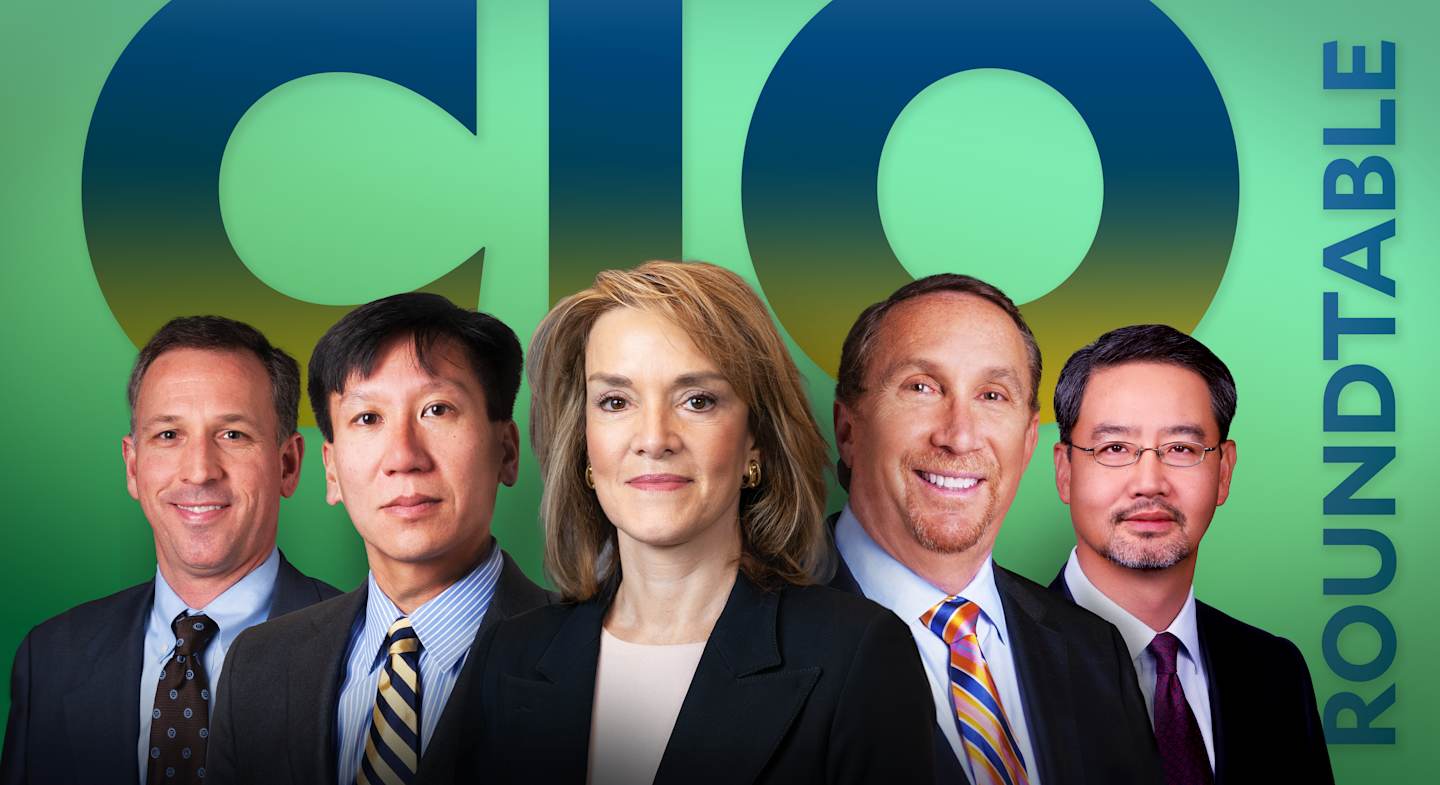
The conflict in the Middle East has increased volatility and energy prices, but markets so far appear to be repricing risk rather than signaling an end to the bullish sentiment for many businesses. That backdrop calls for selectivity—not retreat.
Our chief investment officers (CIOs) recently discussed how their teams are navigating shifting geopolitical risks, separating the true impact of artificial intelligence (AI) from hype, assessing global diversification opportunities, and evaluating how potential changes at the Federal Reserve (Fed) could reshape monetary policy.
Read key takeaways from the event below.
Key Takeaways
Edited excerpts from the conversation.
How Is the Conflict in Iran Impacting Global Markets?
The key question is whether this represents a short-term shock or a longer-term structural disruption. At this point, we lean toward a short-term shock, though that assessment remains fluid.
Practically, that means trimming exposure to some recent outperformers and selectively leaning into areas that have underperformed, where valuations may already reflect a more pessimistic outcome.
Kevin Toney, CFA, CIO, Global Value Equity
From the growth side, one area to consider adding is aerospace and defense, including space-related investments. After decades of underinvestment, we’re seeing a secular opportunity driven by satellites, intelligence capabilities and national security priorities. Even amid volatility, investment in these areas seems likely to continue.
Keith Lee, co-CIO, Global Growth Equity
The key uncertainty is the duration of the fighting. We’re closely monitoring developments and remaining patient, ready to add exposure selectively if longer-term opportunities emerge.
Patricia Ribeiro, co-CIO, Global Growth Equity
From a historical perspective, most market corrections of 10% or more are driven by a small set of catalysts: rising interest rates or inflation, higher taxes or tariffs, sharp increases in oil prices, or geopolitical shocks such as wars or pandemics. Today, we arguably have elements of all four. That doesn’t mean a correction is inevitable, but the potential is there, depending largely on the depth and duration of the current Middle East conflict.
Richard Weiss, CIO, Multi-Asset Strategies
For fixed-income markets, everything comes back to oil prices. Oil feeds directly into inflation expectations, which then influences interest rates. That’s the core mechanism we’re watching.
Charles Tan, CIO, Global Fixed Income
How Are You Distinguishing Real AI Value From Hype?
While there is hype, we also see cases of clear value delivery, like digital advertising. There’s a metric that a lot of digital advertisers use called ROAS, return on ad spend. Whenever AI has been used in ad placement, we’re seeing an average 10% to 15% lift in ROAS.
For software companies, valuations reflect more of an apocalyptic outlook around AI’s impact. But our view is that it’s not just code that gives value to software companies, it’s also their underlying data, and AI cannot replicate that data.
We always go back to our tried-and-true principles of speaking to the company management teams, the people in the trenches, to see what’s hype versus reality.
Keith Lee
When we look at international markets, one of the drivers of the AI push has been capital expenditures by the hyperscalers, the large cloud service providers. But what's really driving the opportunity is the cutting-edge technology. It's the companies that are at the forefront of technology and offer what businesses in the U.S. and other developed markets are looking for. For us, that is really important: having deep knowledge of the competitive environment and how companies are positioned to compete.
Patricia Ribeiro
With all the great inventions of humankind, the idea is to take advantage of it rather than fear it. And American Century is doing just that. We're in the front and center. As we all know, in our business today, you have to get on top of it. Because if you're not doing it, your competitors certainly are.
Richard Weiss
Are the Recent Market Rotations Driven by Skepticism Over AI ROI?
I'd say it's a few reasons. There are questions about valuations and ROI (return on investment). The large AI-exposed firms are businesses that have historically been high-growth companies. They have been high-margin, asset-light businesses, and now, at least in the medium- and near-term, some of that's changing. It's still high growth but decelerating. It’s becoming capital-intensive with all the capital expenditure that's going into it now.
Free cash flow that used to be so appealing is now negligible, maybe even negative in some cases. Now, maybe there will be an ROI down the road, but in the near- and medium-term, the return on invested capital is going down in several high-profile names. Also, as people get concerned about the negative impact of AI, they rotate to the industries and companies where they see some barriers to entry or some protection.
Kevin Toney
How Are Tariffs and Trade Policies Reshaping Global Supply Chains?
We're seeing trade agreements being developed or expanded between countries that don’t include the U.S. These agreements are giving companies opportunities to look for new markets and expand into markets where tariffs are not an issue.
The impact also depends on the sector and the country. In consumer stocks, for example, companies have been slower to pass along tariff costs. They’re not doing it all at once. Instead, it’s being done gradually. Generally, it has been a lot less impactful in emerging markets than initially expected.
Patricia Ribeiro
What Is Fed Chair Nominee Kevin Warsh’s Potential Impact on Fed Policy?
Kevin Walsh is likely to reshape the Fed in a number of ways. He is a former Fed governor and also a well-known critic of Fed policies under Powell and Yellen. I think he has called the Fed's COVID-19 response the greatest macroeconomic policy mistake in 45 years. He has argued that the Fed went too far with its interventions and stayed low way too long, causing inflation and economic damage.
Clearly, he's in favor of a smaller balance sheet and also a reduced role for the Fed in the financial markets. As to his interest rate policies, I think his position is a bit more nuanced. It's difficult to label him as either a dove or a hawk, but as a bond investor, I take comfort in hearing him say in the past that nothing is more expensive than free money.
To me, that means he's a believer in some money, and he's an inflation fighter. Now, of course, he's President Trump’s pick, and the president wants lower rates. So in running the new Fed, I think he really has to do a good job in balancing those political dynamics with his core beliefs in some money and inflation control.
Charles Tan
How Does the End of Japan’s Ultralow Yields Reshape the Outlook for Global Bonds?
Japan has been the world’s largest net creditor nation, with Japanese institutional investors holding more than $5 trillion in foreign assets, including more than $1 trillion in U.S. Treasuries. So they have a big impact on the global capital markets. I think the impact of Japan’s ultralow yield can be felt in two ways.
One is subtle: Government bond markets are highly correlated. Higher Japanese bond yields can also mean higher U.S. bond yields, or European bond yields, everything else being equal.
There could also be a more volatile or disruptive impact: If Japanese bond yields go up quickly and the Japanese yen appreciates sharply at the same time, it could trigger the unwinding of the yen carry trade.
The last time this happened was in August 2024, and that caused a big sell-off in U.S. tech stocks. The Japanese equity market also went down about 11% in a couple of days. So I think as Japan normalizes its monetary policy, it could be a positive for Japan, but it could also be a risk factor for the rest of the world.
Charles Tan
Authors
Explore More Macro and Market Insights
The opinions expressed are those of American Century Investments (or the portfolio manager) and are no guarantee of the future performance of any American Century Investments portfolio. This material has been prepared for educational purposes only. It is not intended to provide, and should not be relied upon for, investment, accounting, legal or tax advice.
References to specific securities are for illustrative purposes only and are not intended as recommendations to purchase or sell securities. Opinions and estimates offered constitute our judgment and, along with other portfolio data, are subject to change without notice.