The Biggest Changes from the Latest Russell Index Reconstitution
The latest update shifted exposures across major benchmarks, highlighting AI’s growing influence on U.S. equity markets.

Key Takeaways
Russell’s annual reconstitution updated index membership to reflect the evolving U.S. equity market.
Artificial Intelligence (AI)-related performance pushed several companies into new market-cap and style categories.
The changes highlight why investors should understand what sits inside their benchmarks.
FTSE Russell’s U.S. indices saw multiple changes as a result of its just-completed reconstitution process, and several of these updates are particularly noteworthy.
During reconstitution, companies are added or removed from specific indices to reflect changes in their market capitalization and other characteristics. Some may gain or lose index weight. In other cases, a company will switch from a growth-style index to a value index, or vice versa.
As a result of this latest reconstitution:
The Russell 1000® Value Index gained significantly more exposure to several Magnificent Seven companies.
The semiconductors and semiconductor equipment industry makes up a meaningfully larger part of the Russell 1000® Growth Index.
Multiple companies are moving to new indices because of substantial increases in market capitalization, as they have benefited from increased spending on AI.
Reconstitution, which occurs every June, performs an important function: It refreshes Russell’s indices to ensure they accurately represent the state of the U.S. equity market.
We believe it’s important for investors to understand exactly what’s changing. The Russell indices serve as the benchmarks for a wide range of funds and ETFs, and they influence which equities those investment products hold. Updates to the indices could in turn impact investors’ exposures to companies, sectors and investment styles.
How the Russell Indices Are Constructed
FTSE Russell maintains multiple indices that track the U.S. equity market, each with a slightly different focus.
The Russell 3000® Index comprises about 3,000 of the largest U.S. stocks, aiming to provide “total market” exposure. It has two subsets: the Russell 2000® and the Russell 1000®.
The Russell 2000 is a small-cap index that includes the smallest 2,000 stocks in the Russell 3000.
The Russell 1000 Index covers mid- and large-cap stocks. It has two subsets: the Russell Midcap® holds roughly 800 mid-cap names, and the Russell Top 200® holds around 200 large-cap names.
Additionally, FTSE Russell produces Growth and Value style indices for all the products listed above. Companies are sorted into Growth and Value based on their book-to-price ratios, five-year historical sales per share and other characteristics. Some companies may be included in both Growth and Value indices.
The style indices include any stocks that appear in the main index and meet the standards for that style. The Russell 2000® Growth Index, for example, contains 1,109 names while the Russell 2000® Value Index has 1,405, as shown in Figure 1.
For more information about the latest reconstitution, download our full white paper.
Figure 1 | Reconstitution Updates the Number of Holdings in the Russell Indices
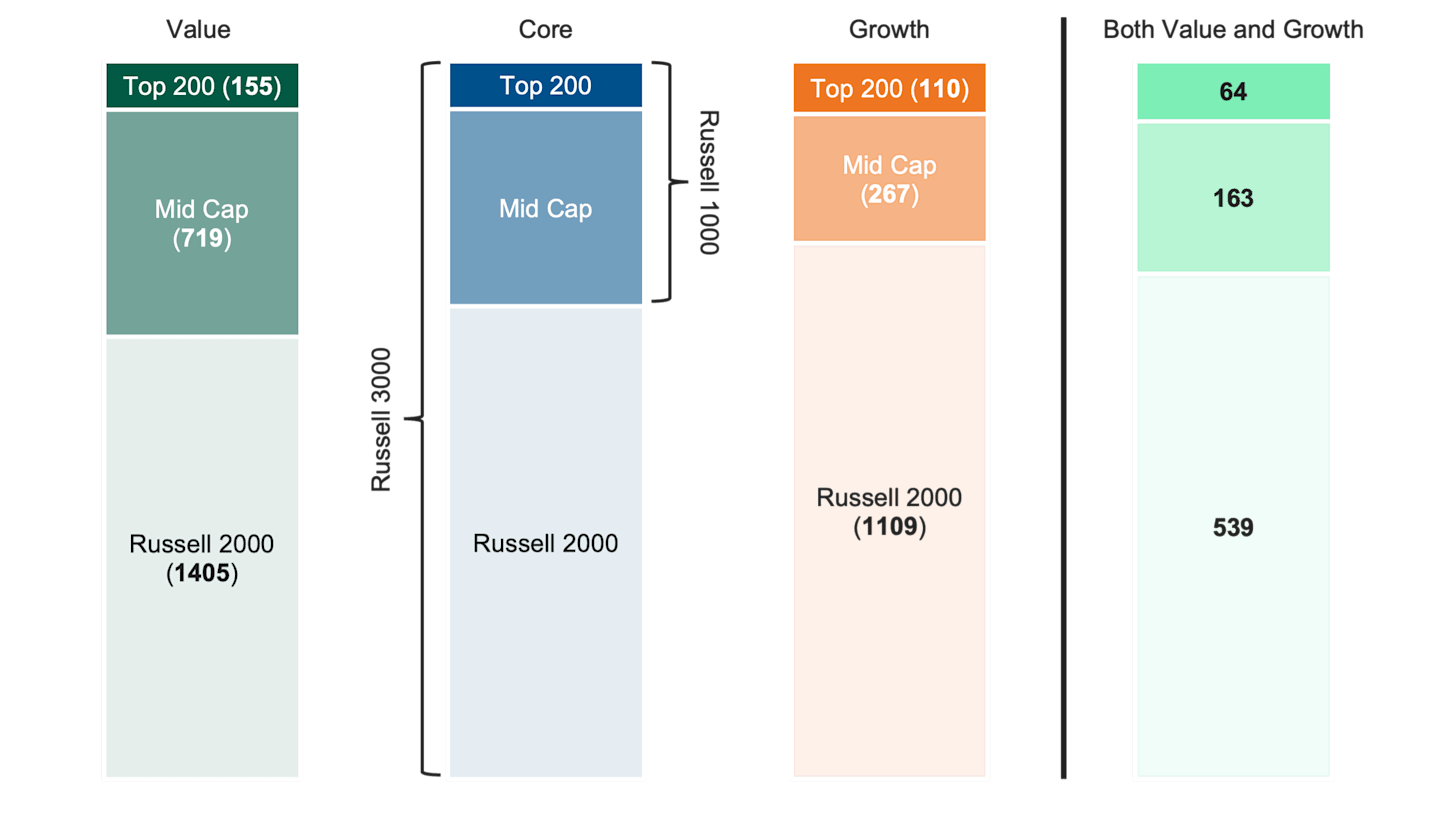
Data as of 6/28/2026. Source: FactSet.
Authors
Senior Client Portfolio Manager
Senior Client Portfolio Manager
Client Portfolio Manager
The Biggest Changes from the Latest Russell Index Reconstitution
References to specific securities are for illustrative purposes only and are not intended as recommendations to purchase or sell securities. Opinions and estimates offered constitute our judgment and, along with other portfolio data, are subject to change without notice.
Diversification does not assure a profit nor does it protect against loss of principal.
The opinions expressed are those of American Century Investments (or the portfolio manager) and are no guarantee of the future performance of any American Century Investments portfolio. This material has been prepared for educational purposes only. It is not intended to provide, and should not be relied upon for, investment, accounting, legal or tax advice.