Why the Future of Space Is Bigger Than SpaceX
Space is finally within investors’ grasp, with opportunities extending well beyond the mega-cap launch company.
Key Takeaways
SpaceX has captured investor attention, but space investment opportunities extend across satellites, communications, data and biotech.
Space's unique conditions enable research and manufacturing that are difficult to duplicate on Earth.
The space economy is still in its early stages, but falling launch costs may create long-term opportunities across emerging commercial applications.
It’s easy to see why investors might equate the space economy with SpaceX. The company’s record-setting initial public offering (IPO), nearly $2 trillion valuation and prominent founder have kept it in the headlines.
But SpaceX is only part of the story. The broader space economy includes a growing constellation of companies pursuing opportunities in satellites, communications, data, biotechnology and more.
What’s Driving Growth in the Space Economy?
Estimates vary, but many observers expect the space economy to grow significantly over the next decade. The World Economic Forum projects the space market could reach $1.8 trillion by 2035. SpaceX has estimated that it has a roughly $2 trillion opportunity across space-enabled services, Starlink broadband and mobile connectivity.1
The exact number matters less than the broader shift now underway: Space is becoming much easier and less expensive to reach. This change is opening the door to companies that can use satellites and other space-based technologies to collect data, improve communication and support research back on Earth.
In our view, the next generation of space companies may look less like traditional launch businesses and more like high-profitability, high-margin software businesses that provide communications, data and analytics.
The World Economic Forum cites an “incredibly broad range of applications” for space-based analysis, including:
Weather
Disaster mitigation
Digital communication
Travel and transportation data, including navigation and positioning
Environmental and sustainability monitoring
Consumer and retail data applications
Manufacturing and pharmaceutical research in microgravity, or near-weightless conditions
In addition to these commercial uses, space also has important government and defense applications.
Reusable rockets have helped make these opportunities possible by sharply reducing launch costs and expanding access to space.
How Have Reusable Rockets Changed the Economics of Space?
The economics of space may be following a familiar pattern. Cars and airplanes were once expensive technologies available mainly to the wealthy. Over time, innovation and mass production made them more affordable, reshaping travel, commerce and daily life. Space flight may now be entering a similar phase.
Reusable rockets have dramatically lowered launch costs over the past few decades, helping make space more accessible for commercial use. Figure 1 shows how sharply these costs have declined.2
Figure 1 | Launch Costs Have Plummeted Thanks to Reusable Rockets
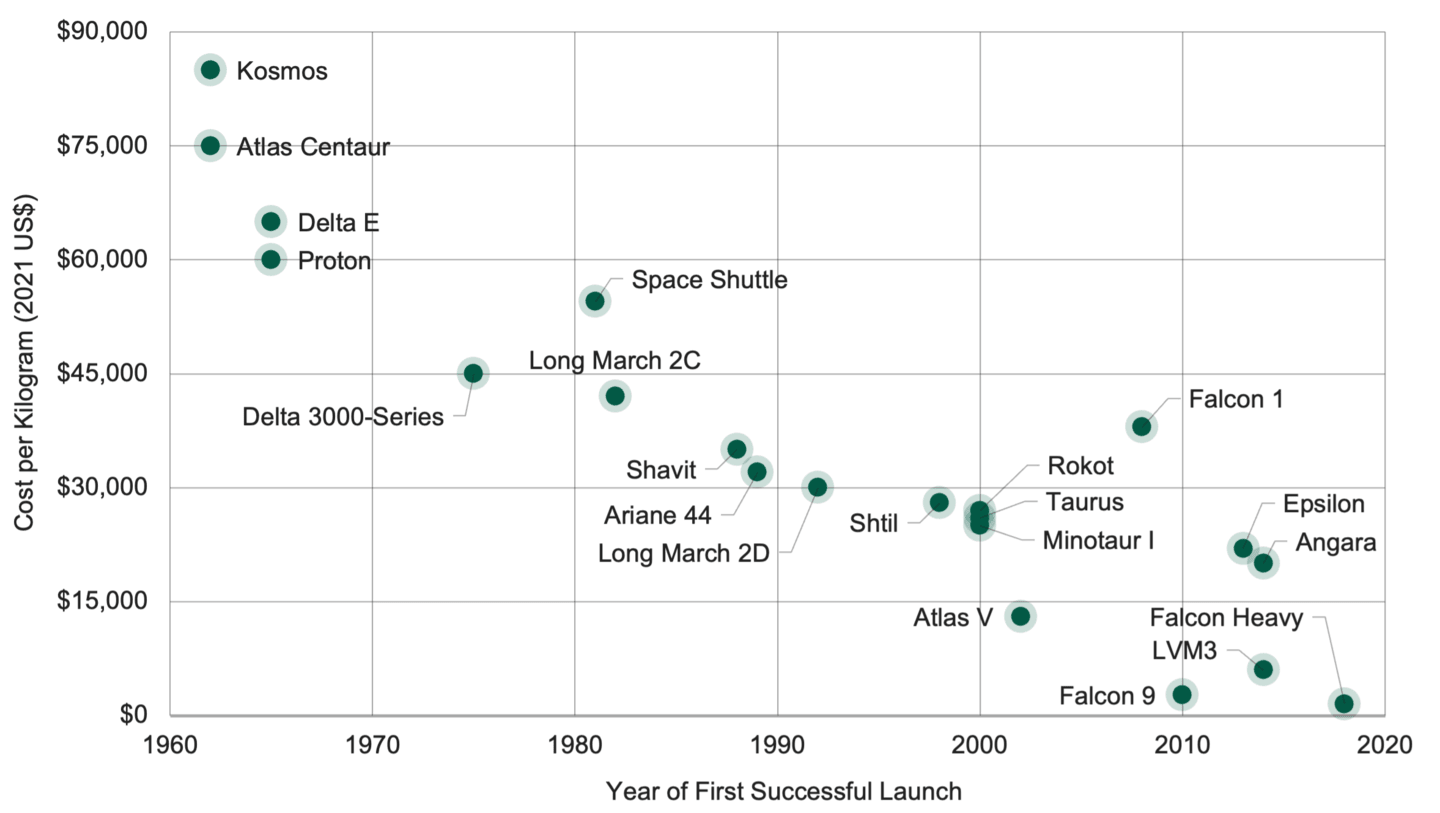
Data as of 12/31/2024. Source: Our World in Data and U.N. Office for Outer Space Affairs.
In the past, most rockets were used only once. Each launch required an entirely new vehicle, making space flight extremely expensive. Today, parts of rockets such as SpaceX’s Falcon 9 and Rocket Lab’s Electron can return to Earth, be refurbished and launched again. This reusability has helped reduce costs and streamline launches.
The next step may be fully reusable launch vehicles. SpaceX is working toward that goal with Starship, its next-generation spacecraft and super-heavy rocket. If larger rockets can be more fully reused and transport heavier loads, launch costs could fall further, making access to space even more affordable.
Why Is Low Earth Orbit Central to the Space Economy?
The biggest near-term opportunity in space may not be on the moon or Mars. It may be much closer to home, in low Earth orbit, or LEO — the region about 100 to 1,200 miles above Earth where companies are deploying large satellite networks.
Nearly 13,000 active satellites are already operating there, according to orbitalradar.com. Goldman Sachs estimates that as many as 70,000 more LEO satellites could be launched over the next five years.3
In January, SpaceX filed documents with the U.S. Federal Communications Commission (FCC) that could allow the company to expand its LEO satellite network to as many as 1 million satellites. This expansion supports its goal of locating data centers in space.
Increasing access to LEO is creating a cottage industry of satellite manufacturers and operators, running everything from cellphone networks to vast data-collection operations across the globe. Here are a few examples.
How Are Satellites Expanding Global Connectivity?
LEO satellites could help expand mobile service in places that traditional cell networks don’t reach. Wireless carriers can partner with satellite operators to offer broader connectivity without building their own space networks or ground infrastructure. That added coverage can be especially valuable in emergencies, as satellite connectivity recently helped rescuers locate survivors after a deadly mountain avalanche.
For launch providers, satellite communications can be a valuable business line. SpaceX’s Starlink network reportedly generated more than $11 billion in revenue and $4 billion in profit last year, showing how connectivity services can complement launch operations.4
Amazon and Rocket Lab have also acquired satellite communications companies that operate LEO constellations and hold radio frequency spectrum rights (legal permission to transmit on assigned frequencies). Rather than spending years building their own satellite networks, these acquisitions give both launch companies immediate access to viable commercial satellite networks.
How Is Space Supporting Biotechnology Research?
The International Space Station (ISS) has served as a research laboratory for decades. Since 2019, it has also supported research into how cells and tissue-like structures develop in microgravity. Scientists hope this work could eventually advance the ability to grow human tissue, and perhaps more complex organs, outside the body.5
Space offers conditions that are hard to replicate on Earth. In microgravity, protein crystals can form with greater size and consistency, giving scientists a clearer view of their structures. These insights may help researchers study potential treatments and improve drug stability, shelf life and delivery.6
Although this may sound like science fiction, space-based research is already contributing to medicines used on Earth. For example, ISS research helped inform the current injectable formulation of Merck’s blockbuster cancer drug Keytruda®.
Varda Space Industries offers another example of space-based pharmaceutical research. The company recently manufactured ritonavir in low Earth orbit and successfully returned it to Earth. Ritonavir is used to treat HIV and is a component of Paxlovid®, a common treatment for COVID-19. Because the drug can be difficult to manufacture consistently on Earth, the successful mission helped demonstrate the potential for producing certain medicines in space.7
How Is Satellite Imagery Turning Space into a Data Business?
Satellite images of Earth can support a wide range of uses, including defense, agriculture, weather forecasting, disaster response and environmental monitoring. Many companies are using satellite imagery to deliver data and insights that customers can use to make better decisions.
Viewed this way, these businesses may look less like traditional satellite companies and more like data providers.
Planet Labs shows how satellite imagery can become a data business. Since 2017, the company has captured daily images of Earth, building a large archive that can help track environmental change. In the Amazon basin, that data supports sustainability, conservation and anti-deforestation efforts.8
One example is Project Guacamaya, a collaboration among Planet Labs, Microsoft and several Latin American government organizations. The project combines satellite imagery with Microsoft’s artificial intelligence (AI) tools to help identify illegal mining, logging and poaching.
AI is making satellite imagery more valuable by helping analyze vast amounts of visual data and turn it into practical insights. It may also affect the space economy in another way — by increasing demand for data centers, including potential ones in orbit.
Could Data Centers Eventually Move to Space?
Some tech executives believe that placing data centers in space could solve major challenges, such as ensuring a continuous power supply and avoiding political opposition from communities unwilling to host new data facilities.
While the exact number of companies involved is uncertain, numerous early-stage firms are addressing various aspects of the issue, working alongside major players like SpaceX, Amazon’s Blue Origin, and Alphabet’s Project Suncatcher.
The main idea is that large arrays of orbital solar panels could supply essential electricity that is both in high demand and difficult to obtain on Earth. If the engineering challenge of relocating warehouses of computer chips and networking gear to LEO can be overcome, the question then turns to the economics.
According to a paper explaining Project Suncatcher, orbital data centers begin to make economic sense when launch costs reach $200 per kilogram of payload sent into orbit.9 The authors estimate that this could be achieved by mid-2030, as larger, fully reusable and more efficient launch vehicles come online. Looking back at Figure 1, the sharp decline in launch costs makes that estimate seem plausible.
What Challenges Could Affect the Space Economy?
Launch remains difficult, expensive and capacity-constrained. In May 2026, an explosion during a test of a new Blue Origin rocket engine badly damaged a launchpad. A NASA spokesperson said repairs could take six months or as long as 2028.
SpaceX and Rocket Labs have also faced repeated delays in developing larger, next-generation launch vehicles. These operational challenges will need to be addressed for launch costs to keep falling and payload capacity to keep expanding — two factors that could make the economics of space more compelling.
Even so, today’s space economy is more open to commercial investment and innovation than ever before. The progress already made in such a demanding environment shows how sustained innovation can gradually turn ambitious ideas into practical opportunities.
We take a similar long-term view when evaluating investment opportunities. Progress toward financial goals can involve setbacks, volatility and changing conditions along the way. From that perspective, we believe select companies participating in the space economy may offer exposure to one of today’s most dynamic areas of innovation.
Authors
Explore Our Large-Cap Growth Capabilities
Helen Burdett and Brett Loubert, “3 Commercial Trends Propelling a $1.8 Trillion Space Market,” World Economic Forum, June 10, 2026.
Global Aerospace, “How Fully Reusable Rockets Are Transforming Spaceflight,” November 21, 2024.
Goldman Sachs, “The Global Satellite Market Is Forecast to Become Seven Times Bigger,” March 5, 2025.
Lora Kolodny and Annie Palmer, “SpaceX Is Heavily Reliant on Starlink for Growth and Profit as It Marches Toward Nasdaq Listing,” CNBC, May 21, 2026.
Josh Sims, “Why Astronauts Are Printing Organs in Space,” BBC, June 1, 2021.
Japan Aerospace Exploration Agency, “Why Space Experiments?” Protein Crystal Growth on the International Space Station,” accessed August 3, 2026.
Alex Knapp, “This Startup Is One Step Closer to Making Drugs in Space,” Forbes, March 20, 2024.
Lina Torres, “Scaling Climate Action in the Amazon: Planet and Partners Lead Regional Innovation in Support of COP30,” Planet Pulse, November 19, 2025.
Travis Beals, “Exploring a Space-Based, Scalable AI Infrastructure System Design,” Google Research Blog, November 4, 2025.
Investment return and principal value of security investments will fluctuate. The value at the time of redemption may be more or less than the original cost. Past performance is no guarantee of future results.
References to specific securities are for illustrative purposes only and are not intended as recommendations to purchase or sell securities. Opinions and estimates offered constitute our judgment and, along with other portfolio data, are subject to change without notice.
The opinions expressed are those of American Century Investments (or the portfolio manager) and are no guarantee of the future performance of any American Century Investments portfolio. This material has been prepared for educational purposes only. It is not intended to provide, and should not be relied upon for, investment, accounting, legal or tax advice.