Why Smaller Deals Are Reshaping Biopharma M&A
Large firms are pursuing innovation, increasing the likelihood of acquisitions.

Key Takeaways
Big Pharma seeks smaller, targeted acquisitions to refill pipelines and better manage risk.
This approach offers more opportunities for small-cap biopharma firms with unique scientific advances and clinical progress.
Selectivity still matters, as buyers appear focused on later-stage assets, strong data and commercial potential.
The biopharma industry has shifted toward a different mergers and acquisitions (M&A) model: more frequent, smaller and more targeted deals. We believe this change has created a more supportive environment for small-cap firms — particularly those developing differentiated therapies with clear clinical potential.
We believe this represents a structural trend: Large pharmaceutical companies need to continually refresh their product pipelines as their existing products lose patent protection. According to one analysis, patent expirations at leading firms could put 15% or more of their revenue at risk by 2030.1
To keep their pipelines full, many acquirers maintain a steady acquisition cadence, often in the low, single-digit billions.2 These smaller deals allow companies to spread risk, target specific therapeutic areas and integrate innovation more efficiently.
This shift could be important for investors. The most supportive environment for biopharma isn’t necessarily defined by deal size but by deal frequency — creating more opportunities for innovative companies to attract interest.
What’s Fueling M&A Activity in Biopharma?
The biopharma industry relies on research and development to fuel innovation. While larger firms conduct their own research, the sheer scale of these operations can become unwieldy, sometimes leading to poor outcomes.
As a result, large biopharma companies have increasingly depended on external partnerships and acquisitions to supplement their pipelines. One study found that the largest pharma companies source nearly half of their drugs externally through deals. 3
Balance sheets across the industry also remain strong. With significant capital available for acquisitions, many buyers have the flexibility to pursue multiple transactions across a range of therapeutic areas.
Recent deal activity reflects this dynamic, with the number of deals surging in 2025. See Figure 1.
Figure 1 | Biotech M&A Hit a High Last Year
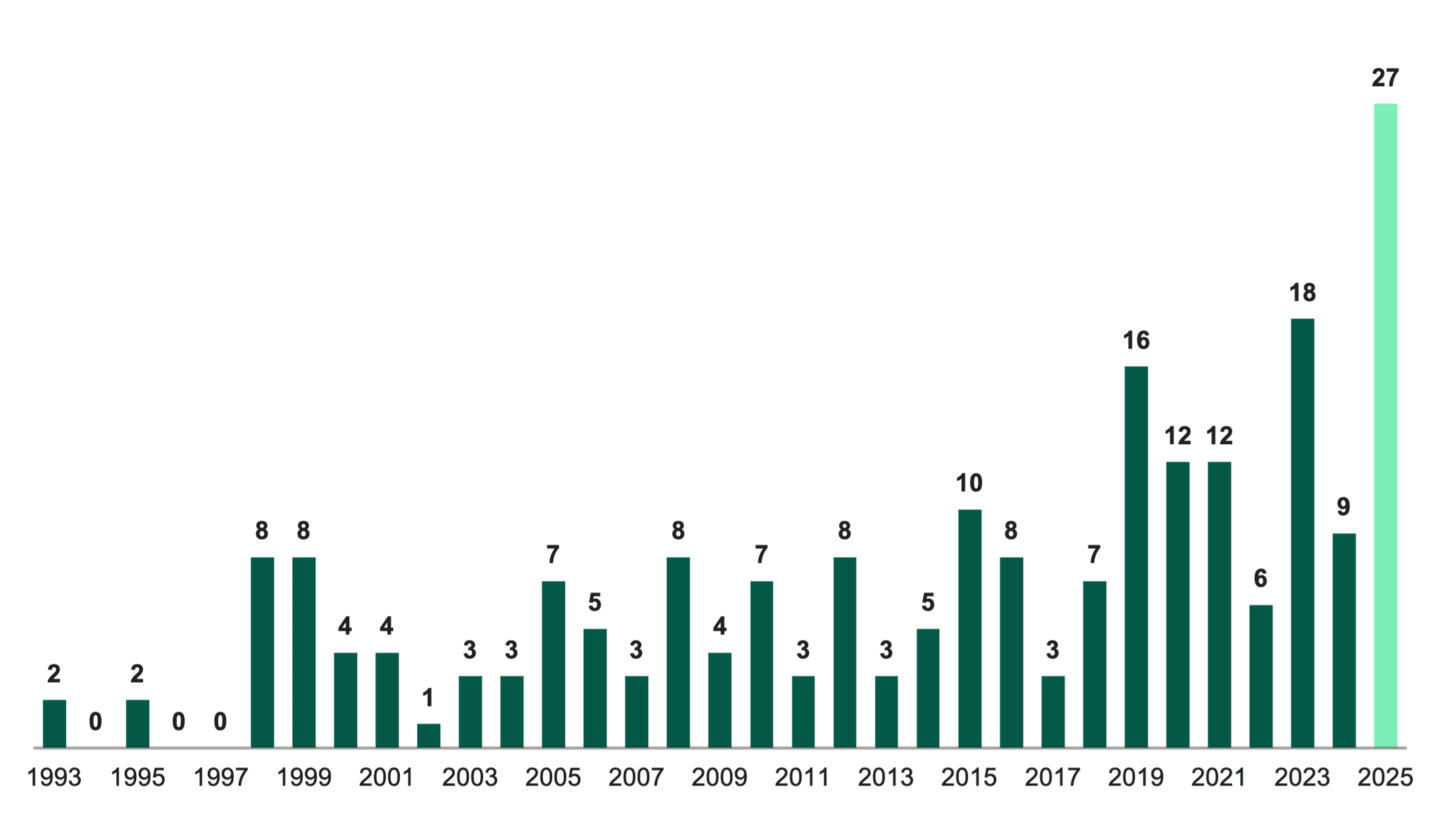
Data from 1/1/1993 – 12/31/2025. Sources: FactSet, FTSE Russell, Jefferies.
How Small-Cap Biopharma Supports Industry Innovation
Small-cap biotech firms play a critical role in the industry’s innovation ecosystem. Many focus on developing next-generation therapies in areas such as oncology, immunology and neurology.
These companies are at the earliest stages of scientific discovery, with pipeline assets that can scale into commercially viable products through partnerships or acquisitions. According to one analysis, emerging biotech firms accounted for roughly two-thirds of new Food and Drug Administration (FDA) drug approvals in 2024.4
Large pharmaceutical companies consistently rely on this segment for innovation, highlighting its strategic importance. This combination — structural demand for innovation and a broad, active acquisition market — could foster a more favorable environment for small-cap biopharma firms.
What Traits Make a Biopharma Company More Attractive to Buyers?
Recent trends suggest that acquirers are increasingly focused on specific types of small-cap biopharma firms.
Companies with later-stage pipelines, strong clinical data and differentiated mechanisms of action have drawn particular attention. These attributes can improve the odds of future commercial success and make integration easier for larger firms.
In addition, therapies targeting large addressable markets — especially in oncology and neurology — have tended to offer more attractive risk-reward profiles. In our view, companies with late-stage, differentiated solutions could be particularly well-positioned as acquisition targets.
Recent transactions illustrate these dynamics.
Gilead Sciences recently completed the acquisition of Arcellx, a developer of cell therapies for patients with cancer.5
Centessa Pharmaceuticals, a developer of treatments for sleep disorders, has agreed to be acquired by Eli Lilly.6
Merck acquired Verona Pharma, a company focused on respiratory treatments, in late 2025.7
In each case, the acquiring company targeted assets with identifiable clinical progress, differentiated science and potential commercial scale.
Why We Think an Active, Diversified Approach Matters in Small-Cap Biopharma
Not all biopharma firms are created equal, and results vary widely by company. Buyers must assess clinical trial data, regulatory pathways and competitive positioning — factors that can meaningfully influence long-term value creation.
Differences in clinical results, product differentiation and execution may lead to significant variation in outcomes across companies, even within the same therapeutic area.
As shown in Figure 2, the biotechnology and pharmaceutical industries show the highest dispersion of returns among small-cap stocks. This means companies in these industries are less likely to move together and exhibit the widest range of outcomes.
Figure 2 | Biotech, Pharma Stocks Tend to Display Higher Dispersion
Measures of Dispersion in the Russell 2000
Data as of 12/31/2024. Quarterly dispersion. Sources: FactSet, FTSE Russell, Jefferies.
Given the wide range of possible outcomes, we believe that taking an active approach makes sense. A diversified strategy within this space — holding a broader set of smaller positions — can also help manage risk while preserving exposure to innovation-driven upside.
Our approach involves holding a relatively large basket of biopharma companies. This aligns with the benchmark. The industry represents roughly 15% of the Russell 2000® Growth Index — a meaningful portion of the small-cap growth universe.
We place special emphasis on holding companies with drugs in later-stage development. Typically, these firms have successfully completed trials that demonstrate the safety and efficacy of their treatments. Their drug candidates are closer to reaching the market, which could also make them attractive acquisition targets.
What Does a Stronger Biopharma M&A Environment Mean?
The combination of structural demand for innovation, improving sector fundamentals and a more dynamic acquisition environment suggests that small-cap biopharma could play an increasingly important role in investors’ portfolios.
At the same time, the move toward smaller, more targeted transactions increases the importance of company-level fundamentals. Strategic buyers appear focused on quality, differentiation and clinical progress.
For investors, this backdrop is likely to offer a compelling opportunity. But capturing this opportunity requires a thoughtful, disciplined approach to identifying companies. In a market where capital is actively seeking innovation, small-cap biopharma remains at the center of the industry’s growth story.
Authors
Senior Client Portfolio Manager
Explore Our Global Small-Cap Capabilities
TD Cowen, “Q4+2026 Preview: Cautiously Optimistic That Biotech’s Bull Market Will Continue,” January 29, 2026.
David Wainer, “Big Pharma Is Thinking Small on Deals. That’s a Boon for Biotech.” Wall Street Journal, April 13, 2026.
Biotechnology Innovation Organization, “The State of Emerging Biotech Companies: Investment, Deal, and Pipeline Trends,” June 17, 2025.
Biotechnology Innovation Organization, “The State of Emerging Biotech Companies: Investment, Deal, and Pipeline Trends,” June 17, 2025.
Gilead Sciences, “Gilead Sciences Completes Acquisition of Arcellx Ahead of Potential Commercial Launch of Anito-cel,” News Release, April 28, 2026.
Eli Lilly, “Lilly to Acquire Centessa Pharmaceuticals to Advance Treatments for Sleep-Wake Disorders,” News Release, March 31, 2026.
Merck, “Merck Completes Acquisition of Verona Pharma,” News Release, October 7, 2025.
Historically, small- and/or mid-cap stocks have been more volatile than the stock of larger, more-established companies. Smaller companies may have limited resources, product lines and markets, and their securities may trade less frequently and in more limited volumes than the securities of larger companies.
Diversification does not assure a profit nor does it protect against loss of principal.
The opinions expressed are those of American Century Investments (or the portfolio manager) and are no guarantee of the future performance of any American Century Investments portfolio. This material has been prepared for educational purposes only. It is not intended to provide, and should not be relied upon for, investment, accounting, legal or tax advice.
References to specific securities are for illustrative purposes only and are not intended as recommendations to purchase or sell securities. Opinions and estimates offered constitute our judgment and, along with other portfolio data, are subject to change without notice.
No offer of any security is made hereby. This material is provided for informational purposes only and does not constitute a recommendation of any investment strategy or product described herein. This material is directed to professional/institutional clients only and should not be relied upon by retail investors or the public. The content of this document has not been reviewed by any regulatory authority.