Market Corrections vs. Bear Markets: What Should Investors Know?
When harsh winter weather approaches, bears retreat into their caves. Similarly, investors can feel like retreating when market conditions deteriorate. But history offers compelling reasons to stay invested.

Key Takeaways
A market correction is a decline of 10% to 20%, while a bear market is a decline of 20% or more over an extended period.
Selling investments during a market decline may lock in losses and reduce the opportunity to participate in a recovery.
Historical market performance shows that markets have recovered after periods of decline—and even rewarded those who stayed invested.
Market ups and downs occur daily. When the percentage loss reaches double digits, however, investors’ worries can spike. There are even specific names for those losses: market corrections and bear markets.
What Is the Difference Between a Market Correction and a Bear Market?
Market corrections and bear markets both describe periods of market decline, but they differ primarily in the severity and duration of the downturn.
My team naturally gets more calls when the stock market is in negative territory. Here are answers to some of the most common questions about market corrections and bear markets.
Why Do Markets Decline?
A variety of factors may cause the market to decline. Three common reasons:
Unexpected news and events shake investors’ outlook for the economy.
Investors think the prices for stocks, bonds or another asset class have become overvalued.
Investors lose confidence in businesses’ abilities to meet corporate goals and earnings forecasts.
How Often Do Market Corrections and Bear Markets Happen?
On average, market corrections have happened about every two years and lasted a few months. However, they can take place more or less frequently. Bear markets have occurred less often than corrections, but they are generally “stickier” because they span a period when overall negative sentiment about the economy has set in.
Some of the most memorable bear markets include the Great Depression, the dot-com bubble in 2000 and the Great Recession of 2007-2008. But one of the shortest bear markets lasted only 33 days. It began in February 2020 in response to COVID-19 pandemic lockdowns across the world.
It’s impossible to know when the ups and downs will occur, but looking back in history provides important reminders about stock market behavior.
Market Downturns by the Numbers
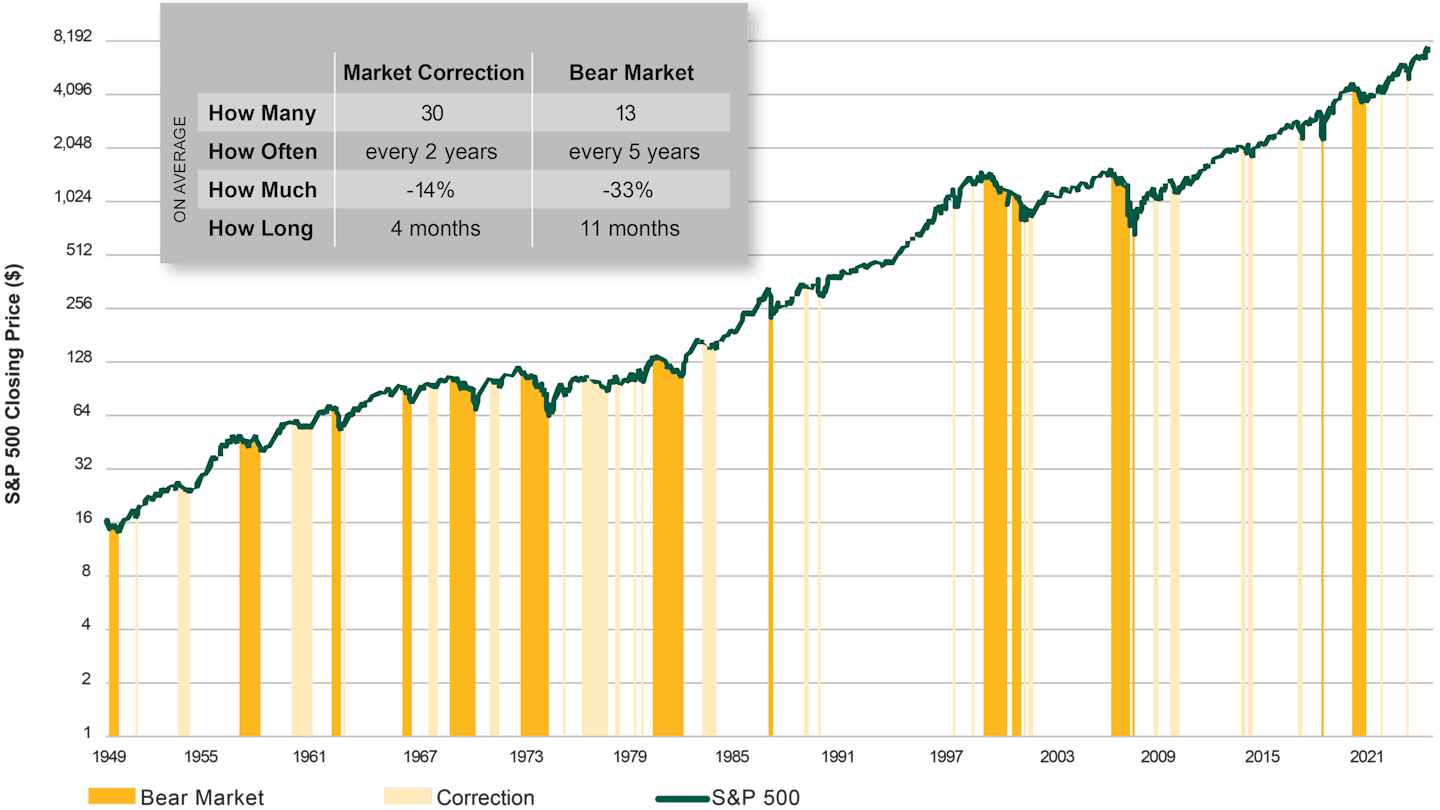
Data from 1/1/1949 to 6/30/2026. Source: FactSet and American Century Investments. Past performance is no guarantee of future results.
What Were the Biggest Bear Markets, and How Fast Did Stocks Recover?
While no one can accurately predict when bear markets occur, history shows that markets have recovered after periods of decline—and even rewarded those who stayed invested.
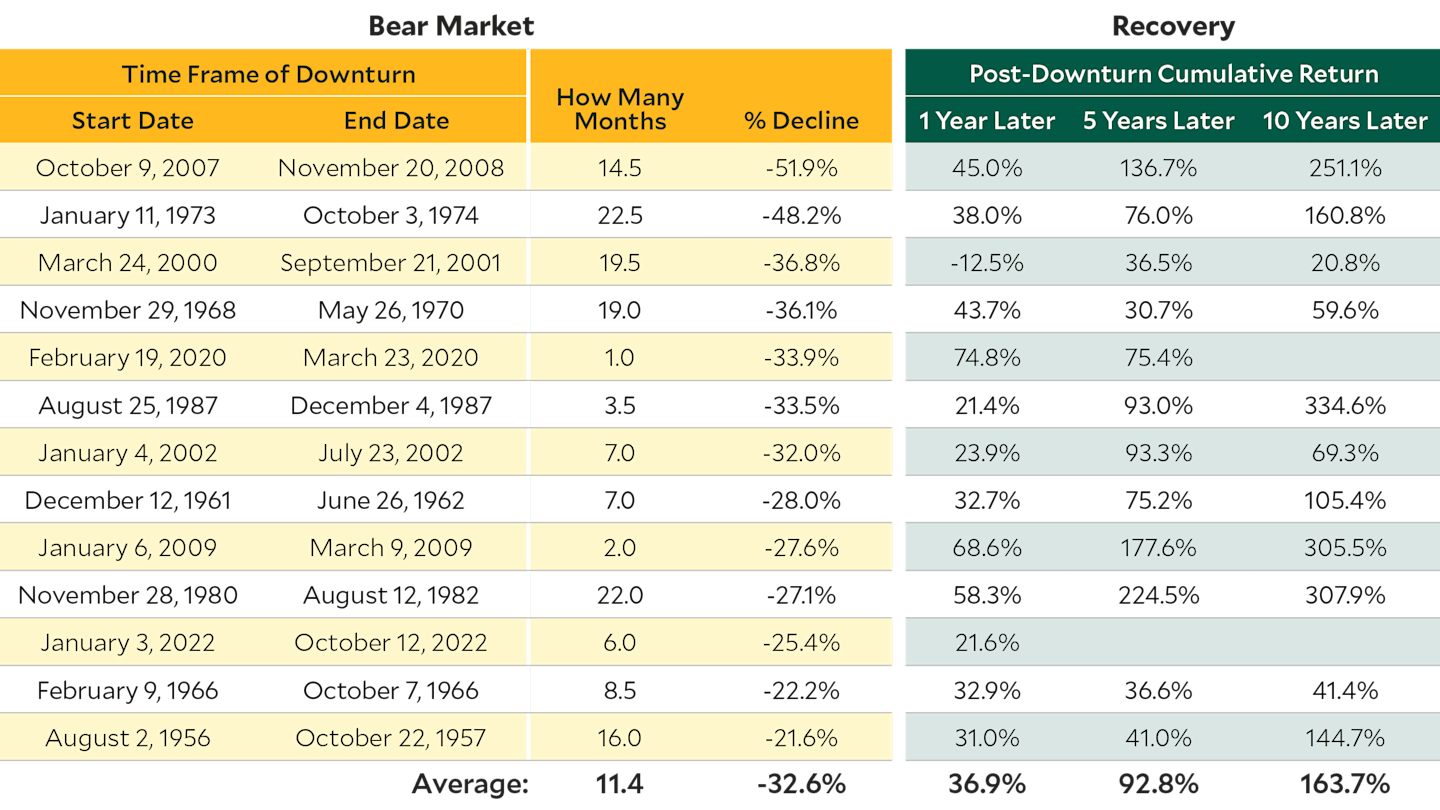
The table above shows all of the bear markets since 1950, as defined by Standard & Poor’s using the S&P 500® Index. The returns are price returns only, not total returns, and thus do not include dividends. Past performance is no guarantee of future results. Thus, the table should not be taken as an implication of future returns. Rather, it should serve as a reminder of the past resiliency of U.S. financial markets.
Sources: FactSet; American Century Investments.
Can Inflation and Interest Rates Contribute to Bear Markets?
While every bear market has unique reasons behind its arrival, inflation and interest rates can contribute by reducing demand for goods and equity investments and depressing corporate earnings.
How Rising Inflation Can Affect Markets
Rapidly rising inflation rates make it more difficult to determine what corporate earnings or consumer buying power will be. What’s more, people worry about the Federal Reserve's ability to control inflation without slowing economic growth too much. Explore how inflation affects the market and your finances.
How Rising Interest Rates Can Affect Stock Prices
When borrowing costs go up, people and businesses may spend less money. This can hurt the economy, lower company profits and decrease stock prices. Learn more about the effect of interest rates on bonds.
Is Selling Investments in a Bear Market a Good Strategy?
In general, selling investments in a bear market is not a good strategy for long-term investors. You will lose the opportunity for those holdings to rebound, unnecessarily reducing your portfolio’s return potential when the market improves.
Market timing involves selling investments when you believe the market is at or near its peak and about to fall to avoid losses. You would then reenter the market to buy investments when you believe prices have fallen to their lowest point, just before they start to rise. In practice, many investment professionals say it's impossible to time market entry and exit points successfully over time.
How Can Selling Stocks in a Downturn Impact Your Returns?
Selling during a downturn actually can lock in losses and significantly reduce a portfolio’s returns by causing you to miss out on the best days of a market recovery.
If it fits your plan, buying stocks when equity markets are low may actually be beneficial. Factors to consider include how long you will hold the investment, whether the stock is likely to rise in value over time, and whether it fits within your personal risk tolerance.
Cost of Missing the Stock Market's Best Days
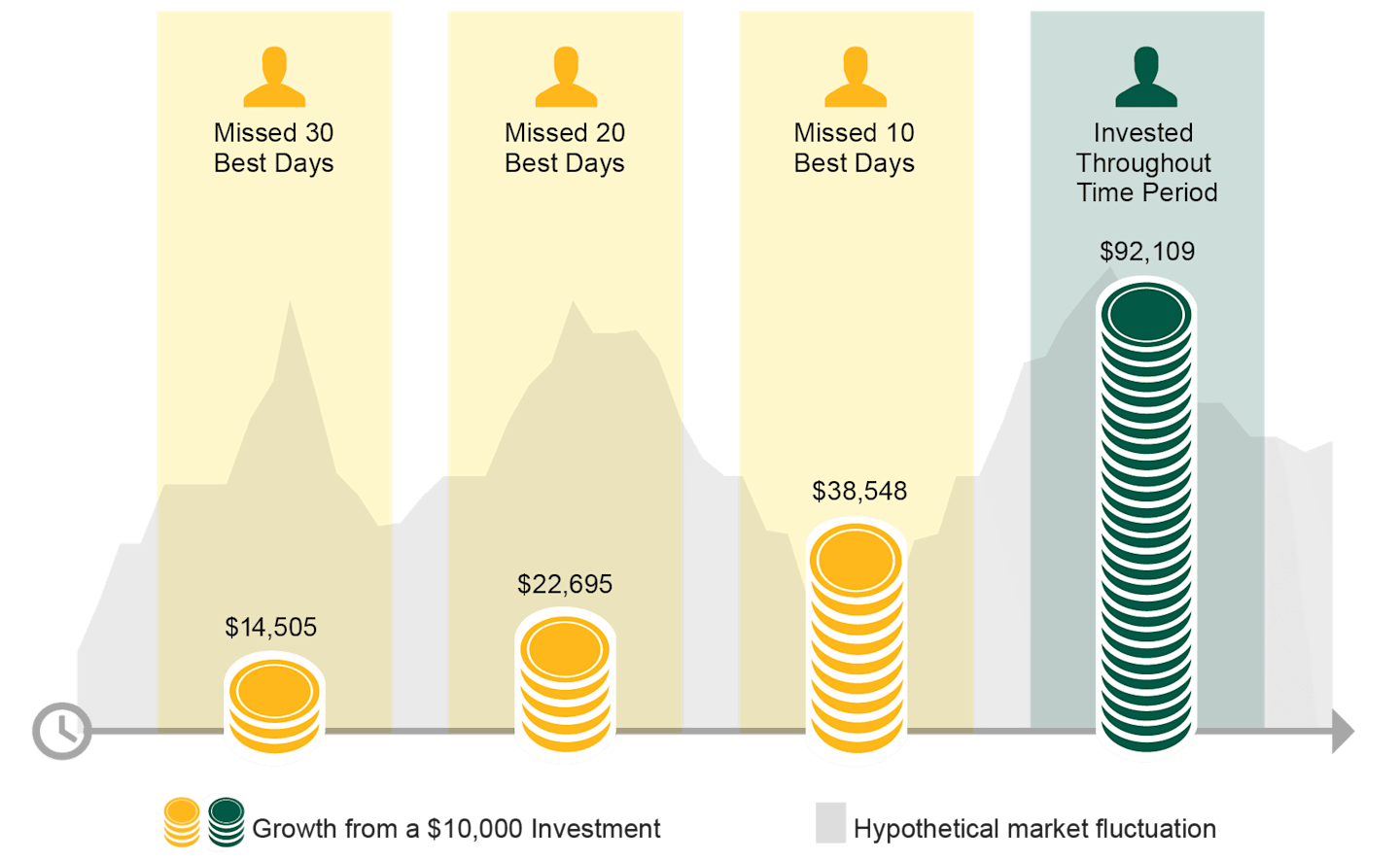
Source: FactSet. Growth of $10,000 in the S&P 500® Index. Data from 01/01/1999 – 6/30/2026. The index does not reflect fees, brokerage commissions, taxes or other expenses of investment. Investors cannot invest directly in an index. Past performance is no guarantee of future results.
This hypothetical situation contains assumptions that are intended for illustrative purposes only and are not representative of the performance of any security. There is no assurance similar results can be achieved, and this information should not be relied upon as a specific recommendation to buy or sell securities.
What Are the Costs of Selling Bonds When Interest Rates Are Rising?
Investors who sell bonds before maturity when interest rates are rising—and bond prices are falling—may incur a loss of principal. When interest rates increase, prices on existing bonds with lower coupon rates typically fall. (The coupon is the rate of interest a bond pays annually.)
Cost of Selling Bonds Before Maturity
Percentage of Time Bonds Increased in Value Over Each Time Period
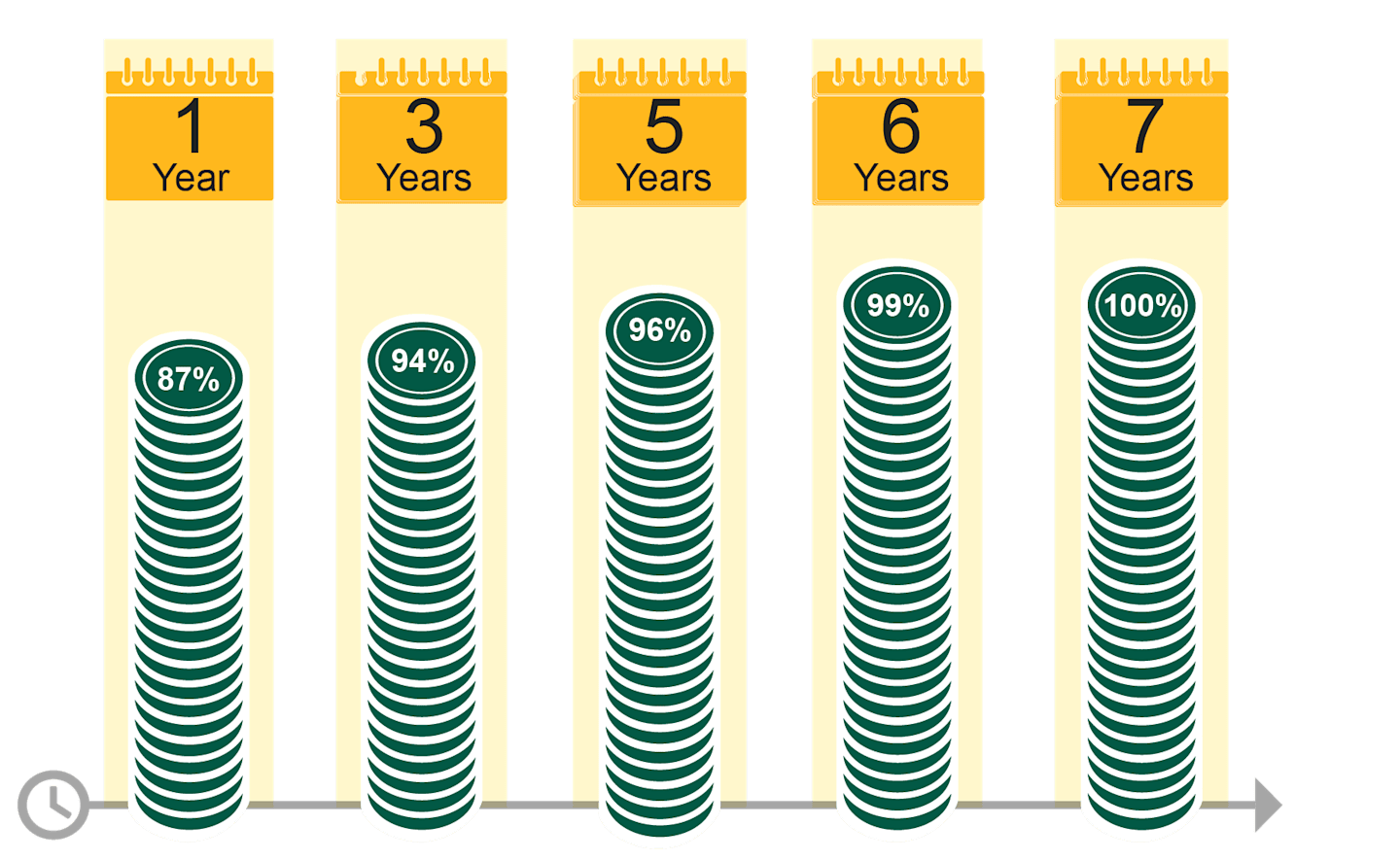
A buy-and-hold strategy with bonds may be beneficial. Bonds are represented by the Bloomberg U.S. Aggregate Bond Index. Source: Ibbotson Associates. Data from 01/31/1976 – 06/30/2026. Past performance is no guarantee of future results.
The indices do not reflect fees, brokerage commissions, taxes or other expenses of investment. Investors cannot invest directly in an index.
This hypothetical situation contains assumptions that are intended for illustrative purposes only and are not representative of the performance of any security. There is no assurance similar results can be achieved, and this information should not be relied upon as a specific recommendation to buy or sell securities.
What Can You Do During a Market Decline?
It may be surprising to hear, but doing nothing might be the best move in a market downturn—if you determine your financial plan already incorporates strategies to cope with volatility.
3 Strategies for Staying on Course Through Market Swings
Strategy: Build and Maintain an Emergency Fund
Having fallback funds may help you weather unexpected market downturns.
Strategy: Use Precommitment Strategies
Automating good financial decisions helps prevent emotions from sabotaging your goals.
Strategy: Take Advantage of Dollar-Cost Averaging1
Making regular purchases regardless of market conditions can smooth out the effects of market ups and downs on your portfolio. And over time, this precommitment strategy could potentially lower the average cost of your investment.
Finally, remember that historically the market has tended to be more bullish than bearish; that is, it has trended upward over time. Focusing on your long-term goals instead of worrying about short-term market trends can help you stay on track through market fluctuations more effectively.
Rich Weiss, chief investment officer of multi-asset strategies at American Century Investments, urges investors to stay informed and keep in mind the following principles when navigating volatile markets.
- Time is on your side. Despite periods of short-term decline, the market’s recovery over the long term has rewarded those who remained invested.
- Stick with your plan. With market alerts, financial TV programs and breaking headlines, news can lead investors to make emotional decisions. Sticking with your plan means resisting the urge to buy high when the markets are going up and to sell when they are going down.
- Diversification may have to change over time. Most professionals agree that a mix of stocks, bonds and cash is a sound long-term investment strategy. How much of each asset type you need can change as you get closer to withdrawing your money. Our research indicates that a gradual approach to reducing stocks and adding bonds might better manage sequence risk and temper the damage of stock market volatility.
My Team Is Here to Help
No one can predict the best time to buy and sell investments, but making money and avoiding losses are more than just guessing at the market’s direction. And research suggests that trying to time the market can do more harm than good.
No matter where you are on your financial journey, it can be helpful to build a relationship with a financial professional so you can ask questions, discuss concerns and review your progress. These conversations can be especially valuable as retirement or other major financial goals approach, helping ensure your investment strategy remains aligned with what matters most to you. Request a call.
Authors
Financial Consultant
Markets Move. Should Your Portfolio?
Explore practical ways to manage market risk and keep your long-term financial goals in focus.
Dollar cost averaging does not ensure a profit or protect against a loss in declining markets. This investment strategy involves continuous investment in securities, regardless of fluctuating price levels. An investor should consider his or her financial ability to continue purchases in periods of low or fluctuating price levels.
Diversification does not assure a profit nor does it protect against loss of principal.
The opinions expressed are those of American Century Investments (or the portfolio manager) and are no guarantee of the future performance of any American Century Investments portfolio. This material has been prepared for educational purposes only. It is not intended to provide, and should not be relied upon for, investment, accounting, legal or tax advice.
Investment return and principal value of security investments will fluctuate. The value at the time of redemption may be more or less than the original cost. Past performance is no guarantee of future results.
Generally, as interest rates rise, the value of the bonds held in the fund will decline. The opposite is true when interest rates decline.