Growth Stocks Explained: Why Have They Been So Volatile?
Investor concerns about AI spending, interest rates and inflation have contributed to growth stock volatility despite strong earnings growth.

Key Takeaways
Growth stocks have experienced sharp volatility in 2026 despite strong earnings.
Rising bond yields and doubts about the sustainability and potential payoff of massive AI spending have contributed to the sell-off.
Investors remain focused on future earnings growth and whether today's AI investments will generate sufficient returns.
Despite many companies reporting strong earnings, growth stocks have swung sharply in 2026. Two key factors have contributed to this volatility:
Investors are questioning whether substantial corporate investments in artificial intelligence (AI) will generate sufficient returns or reflect the kind of overinvestment seen during the dot-com bubble.
Rising bond yields can make fixed-income investments more attractive relative to growth stocks. Higher borrowing costs may also constrain companies’ expansion plans and future profits.
Despite these concerns, innovation continues across the growth stock universe, creating potential long-term opportunities alongside near-term risks.
This article explains how growth and value stocks differ, why growth stocks are often more volatile and why they have struggled despite strong earnings growth.
What Is a Growth Stock?
Growth stocks are shares of companies expected to increase their revenues or earnings at a faster rate than the broader market. These companies often focus on developing new products, services or technologies with the potential to drive future growth.
An early-stage biotechnology company developing a new drug is one example. The company may invest heavily in research and development well before it generates profits, based on the expectation that a successful drug could produce future earnings. Its future financial performance may depend more on innovation and product development than on the broader economic cycle.
Because growth companies often reinvest earnings in their businesses, most pay few or no dividends. Investors are often willing to pay more for these companies because they expect stronger growth in the future.
What Is a Value Stock?
Value stocks are shares in companies that appear inexpensive based on measures such as earnings, cash flow or book value. These firms are often mature, established businesses with steady revenue and earnings.
Banks are a common example: Their earnings typically rise or fall depending on economic conditions, interest rates, loan demand and credit quality. Value stock valuations generally rely more on current financial results and dividend payouts than on expectations of rapid future growth.
How Do Growth Stocks Differ From Value Stocks?
Let’s begin with stock valuation, typically measured by the price-to-earnings (P/E) ratio. Since many growth stocks have little or no current earnings, investors often focus more on their future earnings potential than on current results.
As a result, growth stocks often trade at higher valuations. Investors are typically willing to pay more for these companies because they expect stronger earnings growth over time.
Value stocks, by contrast, tend to have steadier earnings today. Their valuations generally depend more on current financial performance than on expectations of rapid future growth.
Why Have Growth Stocks Struggled Lately?
Long-term bond yields recently reached their highest level since 2002. This rise has been particularly challenging for longer-duration investments, such as growth-oriented companies.
Three key factors are contributing to higher bond yields:
Massive federal debt: U.S. federal debt surpassed $40 trillion in mid-August, raising concerns about the nation’s growing debt burden and the cost of servicing it.
Persistent inflation: Inflation has remained above the Federal Reserve’s (Fed’s) stated target for the fifth consecutive year.
Fed policy shifts: In September 2026, the Fed raised interest rates under new Fed Chair Kevin Warsh. The move followed a series of rate cuts in 2024 and 2025, the last of which occurred in December 2025.
While the Fed influences short-term interest rates, long-term bond yields are driven by investor expectations for economic growth, inflation and the additional compensation investors require for lending money over longer periods.
Growth stocks are often valued based on their potential for future earnings growth. When interest rates rise, bonds become relatively more appealing, increasing the opportunity cost for investors and reducing the value placed on future cash flows.
In contrast, many stocks tend to be less affected when interest rates rise. That's because investors typically place more emphasis on companies generating profits in the present rather than expected profits in the future.
Interest rates are also relevant to the AI investment boom because many companies are borrowing heavily to finance data centers and other AI infrastructure. By some estimates, the four largest AI cloud providers and Meta have doubled their debt to $350 billion over the past five years.1 Last year alone, they issued an estimated $121 billion in bonds.2
Higher rates directly increase financing costs and make it harder for companies to achieve attractive returns on AI-related investments. These investments reflect companies’ belief that such spending could create significant long-term competitive advantages and new growth opportunities.
How Is AI Spending Influencing Growth Stocks?
We don’t view current AI investment as comparable to the excesses of the dot-com bubble. In our view, the expansion of AI infrastructure today is likely to have significant economic benefits in the years ahead.
Go back two decades, when investors expressed similar concerns as Amazon, Microsoft and Alphabet invested heavily to build their cloud businesses. Those investments were costly and initially weighed on profitability, but they ultimately became key drivers of growth and earnings.
We believe today's wave of AI-related capital spending could create similar long-term benefits. In our view, demand for the computing power needed to run AI applications far exceeds what current infrastructure can provide.
Even so, today’s AI spending is unprecedented in scale and is weighing on many companies’ near-term profitability. Past success doesn’t guarantee future results, and the returns on current AI investments remain uncertain. Investors are understandably questioning whether these expenditures will ultimately create enough value to be justified.
Not all companies will benefit equally from AI spending, and some investments may prove more successful than others. In our view, companies with broad exposure to AI models, semiconductors and cloud infrastructure may be better positioned to benefit as AI adoption continues to expand.
Strong Earnings, Continued Volatility
Growth stocks have experienced sharp volatility in 2026 despite continued strong earnings growth. Using the S&P 500® Index as a measure of corporate America’s financial health, earnings increased by more than 50% over the 12 months ending in June 2026.
Comparable earnings growth occurred only during the periods when the economy emerged from the Great Financial Crisis and the COVID recession.
Profit growth for Big Tech companies exceeded 100% year over year through June 2026, while the semiconductor industry posted nearly 140% growth over the same period. These strong results help explain why technology-related companies now represent such a large share of equity markets.
Yet strong earnings alone haven’t been enough to sustain growth stock performance. Investors remain focused on whether today's profit growth can continue and whether rising AI-related spending will erode future returns. That tension helps explain the recent volatility in growth-oriented stocks.
At the same time, earnings growth has increased the “E” in the P/E ratio. Combined with weaker share-price performance, this has made growth stock valuations more attractive relative to their own history and, in many cases, to value stocks.
Still, equity markets tend to focus more on future earnings than on past results. Analysts forecast earnings growth of nearly 30% next year for the large-cap S&P 500, while medium- and smaller-sized companies are also expected to deliver solid growth, as shown in Figure 1.3
Figure 1 | Earnings Estimates Trend Higher Across All Market-Cap Sizes
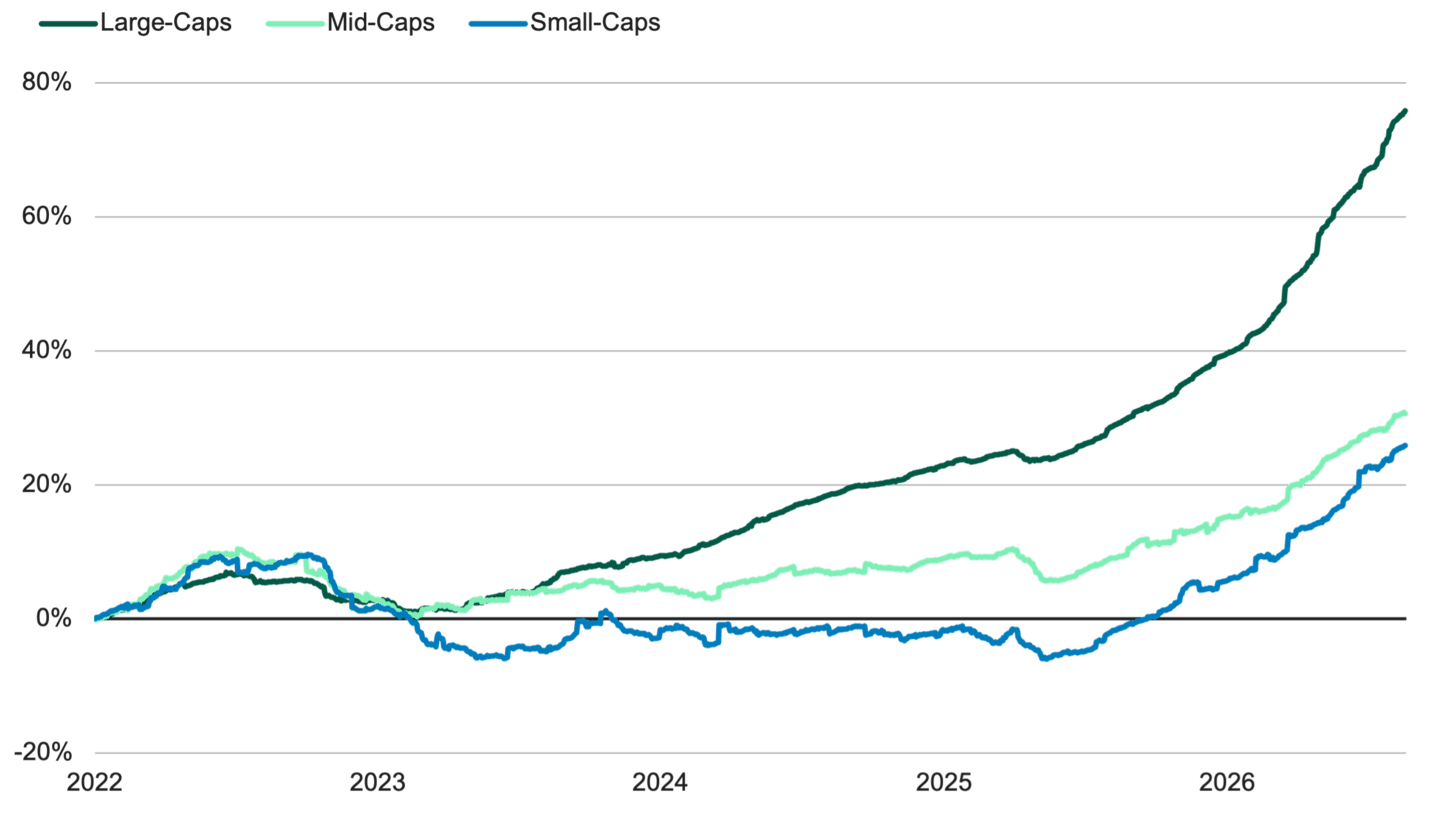
Data from 1/3/2022 – 8/21/2026. Source: Bloomberg. Large-caps represented by the S&P 500 Index. Mid-caps represented by the S&P MidCap 400® Index. Small-caps represented by the S&P SmallCap 600® Index. Past performance is no guarantee of future results.
Looking Beyond Short-Term Volatility
While growth stocks have experienced heightened volatility recently, we remain confident in our investment process. Our long-term perspective helps us look beyond short-term market movements and identify potential opportunities.
Growth stocks have been highly volatile in 2026 despite strong earnings growth. Concerns about interest rates, AI spending and the sustainability of future profits have weighed on investor sentiment, even as many companies have reported strong financial results.
Over time, however, markets tend to focus on companies' ability to translate innovation and investment into earnings growth. As such, we believe maintaining a long-term investment approach may be especially important during periods of market uncertainty and transition.
Authors
Client Portfolio Manager
Explore Our Large-Cap Growth Capabilities
Matt Day and Ian King, “Big Tech Doubles Debt Load to $350 Billion in AI Spending Spree,” Bloomberg, July 10, 2026.
Matt Wirz, “AI Bond Sales Could Hit $300 Billion a Year, Bank of America Says,” Wall Street Journal, January 12, 2026.
John Butters, “More Than 65% of S&P 500 Earnings Calls for Q2 Cited ‘AI,’” FactSet, September 18, 2026.
Investment return and principal value of security investments will fluctuate. The value at the time of redemption may be more or less than the original cost. Past performance is no guarantee of future results.
References to specific securities are for illustrative purposes only and are not intended as recommendations to purchase or sell securities. Opinions and estimates offered constitute our judgment and, along with other portfolio data, are subject to change without notice.
The opinions expressed are those of American Century Investments (or the portfolio manager) and are no guarantee of the future performance of any American Century Investments portfolio. This material has been prepared for educational purposes only. It is not intended to provide, and should not be relied upon for, investment, accounting, legal or tax advice.