This website is intended for use only by Institutional Investors, Professional Investors and Wholesale Clients, not retail investors.
By clicking Accept and Continue, you agree to the Terms of Use of this website.
< < Back
Website terms of use
You affirm or acknowledge the following:
You are an institutional investor or wholesale client. This material is directed to professional/institutional investors and wholesale clients only and should not be relied upon by retail investors or the public.
No offer of any security is made hereby. The above is provided for general and informational purposes only and does not constitute a recommendation of any investment strategy or product described herein.
Nothing on this website should be construed as advice of any nature, including fiduciary investment advice, and prospective investors should seek independent legal, financial and tax advice before making any investment decision. The products described on this website may not be available to, or suitable for, all investors.
For non-U.S. investors – The content and sites on the non-U.S. links below have not been reviewed by any regulatory authority, and that content is for non-U.S. institutional persons or wholesale clients who are accessing the site from outside the United States. Accessing the content and sites on the non-U.S. links below means you further agree to these Terms and Conditions of Use.
Exploring ETFs? Take a closer look at how they work and how to use them strategically. Start here—and build portfolios with confidence.
ETF Basics
What Makes ETFs Unique?
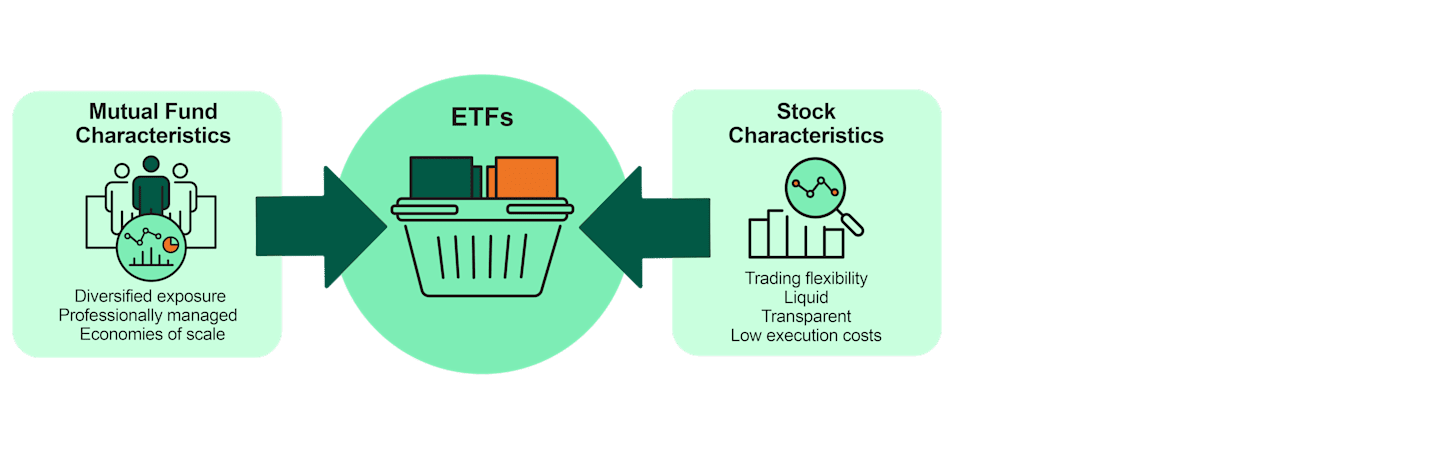
ETFs combine the diversification and professional management of mutual funds with the trading flexibility of stocks. Like stocks, they trade intraday with real‑time pricing—but the ETF structure helps keep trading efficient, even in volatile markets.
ETFs: Where Structure Meets Flexibility
Comparing ETFs, Mutual Funds and Stocks
Like a mutual fund, an ETF is a pooled investment vehicle, meaning it combines your money with other people’s money to invest in a portfolio of stocks, bonds and/or other securities. Unlike mutual funds, ETF shares trade like stocks on stock exchanges—bought or sold throughout the trading day at fluctuating prices.
The ETFs unique creation and redemption process provides the depth of liquidity to dynamically respond to investor supply and demand. This process ultimately ensures that ETFs trade close to their NAV throughout the day.
Transfer of Shares
An ETF trade involves the transfer of shares in the secondary market between investors, with no impact on the ETF's underlying holdings.
Who Pays Transaction Costs
Costs are usually paid by the investors directly involved in the transactions, minimizing impact to long-term investors in the ETF.
When Demand = Supply
When the number of available ETF shares equals demand, the broker-dealer can immediately fulfill the investor’s order.
When Demand > Supply
When there’s more demand to buy or sell an ETF than the existing inventory, large institutional investors called Authorized Participants (APs) step in. They work directly with the ETF issuer to exchange “baskets” of securities to create or redeem additional shares.
The Professionals Supporting Efficient ETF Trading
You are not alone when trading ETFs. From large to small trades to navigating market volatility, take advantage of the ETF community of professionals and the resources and tools they can provide. Their jobs are to support advisors in fulfilling their clients’ needs.
Advisors who are on institutional platforms have access to institutional block desks for ETF orders. These desks provide trade guidance, execution expertise, and advice on trading strategies.
The platform’s website or advisory help center will have contact information for the institutional block trading desk.
Advisors or institutional investors who are not on an institutional platform or do not have access to an institutional block desk should contact their broker/dealer ETF trade desk.
Sales representatives at the broker/dealer should be able to direct advisors to the relevant ETF trade desk.
A market maker exists to "create a market" for specific company securities by being willing to buy and sell those securities at a specified displayed price and quantity to broker-dealer firms that are members of the exchange. These firms help keep financial markets liquid by making it easier for investors to buy and sell securities–they ensure that there is always someone to buy and sell to at the time of trade.
An AP is a broker/dealer that is contractually authorized to create and redeem ETF shares directly with the fund issuer. When there is a shortage of the ETF’s shares in the market, the AP creates more. If the demand falls short of the supply, the AP will reduce the number of shares in circulation. This helps keep ETF share prices aligned with their underlying net asset value (NAV).
Trading ETFs: Market Orders vs. Limit Orders and More
Get tips to help you trade more strategically and use trading orders to your advantage.
Why Does Average Daily Trading Volume NOT Equal ETF Liquidity?
The average daily volume (ADV) has always been a strong indicator of liquidity for stocks, but it’s not the sole indicator of an ETF’s liquidity.
The ADV of an ETF shows only what has been traded, not what can be traded. That’s because, unlike stocks that have a set number of shares, new ETF shares can be created and existing shares can be redeemed based on investor demand.
ETF liquidity encompasses not only the trading of the ETF shares themselves but also the liquidity of the underlying securities in the ETF’s portfolio.
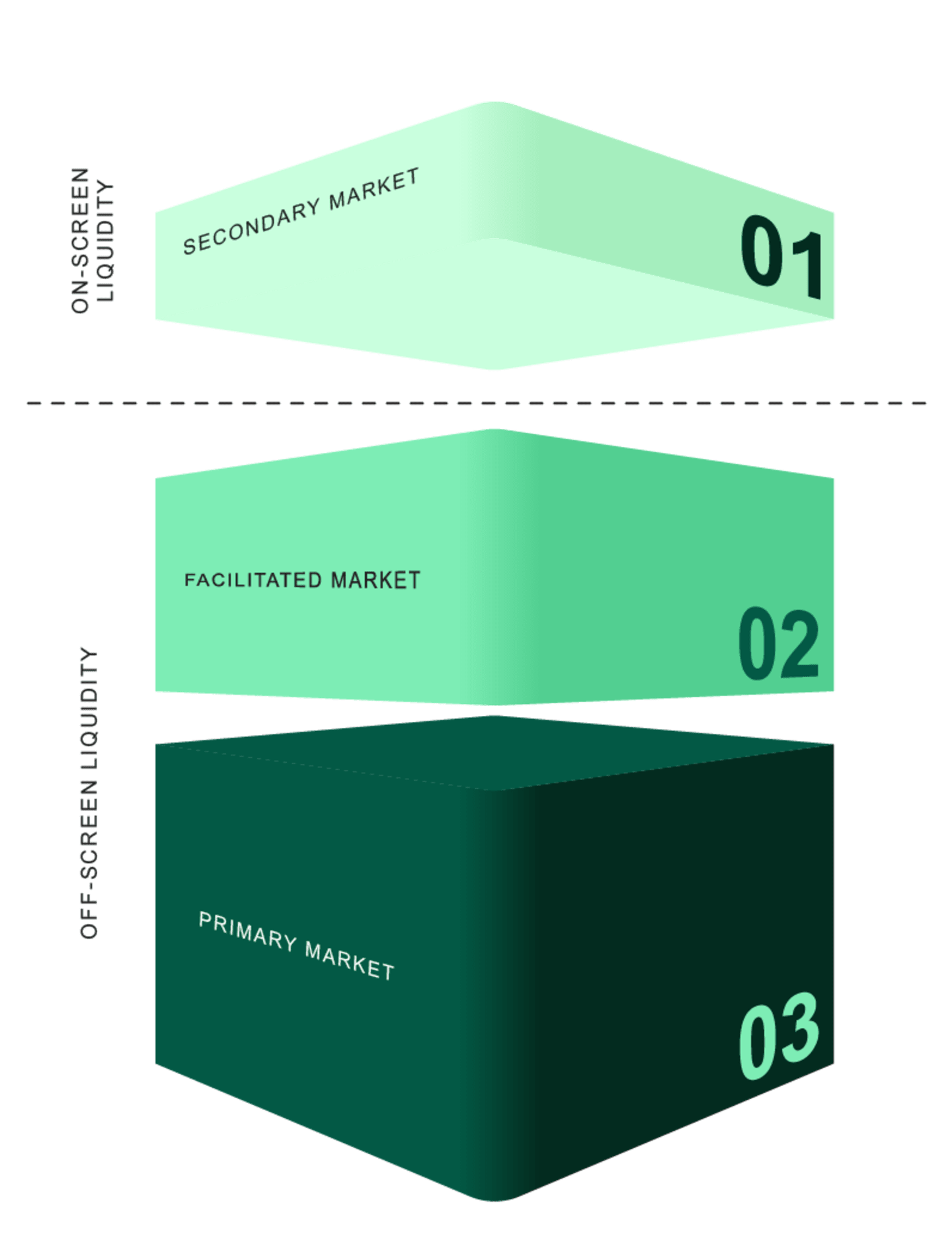
3 Levels of Liquidity
The ETF structure makes its liquidity more dynamic, scalable and responsive to trading needs than many investors realize.
Source: American Century Investments.
On-Screen
What an investor can see.
A financial website or brokerage account shows an ETF’s average daily volume (ADV)—what has traded—plus the current bid/ask quote and size currently available to trade on the exchange at those prices. This represents only what has been traded. It does not represent what can be traded.
Broker Assisted
Off-screen, ETF market makers provide brokers with additional inventory and pricing.
ETF market makers are willing to provide efficient quotes for investors' ETF trades. A custodial platform or a broker/dealer can assist investors in trades that are larger than what is displayed on screen.
Specialist Accessed
ETFs’ underlying securities are the ultimate source of their liquidity.
Authorized participants (APs) can initiate the creation and redemption process in the primary market to produce additional shares of the ETF or to reduce supply. The creation and redemption process ultimately ensures there is sufficient inventory of ETF shares to fill investors' orders.
With a few simple steps, low-volume ETFs can trade efficiently—unlocking opportunities that many investors overlook.
ETF Tax Efficiency
Why Are ETFs More Tax Efficient Than Mutual Funds?
ETF managers generally accommodate investment inflows and outflows through the in-kind share creation and redemption process, which enables them to shed securities that may generate significant capital gains.
ETF shares are bought and sold on the secondary market without transactions occurring among the underlying securities.
A sale that generates capital gains impacts only the person selling the shares—it does not create capital gains for all fund shareholders.
Trading in kind may help eliminate or significantly reduce costs compared to trading the underlying securities.
When managers rebalance an ETF portfolio, they typically apply tax management strategies, such as tax-loss harvesting, to help mitigate gains of distributions.
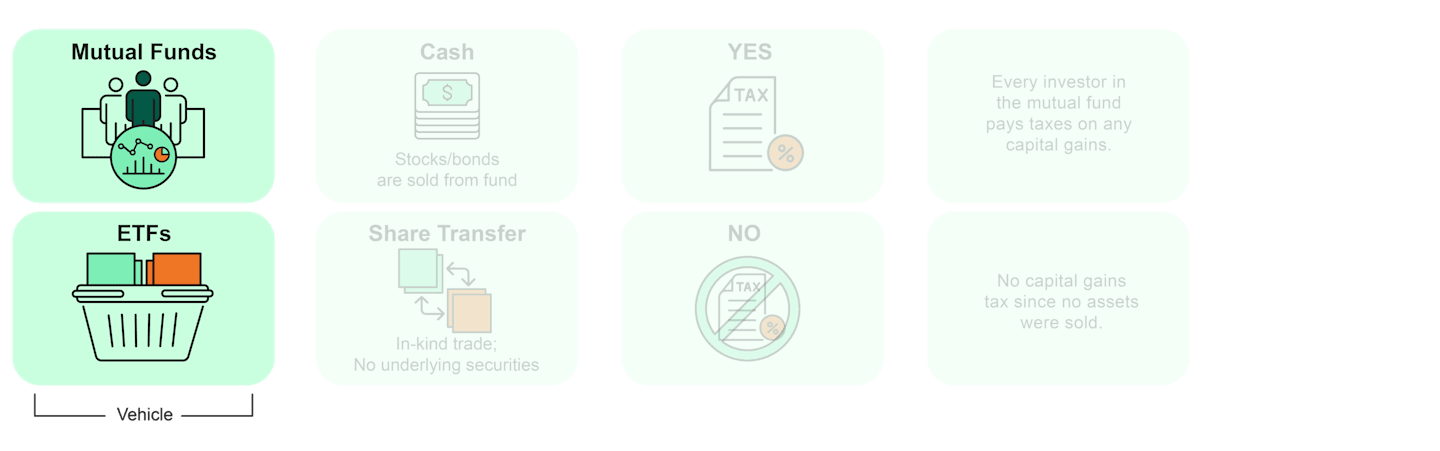
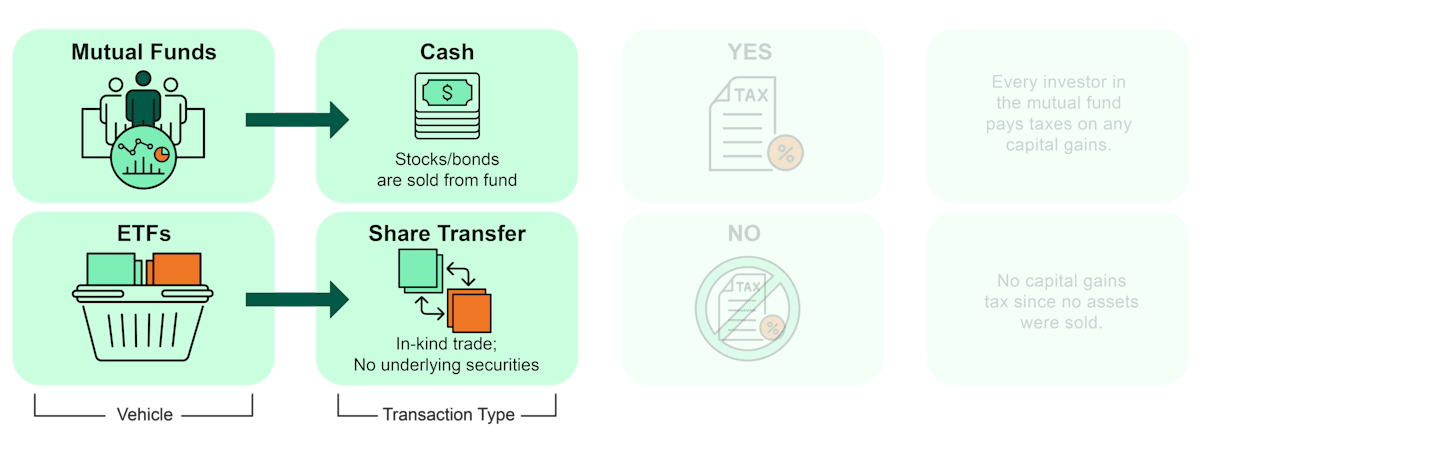
What Happens When an Investor Sells Shares From a Taxable Investing Account
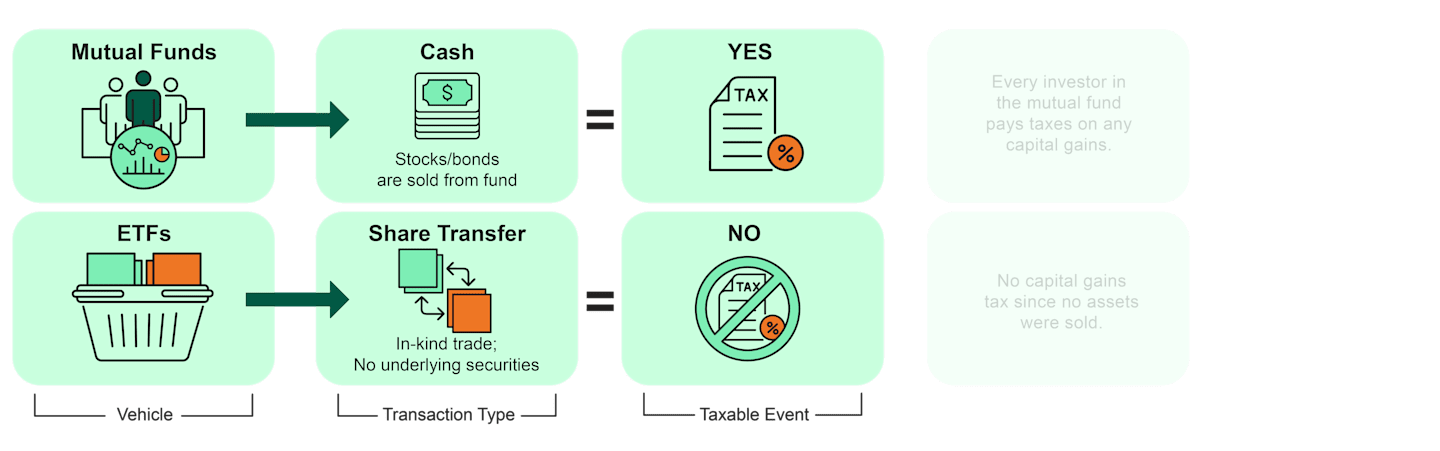
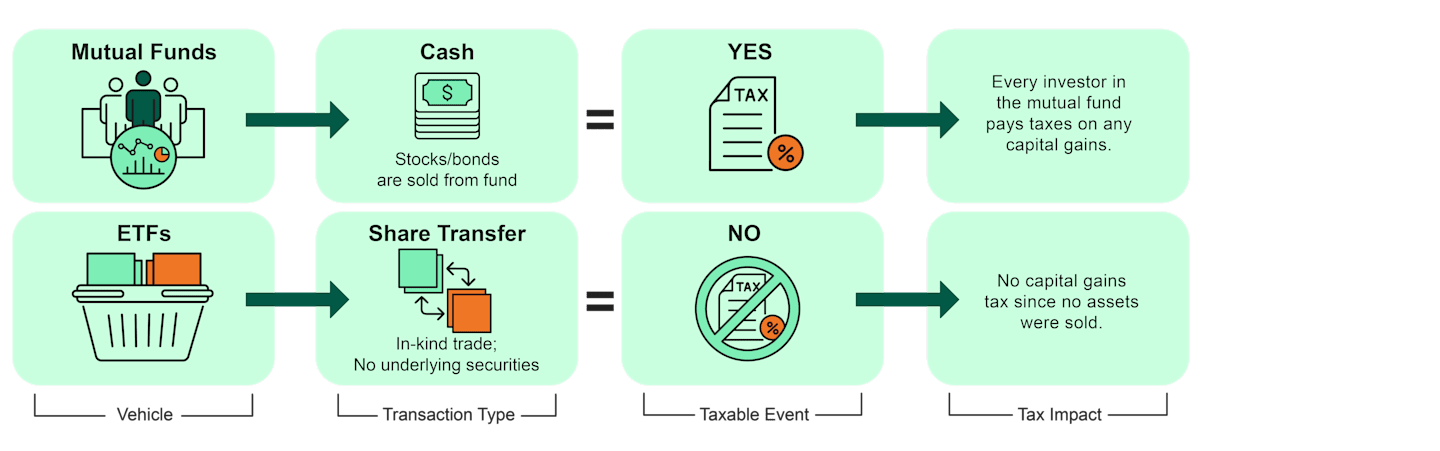
Mutual Funds: Flows into and out of the fund involve the manager selling the underlying securities in the portfolio. These sales are transacted in cash.
ETFs: ETF managers accommodate investment inflows and outflows generally through the in-kind share creation and redemption process.
Mutual Funds: Sales of underlying securities are cash transactions by the portfolio manager in the open market.
ETFs: In-kind transaction means shares are passed back and forth on the exchange and do not involve the sale of underlying securities.
Mutual Funds: Cash transactions are taxable events.
ETFs: In-kind transfers are not taxable.
Mutual Funds: The selling of securities to meet redemptions or reallocate assets may trigger capital gains for the fund and thus for all its shareholders.
ETFs: When ETF investors sell shares, the sale is facilitated by a market maker in the secondary market, with no capital gains impact on other ETF investors.
Mutual Funds: Flows into and out of the fund involve the manager selling the underlying securities in the portfolio. These sales are transacted in cash.
ETFs: ETF managers accommodate investment inflows and outflows generally through the in-kind share creation and redemption process.
Active Decision-Making Built for ETF Tax Efficiency
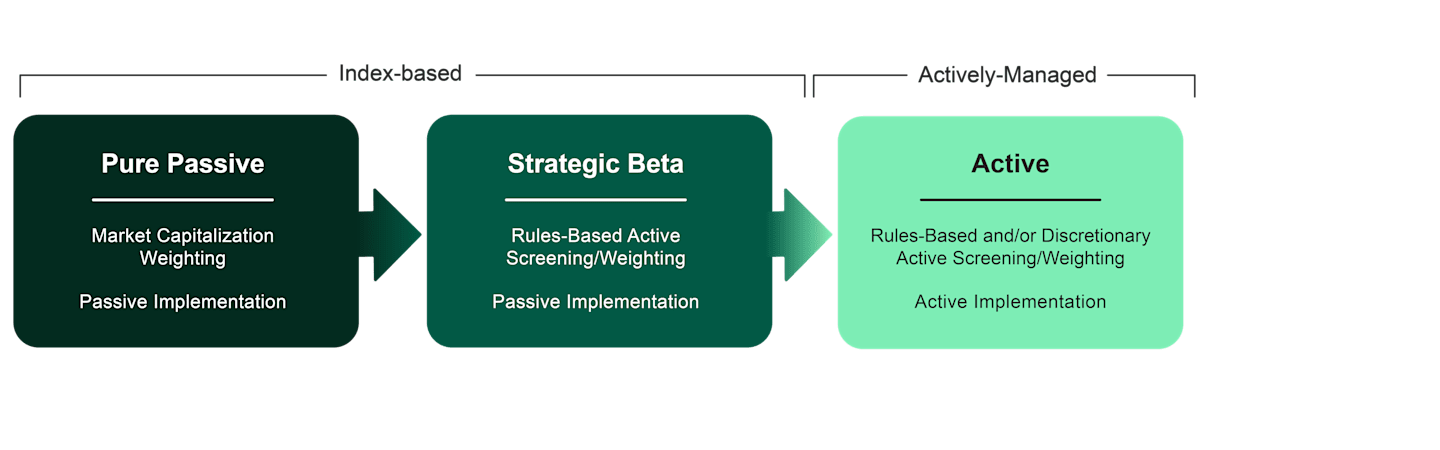
ETFs didn’t stop at passive. Today’s market includes active ETFs—strategies freed from index constraints but delivered in the same efficient, transparent structure advisors rely on.
Active/Strategic Beta/Passive Framework is credited to Ben Johnson at Morningstar.
3:46
Active ETF Momentum & Trading Tips
Why are active ETFs gaining traction—and how can you trade them more effectively? Global Head of ETF Capital Markets Matt Lewis breaks it down with Nasdaq’s Gabrielle Vennitti.
It began in 2018 with a launch that included one of the first active fixed-income ETFs. We introduced Avantis Investors® in 2019, blending the consistency of indexing with the potential for outperformance through active management.
Today, our lineup offers financial advisors and investors varying levels of active management, leveraging both in-depth fundamental research and advanced quantitative methodologies.
Beta is a standard measurement of potential investment risk and return. It shows how volatile a security's or an investment portfolio's returns have been compared with their respective benchmark indices. A benchmark index's beta always equals 1. A security or portfolio with a beta greater than 1 had returns that fluctuated more, both up and down, than those of its benchmark, while a beta of less than 1 indicates less fluctuation than the benchmark.
Bid/ask spread (also known as bid/offer spread)
The difference between the National Best Bid and the National Best Offer, which represents the implied cost to trade a security. As compensation for the risk taken, the market maker (or dealer) earns the bid/offer spread in exchange for facilitating the trade. Wider spreads generally indicate higher costs associated with trading the underlying assets in the ETF, hedging costs, inventory management costs, and general market risk.
Liquidity
Liquidity describes the degree to which an asset or security can be quickly bought or sold in the market without affecting the asset's price.
Primary Market for Exchange Traded Funds
The primary market is where ETF shares are created and redeemed amongst ETF issuers and authorized participants. This is where the underlying basket of securities that make up an ETF is created. Shares of ETFs are made in large batches called Creation Units—usually 25,000 to 600,000 ETF shares are created at a time through this process.
Secondary Market for Exchange Traded Funds (ETFs)
The vast majority of investors will only deal with the secondary market when buying and selling ETFs. This is where shares of ETFs are bought and sold amongst other investors on an exchange.
Exchange Traded Funds (ETFs) are bought and sold through exchange trading at market price (not NAV), and are not individually redeemed from the fund. Shares may trade at a premium or discount to their NAV in the secondary market. Brokerage commissions will reduce returns.
IRS Circular 230 Disclosure: American Century Companies, Inc. and its affiliates do not provide tax advice. Accordingly, any discussion of U.S. tax matters contained herein (including any attachments) is not intended or written to be used, and cannot be used, in connection with the promotion, marketing or recommendation by anyone unaffiliated with American Century Companies, Inc. of any of the matters addressed herein or for the purpose of avoiding U.S. tax-related penalties.
This information is for educational purposes only and is not intended as tax advice. Please consult your tax advisor for more detailed information or for advice regarding your individual situation.
Investment return and principal value of security investments will fluctuate. The value at the time of redemption may be more or less than the original cost. Past performance is no guarantee of future results.
Diversification does not assure a profit nor does it protect against loss of principal.
This material has been prepared for educational purposes only. It is not intended to provide, and should not be relied upon for, investment, accounting, legal or tax advice.