The Active ETF Boom Is Real. So Is the Experience Gap.
Active ETF management is attracting investors at a record pace. But launching an ETF isn't the same as managing one. Learn more about the rise of active ETFs and why experience in active investing still matters.

Exchange‑traded funds (ETFs) have become a go-to investment vehicle for investors. American Century Investments® has met that demand by applying its 60+ years of active management experience to the ETF structure—offering not only the flexibility, transparency and tax efficiency investors expect from ETFs, but also informed decision-making, portfolio discipline and excess return potential.
- $156+ billion in AUM*
- One of the fastest organic growth rates in the industry
- Top-15 ETF Issuer in AUM*
- Top-5 Active ETF Issuer in AUM*
* Source: Morningstar data out of 422 ETF issuers overall and 385 active ETF issuers, as of September 30, 2026.
Key Takeaways
Unlike index-based ETFs, active ETFs aren’t bound by preset rebalancing schedules or index concentration. That flexibility can help portfolio teams respond to new information, manage exposures as conditions change and pursue specific objectives with a disciplined process.
Flows and new launches have accelerated as advisors and investors look for more tools that can navigate volatility and market dispersion. As the category grows, understanding how active ETFs work—and who has real-world experience running them—becomes increasingly important.
Because they trade like stocks, active ETFs can be bought and sold throughout the day, often with no investment minimums. They may also provide cost and after-tax advantages versus comparable mutual funds, while still offering active security selection and risk-aware portfolio construction.
A Wide Spectrum of Active Management
Most active ETFs seek to avoid the drawbacks of indexing—concentrated rebalancing, high liquidity demands and predefined holding periods that unnecessarily disregard current market information.
Active management comes in many forms. Some portfolio managers focus on bottom-up or top-down analysis to drive investment decisions. Others apply quantitative research to deliver a more systematic approach. Active managers identify and select individual securities, use research to determine broad allocations or develop rules-based methodologies that target specific company attributes.
Diverse Approaches, Independent Thinking
American Century Investments' ETF lineup is distinguished by a comprehensive range of active strategies, each managed by a team with its own distinct philosophy and process. In addition to our fundamental active bottom-up security selection capabilities, our investment team at Avantis Investors® offers a systematic active management approach.
Our more than 50 actively managed ETF strategies are designed for markets where selectivity, flexibility and discipline increasingly define outcomes.
Track Records Still Matter—a Veteran in the Active ETF Space
Since launching our first active ETFs in 2018, American Century Investments has built a lineup in which two-thirds of our strategies now feature a three-year track record. This depth of history stands out in an active ETF landscape where nearly 70% of current offerings were launched in only the last three years.1
This experience informs how our teams navigate real‑world market cycles, adapt to changing conditions and develop ETF strategies that pursue specific outcomes—whether through return‑enhancing positioning, risk‑aware portfolio construction or disciplined decision‑making grounded in current market prices.
American Century has a long track record of distributing limited capital gains distributions, which underpins our ETFs' tax efficiency.
Active ETFs: What Investors Are Turning To
In today’s volatile market environment, active ETFs are becoming a preferred investment vehicle for investors seeking products that have the potential to flex with market swings.
At their simplest, active ETFs are ETFs that do not track an index. Instead, they expand the core benefits investors value in the ETF structure—such as transparency, liquidity and tax efficiency—by pairing them with active decision making, a broader opportunity set, and portfolios that are not constrained by arbitrary index rules or concentrations.
Active ETFs have been gaining ground, amassing over $1.9 trillion in assets and accounting for $365 billion in new investments so far in 2026 - 37% of total ETF flows despite representing only 13% of assets.1
Investor preferences are clearly evolving beyond traditional passive exposures:
The compound annual growth rate of active ETF assets topped 64% over the last three years—nearly double the rate of the industry.
A record 962 new active ETFs launched in 2025. For the first time, the number of available active ETFs exceeded the number of passive ETFs. We see the trajectory in 2026 continuing for both flows and new ETF launches. So far in 2026, ETF flows have been $365 billion and 593 new ETFs have been launched.
593 active ETFs have been launched year-to-date compared to 105 passive ETFs (06/30/2026).
Investor demand is clearly shifting toward active ETFs over mutual funds.
Active ETFs Are Growing Faster Than Active Mutual Funds
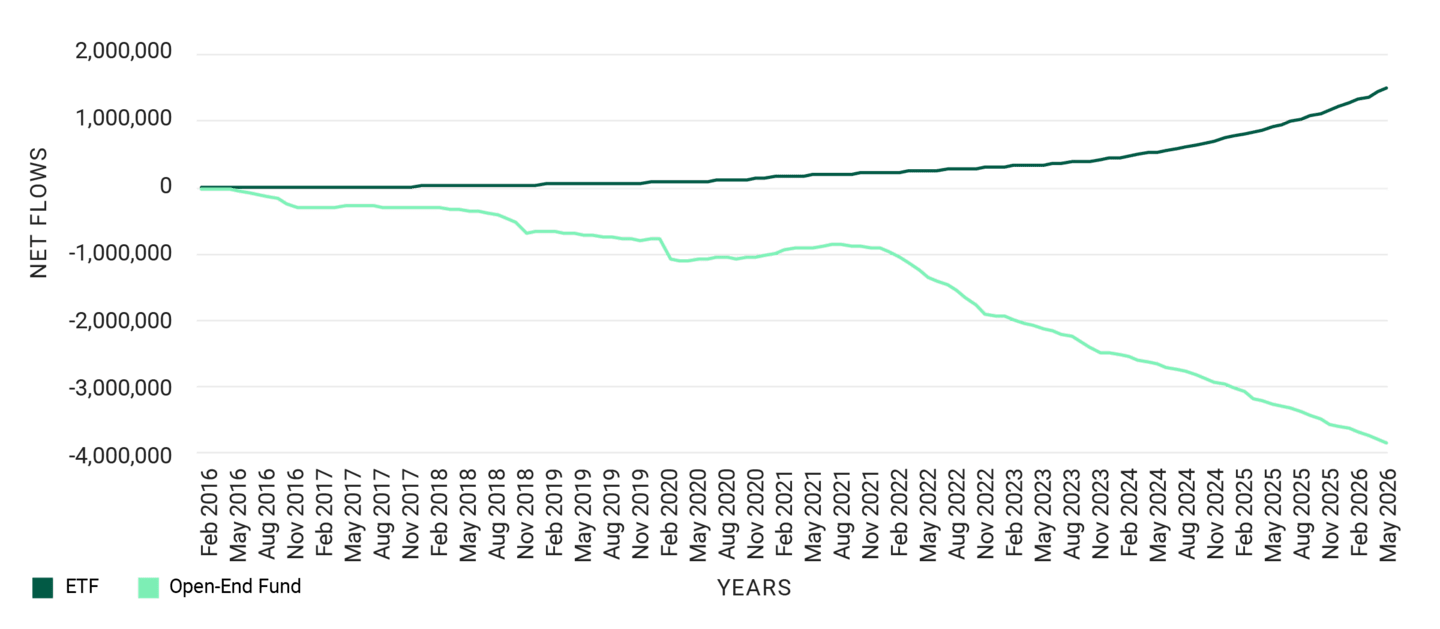
Data as of 6/30/2026. Source: Morningstar Direct.
SEC Rule 6c-11 has allowed actively managed ETFs to be on the same playing field as indexed ETFs. In a nutshell, the rule allows active managers to use optimized and custom or negotiated in-kind baskets for ETF creations and redemptions. Since there is no longer a lengthy exemptive relief process, active ETFs have been coming to the market at an accelerated pace.
Active ETFs Are Just Another Investment Vehicle
Investors often perceive active ETFs as a distinct, complex investment category rather than what they truly are: a flexible vehicle through which asset managers deliver active strategies. They have the same intent as active mutual funds, just delivered through an ETF wrapper. And for portfolio construction purposes, investors can add active ETFs alongside active and passive mutual funds.
Given that active ETFs usually have lower costs and tax-efficiency advantages, investors may benefit from including them in their portfolios rather than active mutual funds, especially in accounts without any tax advantages or deferrals.
Reframing the Liquidity Conversation for Active ETFs
Persistent misperceptions about ETF liquidity and trading volume feed the view that ETFs are hard to access, even though ETF liquidity is driven by the underlying securities and creation/redemption mechanisms, not by daily volume.
Active ETFs Are Easy to Access
In practice, active ETFs are often:
More accessible (no minimums)
More flexible (intraday trading)
More tax efficient
More cost-effective
Increasingly mainstream
Some steps you may want to take to ensure you get the best execution for your active ETF trades:
Talk to your block desk for larger trades. Every custodian has block desk resources, and advisors should leverage them to get the most efficient pricing for those trades.
Use limit orders. For those without direct access to a block desk, use a limit order on your trade to protect the price you are willing to pay. This is most applicable to low-volume active ETFs, but you should also consider using them for high-volume active ETFs to ensure good price execution.
ETFs Are Versatile Portfolio Solutions
Tactical Allocation
Nimbly and quickly express asset allocation views
Risk management
Hedging
Strategic Allocation
Tax-efficient, lower cost exposures
Buy-and-hold investments
Diversification
Core and satellite exposures
Portfolio Implementation
Tax-loss harvesting
Liquidity management
Transition management
ETF model portfolios
Move Portfolios Forward With Active ETFs
Active ETFs have moved from a “nice to have” into an adept portfolio tool—bringing active decision-making into a structure designed for tax efficiency, flexibility and transparency. For investors and advisors seeking to modernize allocations, enhance after-tax outcomes and stay nimble in fast-changing markets, active ETFs can be a compelling way to put conviction to work.
With thoughtful manager due diligence and sound implementation practices, active ETFs can make it easier to implement active views with confidence.
Authors
Head of ETF Product and Strategy
Explore More Insights
Asset and flow data sourced from Morningstar Direct asset flows module ex-fund of funds, ex-feeder as of 06/30/2026.
Exchange Traded Funds (ETFs) are bought and sold through exchange trading at market price (not NAV), and are not individually redeemed from the fund. Shares may trade at a premium or discount to their NAV in the secondary market. Brokerage commissions will reduce returns.
This material has been prepared for educational purposes only. It is not intended to provide, and should not be relied upon for, investment, accounting, legal or tax advice.
You should consider the fund's investment objectives, risks, charges and expenses carefully before you invest. The fund's prospectus or summary prospectus, which can be obtained by visiting americancentury.
IRS Circular 230 Disclosure: American Century Companies, Inc. and its affiliates do not provide tax advice. Accordingly, any discussion of U.S. tax matters contained herein (including any attachments) is not intended or written to be used, and cannot be used, in connection with the promotion, marketing or recommendation by anyone unaffiliated with American Century Companies, Inc. of any of the matters addressed herein or for the purpose of avoiding U.S. tax-related penalties.
This information is for educational purposes only and is not intended as tax advice. Please consult your tax advisor for more detailed information or for advice regarding your individual situation.
Diversification does not assure a profit nor does it protect against loss of principal.
Investment return and principal value of security investments will fluctuate. The value at the time of redemption may be more or less than the original cost. Past performance is no guarantee of future results.
These funds are actively managed ETFs that do not seek to replicate the performance of a specified index. To determine whether to buy or sell a security, the portfolio managers consider, among other things, various fund requirements and standards, along with economic conditions, alternative investments, interest rates and various credit metrics. If the portfolio manager considerations are inaccurate or misapplied, the fund's performance may suffer.
©2026 Morningstar, Inc. All Rights Reserved. Certain information contained herein: (1) is proprietary to Morningstar and/or its content providers; (2) may not be copied or distributed; and (3) is not warranted to be accurate, complete or timely. Neither Morningstar nor its content providers are responsible for any damages or losses arising from any use of this information.
Exchange Traded Funds (ETFs): Foreside Fund Services, LLC - Distributor, not affiliated with American Century Investment Services, Inc.