Adapt and Thrive: How Markets Evolve Through Tech Revolutions
Market Minute | While major tech events shape the economy, the biggest risk might be overlooking what happens next.

Key Takeaways
Every major technology has reshaped the economy. Each time, markets have adapted to reach new highs.
Adoption timelines are shortening from decades to months, and markets are recovering faster from shocks.
The biggest risk during a tech revolution isn’t disruption — it might be missing what comes next.
New Technologies, Familiar Debate
Markets have a remarkable track record of absorbing technological change, even when the transition feels uncertain.
As the internet went mainstream, people debated whether traditional businesses could survive. Yet as businesses adapted and new industries emerged, the economy evolved and stock prices reached levels that had seemed unimaginable just a decade earlier.
Artificial intelligence (AI) raises similar questions about how businesses and markets will adapt. Although the outcome remains uncertain, history suggests that staying invested through technological change may be more effective than trying to time the market.
Figure 1 | Moments of Fear

How Markets Have Adapted to Technological Change
Think of Figure 2 as the market’s fossil record, with each annotation marking a moment when a new technology reshaped the economic landscape. Although these shifts often brought disruption, markets adapted and eventually climbed higher.
The dot-com bubble, for example, helped spur the development of digital infrastructure that supported the emergence of a new generation of leading companies. Across successive technological shifts, periods of disruption have often given way to new sources of growth.
Figure 2 | Through Every Tech Revolution, Markets Tend to March Higher
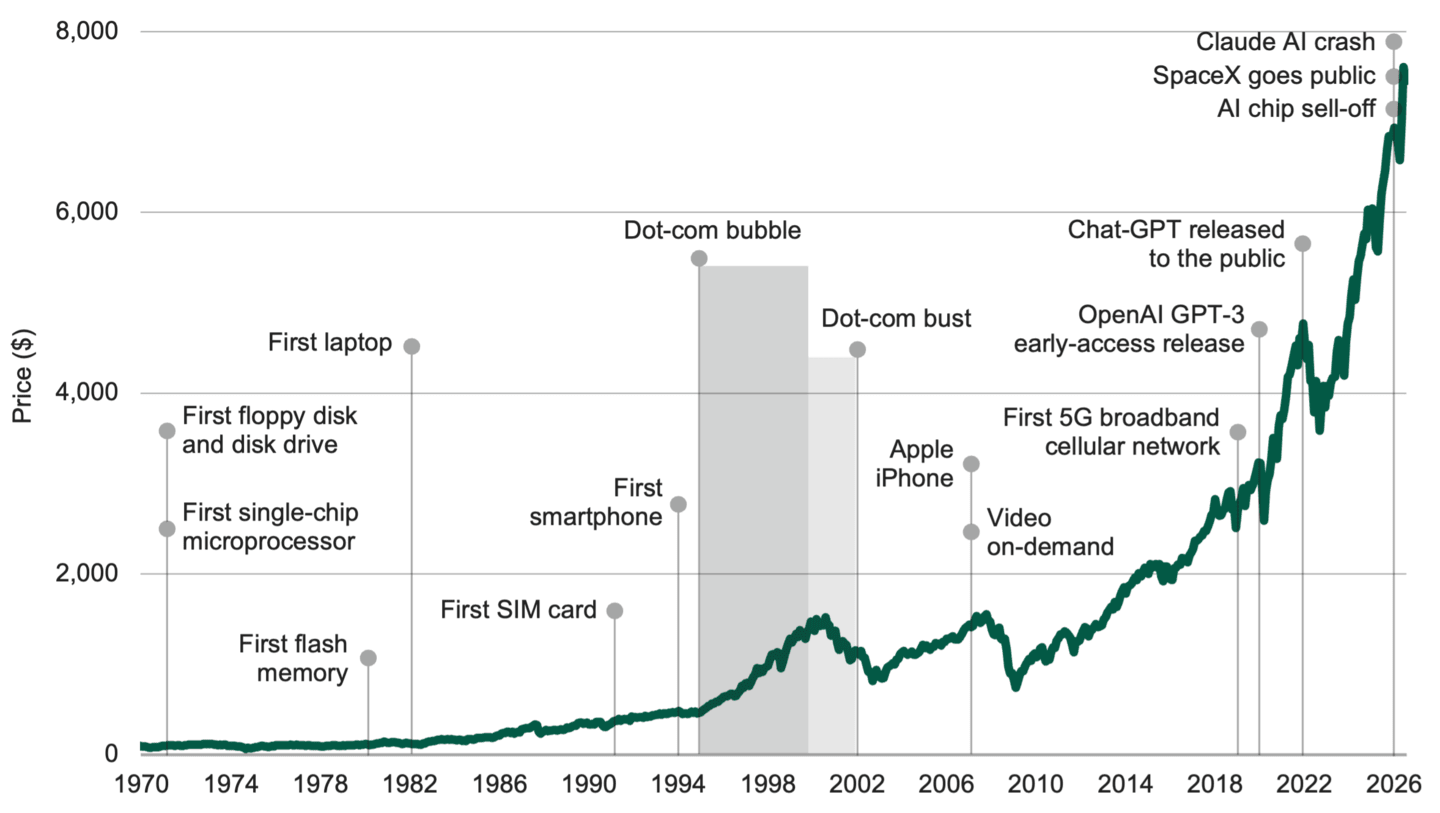
Data from 1/1/1970 – 7/31/2026. Source: Bloomberg Finance L.P. Technology milestones are from American Century Investments research. Past performance is no guarantee of future results.
Why Markets Are Adapting Faster Than Ever
Each successive wave of technology reaches mass adoption faster. For example, it took only two months for ChatGPT to reach 50 million users.
The market’s adaptive machinery is getting faster, too. It took the S&P 500® Index about seven years to recover from the dot-com bubble. The 2018 correction, driven by trade-war pressure on tech and semiconductor stocks, resolved in roughly five months. Even after the 2022 bear market, when aggressive interest rate hikes hit growth and AI stocks the hardest, the S&P 500 took just over a year to regain its previous peak.
Both recent tech-driven downturns recovered in a fraction of the time it took after the dot-com bust. Waiting for certainty may mean missing part of the market rebound.
Figure 3 | Market Recovery Speed
S&P 500 Index
Data as of January 2024. Sources: Bloomberg Finance L.P. Stock Market Historical Tables: Bull & Bear Markets, Yardeni Research Inc. Past performance is no guarantee of future results.
Survival of the Invested

What Can Happen When You Stay in the Market?
A hypothetical $10,000 investment tracking the S&P 500® Total Return Index (showcases the effect of dividends, differing from the standard S&P 500 Index) in early March 2000, near the peak of the dot-com bubble, would have grown to just over $79,000 as of June 30, 2026, assuming dividends were reinvested.1
Technological revolutions create turbulence. They also create the next era of growth. The microprocessor, the internet, and the smartphone each initially felt like a threat, but each became a foundation for the growth that followed.
Will AI Cause Markets to Change?
Yes. The question is whether that’s a reason to leave the market. Fifty-five years of technological evolution suggest otherwise.
The Bottom Line: Markets Adapt to Technology Revolutions
From the microprocessor to AI, every wave of innovation has been met with uncertainty, and each time, the S&P 500 has adapted to reach new highs.
Recovery windows are shrinking, adoption cycles are shortening and markets are adapting faster than ever.
While technological advances can cause market volatility, disciplined investors who stay invested have historically benefited from subsequent recoveries and growth.
Authors
Senior Client Portfolio Manager
Check Out More of Our Market Minute Articles
Investment insights for savvy investors.
Based on a $10,000 investment tracking the S&P 500® Total Return Index from 3/3/2000–6/30/2026. Source: Bloomberg Finance L.P. This hypothetical situation contains assumptions that are intended for illustrative purposes only and are not representative of the performance of any security. There is no assurance similar results can be achieved, and this information should not be relied upon as a specific recommendation to buy or sell securities.
The S&P 500 Total Return Index assumes that all cash dividends are reinvested and tracks the price of the S&P 500.
Investment return and principal value of security investments will fluctuate. The value at the time of redemption may be more or less than the original cost. Past performance is no guarantee of future results.
The opinions expressed are those of American Century Investments (or the portfolio manager) and are no guarantee of the future performance of any American Century Investments portfolio. This material has been prepared for educational purposes only. It is not intended to provide, and should not be relied upon for, investment, accounting, legal or tax advice.
References to specific securities are for illustrative purposes only and are not intended as recommendations to purchase or sell securities. Opinions and estimates offered constitute our judgment and, along with other portfolio data, are subject to change without notice.