Ultrashort Bonds vs. Cash: Understanding the Trade-Offs
Compare the income potential, interest rate sensitivity and other risks of ultrashort bond funds and cash equivalents.

Key Takeaways
Yields on cash-equivalent assets have trended lower over the past few years, so cash-heavy portfolios are likely earning less income.
Actively managed ultrashort bond funds may offer higher income potential than cash equivalents while helping limit interest rate risk.
Unlike cash holdings, ultrashort bond funds pursue opportunities across a mix of securities designed to limit exposure to interest rate volatility.
Cash-Equivalent Yields Are Falling — So What?
Many investors keep money in cash equivalents — such as certificates of deposit (CDs), Treasury bills and money market accounts — for their liquidity and quality benefits.
In recent years, these instruments offered attractive yields that outpaced inflation, as shown in Figure 1. The result? Investors could generally maintain purchasing power.
Today, that may no longer be the case, as lower yields can make it harder for cash holdings to maintain purchasing power.
Figure 1 | Cash-Equivalent Yields Have Fallen
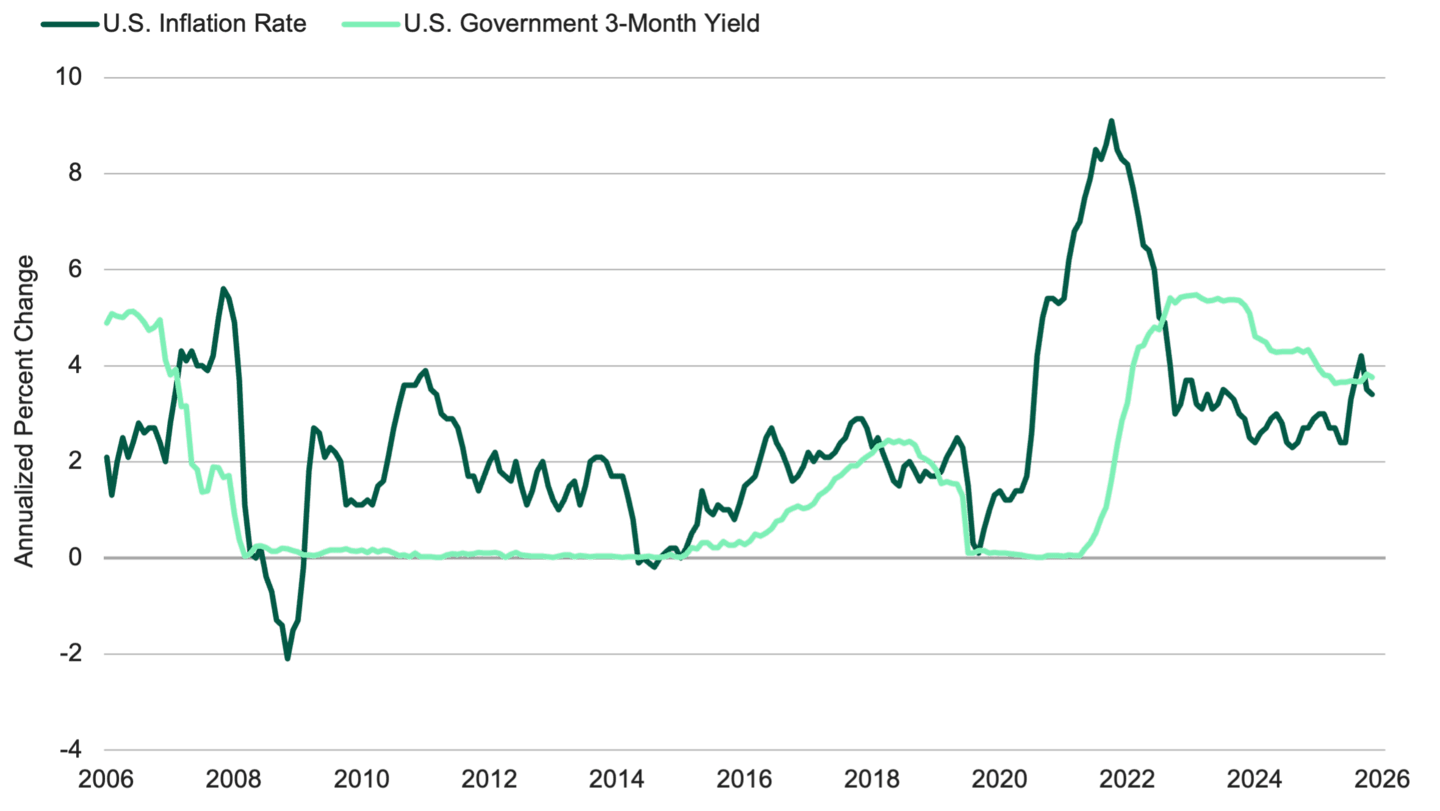
Data from 9/29/2006 - 8/31/2026. Source: FactSet. Past performance is no guarantee of future results.
Since late 2024, when the Federal Reserve (Fed) launched a rate-cut campaign, yields on many cash investments declined. As a result, cash equivalents began generating less income than in prior years.
In addition to lower income levels, other factors should be considered.
Taxes can further reduce that income, while inflation can diminish its purchasing power. Interest from many cash equivalents is typically taxed as ordinary income, although tax treatment varies by investment and investor. At the same time, persistent inflation increases the cost of everyday expenses, gradually reducing what those cash holdings can buy.
Understanding the Impact of Taxes and Inflation on Cash
Suppose a $1,000 cash investment earns 3% annually, generating $30 in interest over one year. Taxes may further reduce that income, depending on the investment and the investor’s tax situation.
If inflation is also 3%, rising prices may offset much of the purchasing power from that interest. The account balance increases, but the money may buy little more than it did a year earlier.
Ultrashort-maturity bonds may offer higher income potential than cash equivalents, although their values can fluctuate and they carry additional risks. Because their maturities and durations are typically short, they may be less sensitive to interest-rate changes than longer-maturity bonds.
Why Cash-Equivalent Yields May Stay Low
Cash equivalents typically move in tandem with the federal (fed) funds rate. This is the interest rate set by the Fed that banks charge each other for overnight loans.
Yields on cash equivalents rose to multidecade highs after high inflation prompted the Fed to raise rates in 2022. When the Fed later paused and began cutting rates, cash-equivalent yields declined.
If interest rates remain near current levels, cash equivalents may continue to generate less income than they did in recent years.
Why the Fed May Hold Rates Near Current Levels
Cash-equivalent yields may change little in the near term. Although the Fed has shifted to a tightening bias, we don’t believe this marks the start of an extended rate-hike cycle.
Here’s why we think the Fed may be content to keep the fed funds rate close to its current range of 3.75% to 4% in the near term:
While inflation, measured by the Consumer Price Index (CPI), remains above the Fed’s 2% target, it has moderated from prior highs, as Figure 2 illustrates.
The labor market has remained fairly stable.
The economy has continued to grow.
Figure 2 | Inflation Has Moderated but Remains Above 2% Target
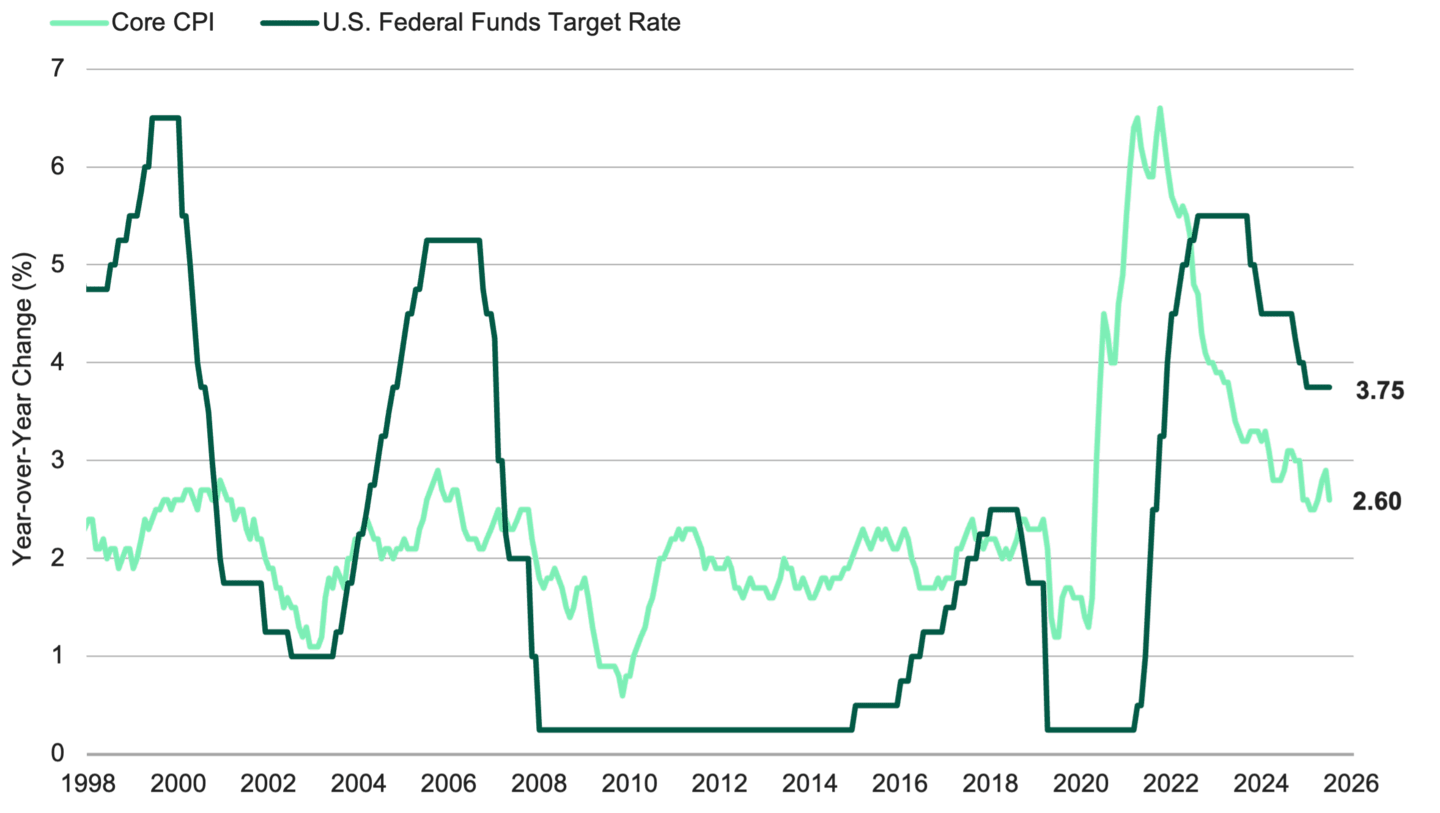
Data from 12/31/1998 to 6/30/2026. Source: FactSet, U.S. Bureau of Labor Statistics. Past performance is no guarantee of future results.
What’s Driving Higher Bond Yields?
While Fed policy has influenced Treasury bill and other cash-equivalent yields, market forces have pushed bond yields higher across the yield curve. These forces include:
Resilient economic growth
Persistent above-target inflation
Less forward guidance from the Fed
Growing federal debt
Increased corporate bond issuance, particularly among artificial intelligence (AI)-related companies
These conditions may contribute to higher yields on ultrashort- and longer-maturity bonds than on cash equivalents. However, unlike cash equivalents, ultrashort bond funds can fluctuate in value and carry additional risks.
Ultrashort bonds have provided higher average yields than three-month Treasury bills over time, as Figure 3 illustrates.
Figure 3 | Ultrashort Bonds Had Higher Average Yields Than Treasury Bills Over 20 Years
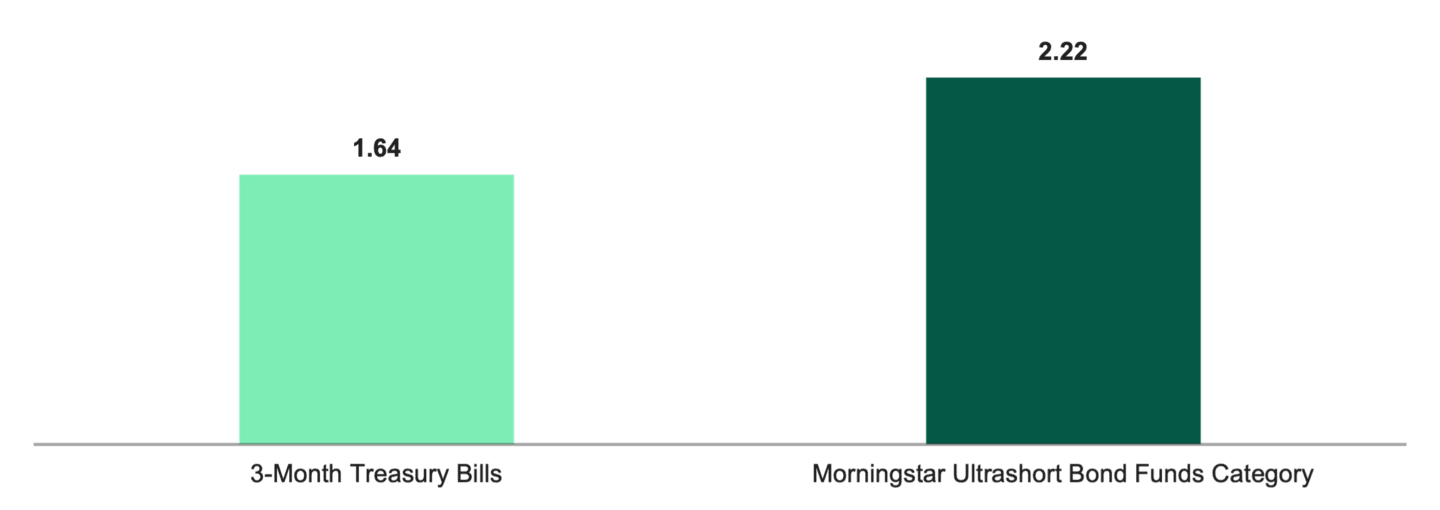
Data from 7/31/2006 - 8/31/2026. Morningstar’s Ultrashort bond category includes portfolios that invest primarily in investment-
Why Interest Rate Volatility Remains Elevated
Interest rate volatility, as measured by the ICE BofAML MOVE Index, has been elevated in recent years. Higher index readings generally indicate greater uncertainty about the direction of interest rates.
As of July 31, 2026, the index’s five-year average was 99, compared with an average of 67 over the preceding 10 years, as shown in Figure 4.
Figure 4 | Interest Rate Volatility Has Increased in Recent Years
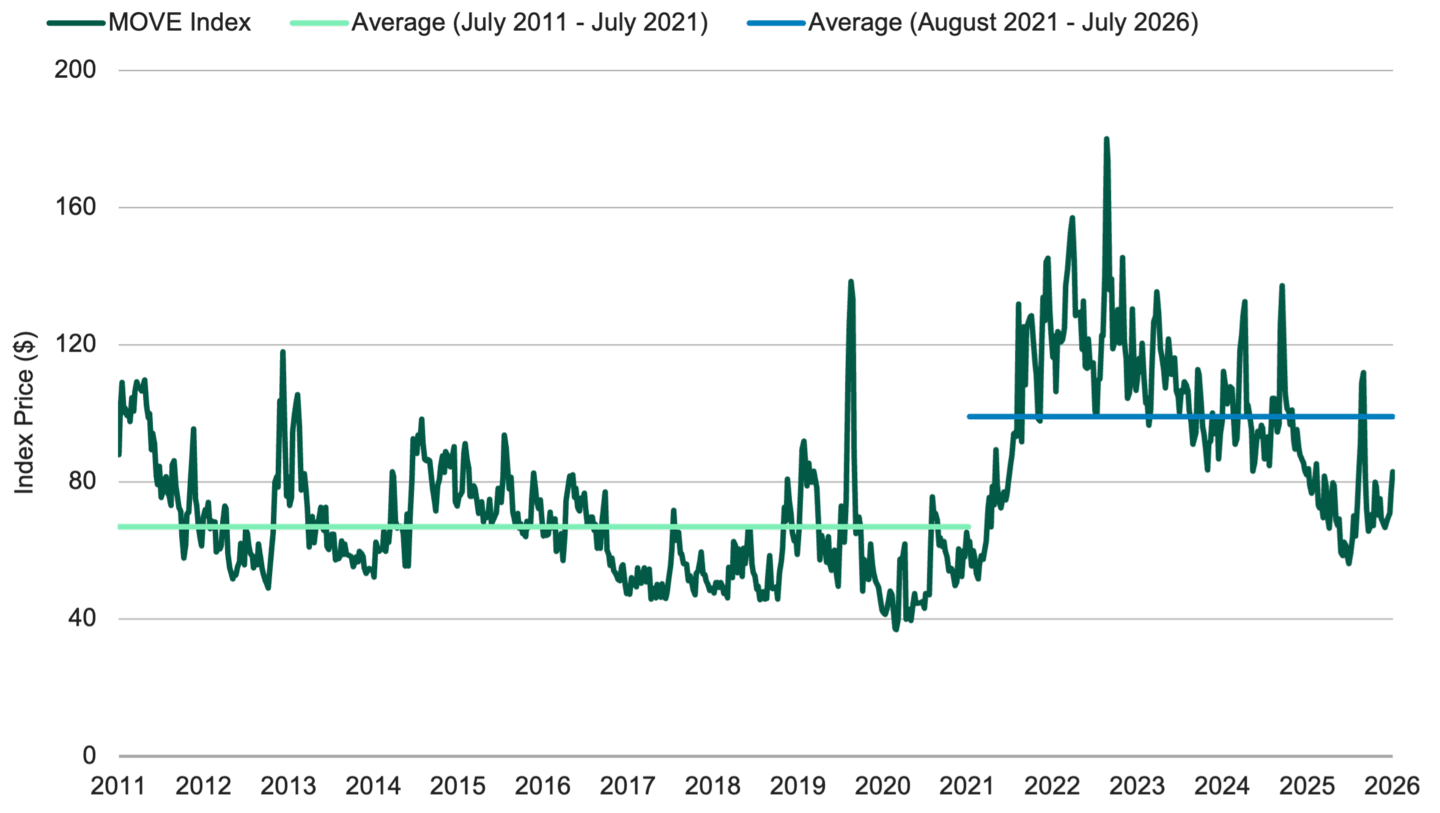
Data from 7/29/2011 – 7/31/2026. Source: FactSet. Past performance is no guarantee of future results.
Following his first policy meeting as Fed Board chair, Kevin Warsh reiterated his skepticism of central bank interest rate forecasts. Consequently, he didn’t participate in the Fed’s quarterly dot plot, which shows each Fed Board member’s individual outlook for interest rates.
Less forward guidance from the Fed could contribute to continued uncertainty about the path of interest rates, potentially keeping bond market volatility elevated.
Shorter-maturity bonds are generally more insulated from rate volatility than bonds with longer maturities.
Ultrashort vs. Money Market Funds: What’s the Difference?
Investing for income often involves comparing money market funds with actively managed ultrashort bond funds. Ultrashort bond funds generally hold securities with very short maturities and maintain durations of less than one year.
Compared with money market funds, ultrashort bonds may offer:
Higher yield and income potential
Greater flexibility to pursue opportunities across government, corporate and securitized issuers
Greater sensitivity to interest rates, credit conditions and changes in market value
Figure 5 outlines the key characteristics of the two types of funds. Money market funds seek to maintain a stable $1 share price, while ultrashort bond fund share prices fluctuate. Ultrashort bond funds also generally carry higher interest rate and credit risk, though their ultrashort maturities may help mitigate these risks.
Figure 5 | A Comparison of Ultrashort Bond Funds and Money Market Funds
Source: American Century Investments.
What Happens to Ultrashort Bonds When Rates Change?
Bond prices generally move in the opposite direction as interest rates. When rates rise, existing bond prices typically fall, and when rates decline, existing bond prices typically rise.
Duration helps estimate the potential magnitude of those price changes and their effect on total return. All else equal, bonds with longer durations generally experience greater price changes — and a larger effect on total return — than bonds with shorter durations.
Because ultrashort bond funds have relatively short durations, they generally experience less price movement when interest rates change than intermediate- and long-maturity bond funds. However, their share prices and total returns can still fluctuate.
Income from a fund’s underlying bonds may help offset interest-rate-related price declines. As the hypothetical scenario in Figure 6 illustrates, even with a half-point move in interest rates, the potential total return range remains tight due to the short duration.
Figure 6 | How an Ultrashort Bond Fund May Respond to Changing Interest Rates
Source: American Century Investments. The estimated total return range assumes a 5% annual yield and a 0.3-year duration (about four months) and excludes reinvestment, fees, credit-spread changes and other market effects.
This hypothetical situation contains assumptions that are intended for illustrative purposes only and are not representative of the performance of any security. There is no assurance similar results can be achieved, and this information should not be relied upon as a specific recommendation to buy or sell securities.
Key Considerations for Investors Holding Cash
A less predictable path for Fed policy could contribute to continued volatility in interest rates. With less forward guidance, financial markets may respond more directly to incoming economic data, which can change unexpectedly.
In this environment, investors may compare the income potential and risks of cash equivalents with those of ultrashort- bond funds. Ultrashort bond funds may offer higher yield potential than cash equivalents and less interest-rate sensitivity than longer-duration bond funds. But ultrashort bond funds also carry greater interest-rate, credit and share-price risk than cash equivalents.
In our view, actively managed ultrashort bond funds may offer compelling income opportunities across a broad mix of short-maturity securities.
Authors
Client Portfolio Manager, Global Fixed Income
Explore Short-Term Fixed-Income Strategies
The opinions expressed are those of American Century Investments (or the portfolio manager) and are no guarantee of the future performance of any American Century Investments portfolio. This material has been prepared for educational purposes only. It is not intended to provide, and should not be relied upon for, investment, accounting, legal or tax advice.
Investment return and principal value of security investments will fluctuate. The value at the time of redemption may be more or less than the original cost. Past performance is no guarantee of future results.
Generally, as interest rates rise, the value of the bonds held in the fund will decline. The opposite is true when interest rates decline.
©2026 Morningstar, Inc. All Rights Reserved. Certain information contained herein: (1) is proprietary to Morningstar and/or its content providers; (2) may not be copied or distributed; and (3) is not warranted to be accurate, complete or timely. Neither Morningstar nor its content providers are responsible for any damages or losses arising from any use of this information.