Fed Shifts to High Gear Under Warsh
With his task forces, Jackson Hole speech and recent rate hike, the Fed Board chair seeks to tame inflation with a reenergized, more-efficient Fed.
Key Takeaways
The Fed recently hiked short-term interest rates for the first time in more than three years, pushing yields higher across the fixed-income market.
Along with taking aim at persistent inflation, Kevin Warsh seeks to refocus the Fed toward 21st-century demands and challenges.
Most Fed officials expect additional rate hikes, but a continued slowdown in key inflation components may limit the tightening.
What Was the Fed’s Interest Rate Decision in September 2026?
Decision: As we expected, following recent hawkish comments from Federal Reserve (Fed) Board Chair Kevin Warsh, the Fed hiked interest rates. This action marked the first Fed rate increase since July 2023.
Target Range: The Fed's rate hike pushed the federal funds target rate to a range of 3.75% to 4%.
Vote: The rate-hike decision was unanimous.
Figure 1 | September Rate Hike Marked the First Fed Increase in Three Years
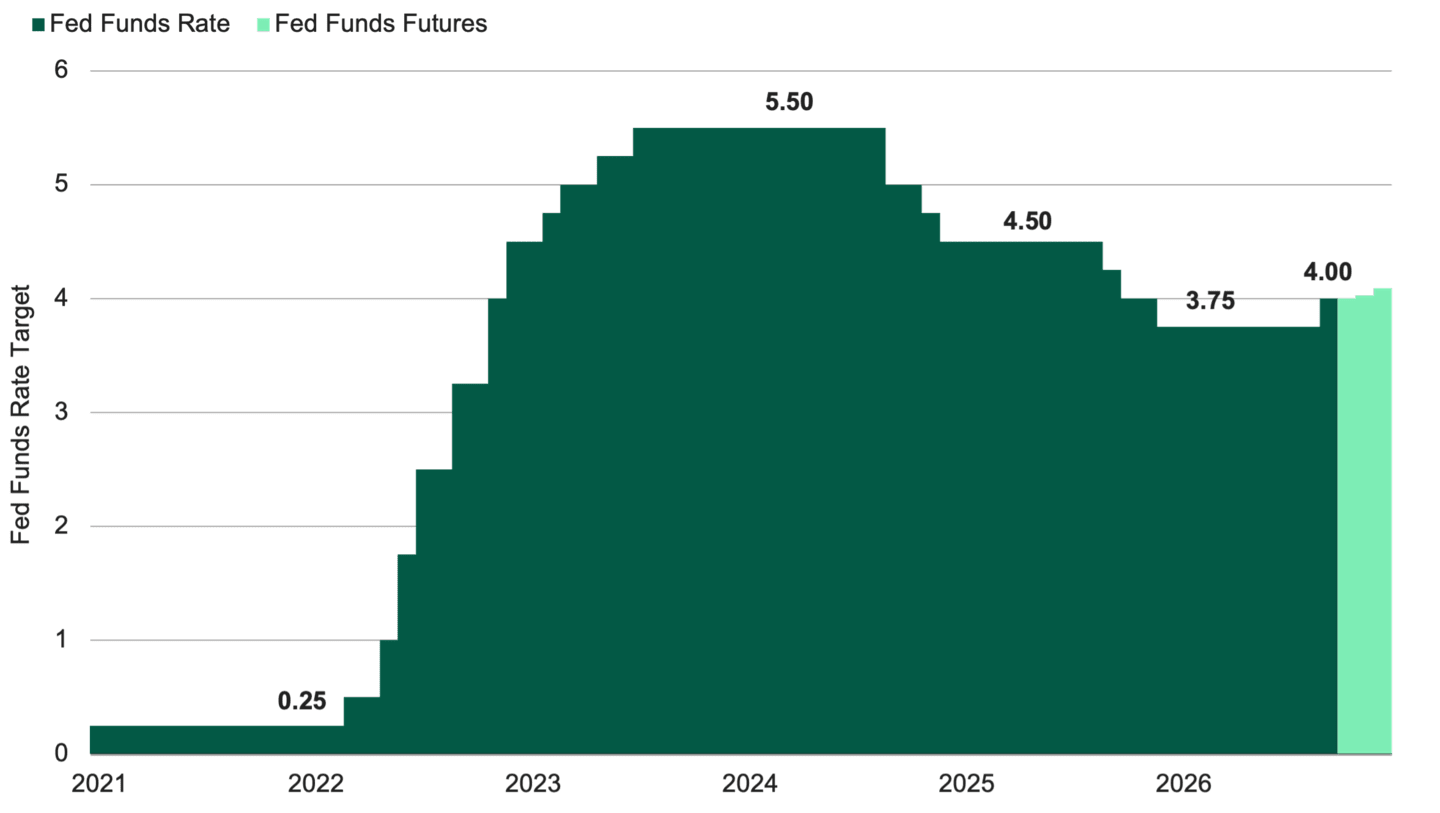
Data as of 9/24/2026. Futures prices as of 9/24/2026. Source: FactSet, Federal Reserve. Fed Fund Futures: Financial contracts traded on the Chicago Mercantile Exchange that track the federal funds rate. Fed Funds Rate: An overnight interest rate banks charge each other for loans. More specifically, it's the interest rate charged by banks with excess reserves at a Federal Reserve district bank to banks needing overnight loans to meet reserve requirements. U.S. Discount Rate: The interest rate at which commercial banks can borrow money directly from the Federal Reserve.
Why Did the Fed Raise Rates?
With inflation remaining above the Fed’s 2% target for more than five years, policymakers’ patience finally ran out. Rising energy prices and little progress toward a permanent Middle East solution have left the U.S. more exposed to second-round effects from the energy shock.
At the same time, upbeat economic data, including a solid jobs market and robust business investment, gave the Fed room to raise rates.
The September dot plot revealed policymakers’ frustration with stubbornly high inflation. Fed officials’ median interest rate projection suggests a mild rate-hike cycle. Consistent with his aversion to forward guidance, Warsh didn’t participate in the forecasting.
What Does the Fed Rate Hike Mean for Bond Investors?
A higher federal funds rate (fed funds rate) typically triggers higher yields throughout the bond market. Investors in money market accounts, Treasury bills, CDs and other cash equivalents may earn higher yields, as these instruments typically track the fed funds rate. However, many consumer loan rates move with the fed funds rate, meaning borrowers will likely pay higher interest rates.
Fed policy can also affect yields on longer-maturity securities. The Fed’s forecast implies that rate cuts are unlikely in the near term, and interest rates may remain higher for longer. Accordingly, longer-maturity Treasury yields, which have been on the upswing lately, may remain high or climb even higher.
For bond investors, higher yields can have benefits and drawbacks:
Newly issued bonds may offer more attractive yields, potentially enhancing investor income.
Existing bonds may experience near-term price declines, as their yields can’t compete with newly issued bonds.
In our view, the rate hike reinforces the case for active fixed-income management. As the interest rate backdrop changes, actively managed bond portfolios seek to capitalize on opportunities while potentially helping to manage risk exposure.
Does the September Rate Hike Mark a Change in Direction for the Fed?
The Fed’s annual Jackson Hole, Wyo., economic conference in late August marked the beginning of a new era for the central bank. In his speech, Warsh outlined the key principles that will guide the Fed under his leadership. His vision marks a clear departure from former Fed Board Chair Jerome Powell’s more gradual approach.
Kevin Warsh’s Key Principles
Formulate forward-looking policy based on timely, accurate, actionable trends, not stale news or isolated data points.
Recognize that the balance between aggregate demand and supply is inferred and inherently uncertain.
Treat 2% core inflation as a firm target that requires active delivery, not assumed mean reversion.
Pursue price stability and maximum employment together, because durable prosperity depends on both.
Use short-term interest rates as the primary tool, reserving unconventional policies for genuine crises.
Monitor money and financial conditions, communicate purposefully and judge credibility by results.
In June, Warsh announced five task forces to review the central bank's core functions and modernize its operations, as Figure 2 outlines. This effort aims to move the Fed into the 21st century by implementing practices prevalent in the private sector. As the broad adoption of artificial intelligence (AI) rapidly transforms the U.S. economy, this process revamp is crucial for the Fed.
Overall, Warsh's changes seek to make the Fed's reaction function – or how policymakers respond to shifting economic conditions – more dynamic.
While it will likely take time for the market to adjust to a more proactive Fed, we believe it could prove beneficial. If successful, the Fed will deliver more frequent but shorter interest-rate calibration cycles, potentially offering investors a more stable long-term rate outlook.
Figure 2 | Warsh’s Framework for a More Efficient Fed
Source: American Century Investments research.
We continue to closely monitor various data points for evidence of inflationary pressures. The more pressure, the more likely the Fed will maintain its hawkish bias. As Figure 3 illustrates, it seems the Fed currently has the green light to continue hiking in the fourth quarter.
Figure 3 | Criteria for Further Fed Rate Hikes
Source: American Century Investments research.
Inflation Risk Appears More Balanced
Further Fed rate hikes are possible if inflation or economic activity remains firm. However, continued disinflation in the shelter component and normalization in some volatile services sector components could justify a slower, data-dependent path after October.
Additionally, the U.S. Bureau of Economic Analysis is changing how it calculates certain components of the PCE price index and will unveil the new methodology on September 30, 2026. This has created some uncertainty about PCE’s future path, but most economists expect that this change will revise core PCE lower.
Authors
Explore Our Fixed Income Capabilities
Our range of fixed-income ETFs and mutual funds offers investment options for a variety of needs.
Investment return and principal value of security investments will fluctuate. The value at the time of redemption may be more or less than the original cost. Past performance is no guarantee of future results.
References to specific securities are for illustrative purposes only and are not intended as recommendations to purchase or sell securities. Opinions and estimates offered constitute our judgment and, along with other portfolio data, are subject to change without notice.
The opinions expressed are those of American Century Investments (or the portfolio manager) and are no guarantee of the future performance of any American Century Investments portfolio. This material has been prepared for educational purposes only. It is not intended to provide, and should not be relied upon for, investment, accounting, legal or tax advice.
Generally, as interest rates rise, bond prices fall. The opposite is true when interest rates decline.
Diversification does not assure a profit nor does it protect against loss of principal.