Got Bonds? Understanding Interest Rate and Reinvestment Risks
If you have bond investments, then you have interest rate and reinvestment risks. As an investor, you can’t eliminate the risks, but you can seek to mitigate them. Here’s how.

Key Takeaways
The prospect that a bond you hold loses value due to rising interest rates is known as interest rate risk.
Reinvestment risk is the inability to reinvest money into securities that will earn the same or higher rates as your original investment.
Having a mix of bond holdings—different bond types and maturities—can help you manage bond risks.
New investors quickly learn that investing in bonds may help diversify portfolios because bonds are typically less volatile than stocks. And bonds may offer regular income, regardless of the interest rate environment.
But investing in bonds involves risks, including interest rate and reinvestment risks. These risks can also contribute to periods of volatility in bond prices. Understanding that volatility is key to managing bond investments effectively.
Let’s dive into interest rate risk, including how rate fluctuations can impact your bond portfolio, the connection between interest rate and reinvestment risk, ways to help manage these risks and why actively managed bond funds may be a solution.
What Is Interest Rate Risk?
Interest rate risk refers to the possibility that a bond's value will decline due to rising interest rates.
Interest rates and bond prices move in opposite directions. When market interest rates rise, newly issued bonds will offer coupons and yields that align with prevailing interest rates. However, prices on existing bonds generally decline because their yields don’t reflect the higher level of interest rates now available in the market.
Conversely, as interest rates fall, prices of older bonds with higher coupons increase amid rising investor demand for the higher-yielding securities.
Note: If you hold bonds to maturity, interest rate risk is generally less of an issue because you continue to receive scheduled interest payments and the bond’s face value at maturity (provided the issuer does not default).
How Changing Interest Rates Impact Bond Investments
Current interest rates help determine a new bond’s coupon—that is, how much income you’ll receive from the bond’s regular interest payments. A bond’s coupon is the rate of interest a bond pays annually. So, a $1,000 bond with a 3% fixed coupon would pay $30 in annual interest.
While bond issuers set the coupon when they issue a bond, its current yield—the bond’s coupon divided by the current market price—will change as market prices change.
If interest rates rise, prices on existing bonds typically fall. Bonds continue to pay interest even as their prices fluctuate, but the near-term total return (price change and yield) may decline.
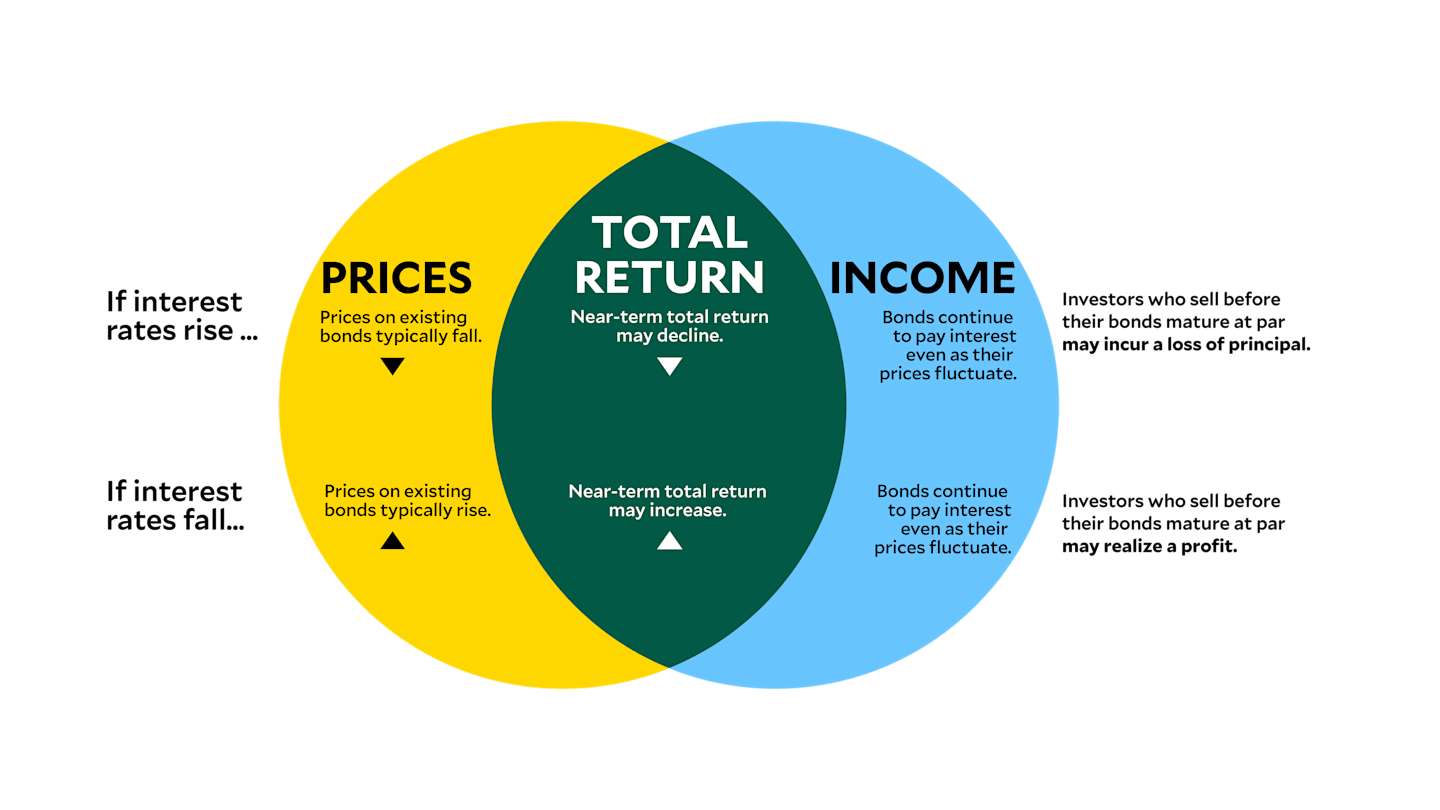
Example of Interest Rate Risk Impacting Investors
Consider a scenario in which you buy a bond at a par value of $1,000 with a fixed coupon rate of 3%.
If market interest rates rise to 4%, newly issued fixed-rate bonds may feature a 4% coupon.
You will have trouble selling your existing bond in the secondary market because newer bonds can provide more attractive yields.
The lower demand will trigger lower prices, and the market value of your 3% coupon bond will likely drop below your $1,000 purchase price. If you sell the bond before it matures, you may incur a loss of principal.
What Is Bond Duration, and How Does It Affect Interest Rate Sensitivity?
Duration, expressed in years (but not the same as a bond’s maturity), is a key measure of a bond fund’s sensitivity to interest rate changes. Although the prices of all bonds are affected by interest rate fluctuations, the magnitude of the change varies.
The longer the duration, the more a bond’s value will rise or fall with changes in market interest rates.
How to Use Bond Duration to Help Manage Interest Rate Risk
As an investor, you can’t eliminate interest rate risk, but you can seek to mitigate it by looking at your mix of longer- and shorter-duration bonds.
If you think interest rates have peaked and will likely move lower:
Focus on Longer-Duration Bonds
Investing in longer-duration, higher-yielding bonds or funds when interest rates are high offers price appreciation potential if interest rates fall.
If you think interest rates have not peaked and will continue to rise:
Focus on Shorter-Duration Bonds
Investing in shorter-duration bonds or funds when interest rates rise may help limit price declines because their prices are less sensitive to interest rate changes.
What Is Reinvestment Risk and How Does the Fed Affect It?
Reinvestment risk is the inability to reinvest money into securities that will earn the same or higher rates as your original investment.
When it seems that the Federal Reserve (Fed) might cut interest rates, investors may face growing reinvestment risk. Yields on short-maturity bonds and cash equivalents tend to move in sync with the federal funds target rate. So, if the Fed cuts rates, yields on savings accounts, Treasury bills, certificates of deposit and other similar investments likely will fall too.
Going back to our bond example with the 3% fixed coupon, what if interest rates fell to 2%?
You would first be a happy investor because your bond’s price likely would rise above your $1,000 purchase price—as interest rates fall, bond prices generally rise. The 3% bond pays more than newly issued bonds at 2%.
However, suppose your bond matures and you want to purchase another bond. You would reinvest your principal in a lower interest rate environment, and your new bond investments will not earn as much as before.
Reinvestment risk is heightened when the yield curve is inverted; that is when shorter-maturity yields are higher than longer-maturity yields. Learn more about what the shape of the yield curve can tell investors.
Having some longer-maturity bonds or bond funds may help mitigate reinvestment risk in this situation. Adding duration with longer-maturity holdings may help generate capital appreciation when rates fall. However, if rates have not yet peaked, this move would increase your interest rate risk.
As Rates Move, Risk Exposures Change
How Can You Help Manage Bond Risks?
Diversify Holdings With Higher-Yielding Bonds
Corporate bonds or mortgage-backed bonds are typically less sensitive to interest rate changes than Treasuries and thus can diversify high-quality bond portfolios. But keep in mind that these bonds are typically riskier than Treasuries and add exposure to another risk: credit risk.
Spread Out Bond Maturities With Bond Laddering
Bond laddering is a strategic approach that many active managers of diversified fixed-income portfolios use to manage bond risks. It involves having bonds with different maturities and smaller amounts to reinvest over time.
For instance, if you have $50,000 to invest, you might divide that into equal parts and put $10,000 each in bonds that mature in one, five, 10, 20 and 30 years. When the one-year bond matures, you can use the proceeds to buy a new five-year bond at the prevailing market rate.
If interest rates have risen, you have the opportunity to buy a bond offering a higher yield.
If interest rates have fallen, you may still buy a new five-year bond to keep the bond ladder in place. However, the other bonds in the portfolio may continue to yield returns more elevated than the current market rates for new bonds.
Why You May Benefit from Actively Managed Bond Funds
Interest rate and reinvestment risks are just two of many aspects to consider when investing in bonds. Economic, sector-specific and issuer-specific issues and more can affect bond returns. If managing it all on your own seems daunting, you might look into a professionally managed fund.
When interest rates are rising, a bond fund will reinvest the coupon payments and maturing securities in its portfolio at the new, higher rate, so the fund typically will reflect the increase in prevailing yields faster than many investors buying individual bonds on their own.
The investment professionals on our actively managed funds have the flexibility to adjust portfolios as market risks and opportunities shift, which gives them the potential to outperform.
Choose the Right Active Bond Fund for Your Investment Horizon
The nearer you are to your goal, and/or the more sensitive you are to potential changes in the value of your portfolio, the shorter your duration likely should be.
If Your Time Horizon Is Approximately Three Years
Consider our shorter-duration investments:
If Your Time Horizon Is Longer Than Three Years
You may be willing to accept a higher degree of interest rate risk for higher potential rewards. However, if your goals are more long term, we believe intermediate-term, core diversified fixed-income holdings may be a good option.
We offer several funds with an intermediate duration. You may want to consider:
Put Active Expertise to Work With Bond ETFs
The exchange-traded fund (ETF) structure is an appealing investment vehicle if you're pursuing fixed-income opportunities, as it offers cost and tax efficiencies unavailable in other portfolio types.
Additionally, active fixed-income ETFs may make sense in today’s dynamic bond market. Portfolio managers are able to respond to market dislocations and evolving risks in real time: They can adjust duration, credit exposure and sector allocations as interest rates, inflation and economic conditions change. That may give investors more opportunities for attractive income and total return potential.
Explore our actively managed bond ETFs.
Let Asset Allocation Funds Choose the Bond Mix
Choosing your own investments can be difficult, especially when you’re just starting to invest. Asset allocation portfolios choose your bond and stock mixes for you.
Our signature One Choice® Portfolios offer automatically diversified solutions—based on time or risk. Just one selection to make for your portfolio, and the guesswork goes away.
Don’t Let Bond Risks Overshadow Their Potential Value in Portfolios
Interest rate and reinvestment risks are part of bond investing, but they don’t diminish the potential value of a thoughtfully constructed bond allocation. A diversified mix of maturities and bond types—whether selected individually or through active bond funds, ETFs or asset allocation portfolios—can help you adapt. With an approach matched to your goals and time horizon, a bond allocation can serve as a valuable portfolio building block.
Authors
Senior Director, Product Management
How Does Inflation Affect Your Money?
Explore the effects of rising prices and ways to help your portfolio combat it.
Exchange Traded Funds (ETFs) are bought and sold through exchange trading at market price (not NAV), and are not individually redeemed from the fund. Shares may trade at a premium or discount to their NAV in the secondary market. Brokerage commissions will reduce returns.
Investment return and principal value of security investments will fluctuate. The value at the time of redemption may be more or less than the original cost. Past performance is no guarantee of future results.
As with all investments, there are risks of fluctuating prices, uncertainty of dividends, rates of return and yields. Current and future holdings are subject to market risk and will fluctuate in value.
Investments in fixed income securities are subject to the risks associated with debt securities including credit, price and interest rate risk.
Diversification does not assure a profit nor does it protect against loss of principal.
The opinions expressed are those of American Century Investments (or the portfolio manager) and are no guarantee of the future performance of any American Century Investments portfolio. This material has been prepared for educational purposes only. It is not intended to provide, and should not be relied upon for, investment, accounting, legal or tax advice.