Looking Beyond the Headlines During the 2026 Midterm Election Season
Market swings around elections can be unsettling, but staying focused on your long-term financial goals may help you keep short-term volatility in perspective.
Key Takeaways
Market volatility has often increased around midterm elections.
U.S. stocks have historically rebounded after midterms, but outcomes can vary.
Election headlines may be short-term; your financial goals are long-term.
Election season is back, and the public’s focus is shifting to the November midterm congressional races, along with numerous state and local ballots.
This year’s election season will likely unfold against the backdrop of the conflict in Iran, which has heightened inflation concerns and added to the unease that often accompanies midterm elections. Historically, such periods have produced higher volatility in financial markets, and this year has proved no different.
But investors shouldn’t let short-term market anxiety hamstring their long-term decisions. History has shown that when the midterm dust settles, stocks typically have advanced — regardless of outcomes or which party controls Congress. In the meantime, try not to let the midterms overshadow other market factors as you focus on a sound long-term investment plan.
Why Are Markets Volatile During Midterm Election Years?
It’s understandable for markets to feel more uncertain as midterm elections approach. Election outcomes can shape policy priorities, and those policies may affect the economy and financial markets.
This year, the narrow balance of power in Congress has added another layer of uncertainty. Republicans held a slim majority in the U.S. House of Representatives as of early August, while several competitive Senate races could influence which party controls that chamber.
Historically, the president’s party has often lost House seats in midterm election years. Since World War II, the president’s party has lost House seats in 18 of 20 midterm elections, underscoring how midterms can shift expectations for future policy priorities.1
But the midterms are far from the only factor increasing market uncertainty this year. The stock market fell sharply in March amid the onset of the conflict in Iran, then rebounded in the second quarter. Investors have also continued to assess the potential effects of artificial intelligence (AI) on the global economy and financial markets, contributing to shifts in market sentiment.
Still, midterm election years have historically been associated with higher volatility, regardless of other events.
How Has the Market Historically Performed After Midterm Elections?
Although market volatility often increases around midterm elections, history shows that stocks have historically risen after voting is over.
Since 1950, U.S. stocks have advanced in the 12 months following each midterm election. On average, the S&P 500® Index has gained 24.5% in those 12-month periods.
Those results have been consistent across different political environments, including periods when one party controlled Congress and periods when power was divided. See Figure 1. Still, past performance doesn’t guarantee future results, and election outcomes are only one of many factors that can affect markets.
Figure 1 | Red, Blue or Purple: Does It Matter?
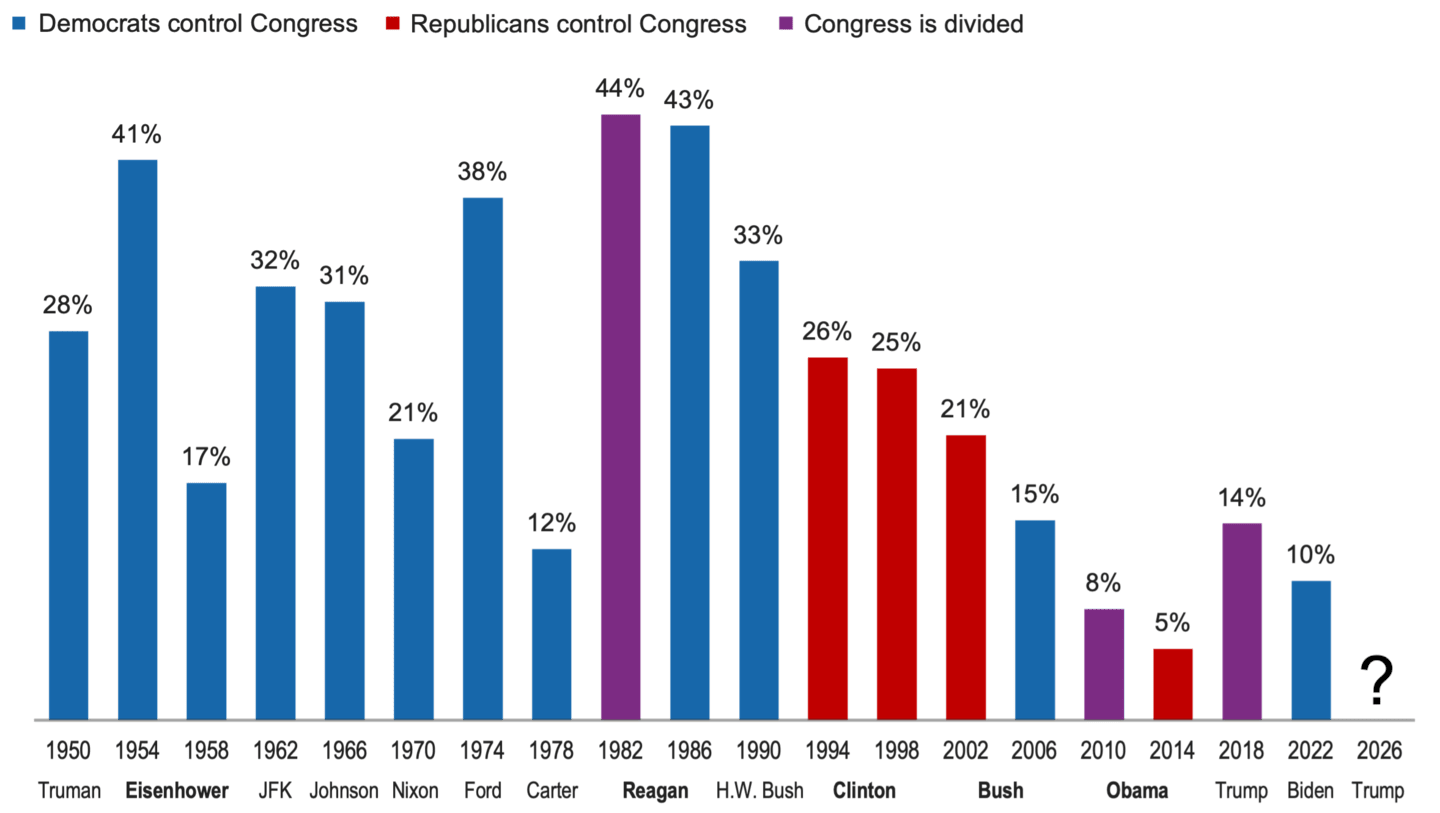
Data reflects 12-month performance beginning 11/1 in each midterm election year. Source: Morningstar. The presidents whose names are bolded served two consecutive terms. Past performance is no guarantee of future results.
Should Investors Adjust Their Portfolios in Anticipation of Election Results?
Election outcomes are difficult to predict, and market reactions can be even harder to anticipate. Even if one party controls Congress, it’s not always clear which policies will become law, how they may change during the legislative process or how markets and companies may respond over time.
That uncertainty is one reason to be cautious about making portfolio changes based on election forecasts. Instead, it may help to focus on factors within your control, such as saving consistently, staying diversified and keeping your long-term financial goals in view.
Voting is a political decision, whereas managing a portfolio is a financial one. Keeping these decisions separate can help ensure that election headlines don’t sway long-term investment decisions.
How Do Government Policies Affect the Market?
Get insights about the intersection of U.S. government policies and the financial markets from our investment professionals.
Robert A. Strong, “For 80 Years, the President’s Party Has Almost Always Lost House Seats in Midterm Elections, a Pattern That Makes the 2026 Congressional Outlook Clear,” The Conversation, January 19, 2026.
Past performance is no guarantee of future results. Investment returns will fluctuate and it is possible to lose money.
Diversification does not assure a profit nor does it protect against loss of principal.
This material has been prepared for educational purposes only. It is not intended to provide, and should not be relied upon for, investment, accounting, legal or tax advice.
©2026 Morningstar, Inc. All Rights Reserved. Certain information contained herein: (1) is proprietary to Morningstar and/or its content providers; (2) may not be copied or distributed; and (3) is not warranted to be accurate, complete or timely. Neither Morningstar nor its content providers are responsible for any damages or losses arising from any use of this information.