Munis and Midterms: Spotting Signals Amid the Noise
What happens at the ballot box can ripple through the municipal bond market. Here’s what investors may want to keep on their radar postelection.

Key Takeaways
The 2026 midterm elections highlight key federal, state and local issues important for municipal bond investors.
State-level elections often have a greater impact on the muni market than the federal elections that dominate headlines.
We believe active fund managers attuned to the central issues facing muni issuers may be well-positioned to uncover election-related opportunities.
With the U.S. midterm elections quickly approaching, we’re sifting through scenarios and evaluating potential effects on the municipal bond (muni) market. Because of their tax status and purpose, most munis are linked to a government entity. That means muni investors should keep a sharp eye on election results.
Election Outcomes Can Affect Munis
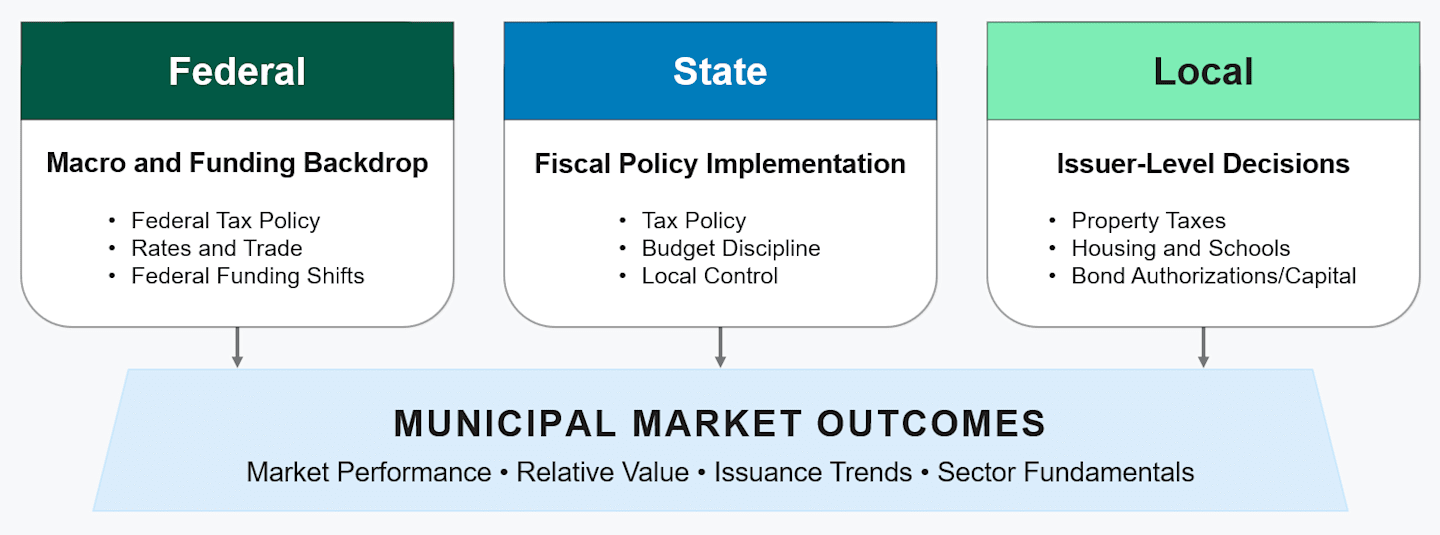
On November 3, 2026, Americans will vote for officials at every level of government. Each set of races may impact the muni market differently:
Federal elections influence macroeconomic conditions.
State elections shape fiscal policy.
Local elections frequently determine the operational environment for municipal matters.
Figure 1 illustrates how voters’ decisions drive policies that ultimately affect the municipal bond market.
Figure 1 | How Midterm Election Results Flow Through to Municipal Markets
Source: American Century Investments.
Federal Elections Have Historically Had Mixed Effects on Munis
Given their big-picture, macroeconomic focus, federal midterm elections have typically created “noise” for the muni market. Overall, their impact on muni yields has been mixed, as Figure 2 demonstrates.
Looking at the 11 midterms since 1982, and the 10-day periods before and after those elections, muni yields rose in five periods and fell in six. Overall, the average yield change for 10-year investment-grade munis was 0.32 percentage points. The 10-year Treasury yield experienced similar election-year trends, but the average shift was smaller, at 0.24 percentage points.
Figure 2 | Market Reactions to Federal Midterms Have Varied Over Time
Changes in Yield Over the 10 Business Days Before and Through the 10 Business Days After Each Election
Data from 1982 – 2022. Source: Bloomberg, Municipal Market Data (MMD).
State Elections Can Directly Impact Munis
State elections directly influence budgets, taxes, education funding, infrastructure priorities and local government authority. Consequently, these elections typically have a direct impact on municipal bond portfolios:
Material changes to budgets, funding or revenue flexibility would affect our relative value decisions.
Limitations on local government control could alter our sector allocations and security selections.
A new governor often introduces financial-related changes and sets project priorities that could alter the state’s muni backdrop.
According to the National Governors Association, 39 states will elect governors this year, with 18 incumbents seeking reelection. We expect minimal impact on state-level party control and remain focused on issues related to federal funding changes in a declining revenue environment. These include how states will adapt to changes in Medicaid and SNAP (Supplemental Nutrition Assistance Program) funding, and to FEMA (Federal Emergency Management Agency) revamping.
On the fiscal policy side, we are actively watching two potential changes:
Wealth taxes. Some politicians are proposing such taxes to generate new revenue to offset federal funding shifts. This isn’t a new idea, but it has gained momentum in the wake of the One Big Beautiful Bill Act.
For example, California has dueling “billionaire tax” measures on the ballot. If the billionaire’s tax passes, it would finance health care and pave the way for other states to follow suit.
Limitations on local control. Meanwhile, other states seek tax relief via ballot measures, as Figure 3 outlines. Florida’s proposal seeks to reduce local property taxes, while North Carolina’s amendment requires the legislature to set property tax limits.
A 2025 Texas amendment limited property taxes, and the Texas legislature continues to debate implementing stricter local spending caps and stronger voter approval. Californians will also decide whether local property and other taxes will require a two-thirds vote.
Figure 3 | State Election Measures Target Property Taxes
Local Control Ballot Initiatives
Source: National Conference of State Legislatures, 2026.
Elsewhere, Iowa recently imposed a cap on property tax revenue growth, while legislatures in Georgia, Oklahoma and Wyoming are considering their own measures.
Municipal bonds repaid from property or other local taxes demand specific scrutiny at election time. Any limits on the ability to raise revenues and/or finance operations would represent a material shift in our assessment of certain local government credits.
One example is the Texas governor’s property tax reform proposal, which would eliminate school district property taxes for homeowners. This change could negatively affect school district bonds. From a pure credit perspective, a new funding structure could shift perceived credit strength toward state-supported deals.
Local Elections Debate Data Center Development
Data center expansion is becoming an important credit concern affecting state and local elections. The focus has moved from economic development strategies to issues related to local utility and infrastructure management.
Figure 4 highlights the states that have paused data center development or are considering restrictions on it. We view the cost-benefit analysis as a modest positive for the market, though we expect continued variability in construction and development activity.
Figure 4 | Data Center Development Faces Growing State Scrutiny
Source: National Conference of State Legislatures, 2026.
It’s difficult to aggregate local elections, but the muni market expects the largest states to propose more than $75 billion in bond authorizations in November. If they pass, these authorizations would be positive for capital infrastructure and muni market supply.
At the same time, local governments are grappling with declines in federal and state revenue, housing affordability, insurance availability and rising utility costs. Most of these challenges are outside local governments’ control.
Managing Municipal Bonds Through Election Cycles
Elections at every level of government often influence municipal bonds more than other assets. The nature of munis — from their tax-exempt status to their issuer profiles and the projects they finance — means government policy plays a prominent role.
Heading into the 2026 midterm election season, our muni team remains focused on the political issues shaping market opportunities and challenges. Analyzing policy proposals, evaluating potential outcomes and identifying promising issuers are crucial to our active investment process. We believe this approach helps keep our portfolios nimble, opportunistic and ready to respond to voters’ choices.
Authors
Senior Portfolio Manager
Senior Municipal Credit Analyst
Learn about the tax advantages of municipal bonds.
IRS Circular 230 Disclosure: American Century Companies, Inc. and its affiliates do not provide tax advice. Accordingly, any discussion of U.S. tax matters contained herein (including any attachments) is not intended or written to be used, and cannot be used, in connection with the promotion, marketing or recommendation by anyone unaffiliated with American Century Companies, Inc. of any of the matters addressed herein or for the purpose of avoiding U.S. tax-related penalties.
This information is for educational purposes only and is not intended as tax advice. Please consult your tax advisor for more detailed information or for advice regarding your individual situation.
Investment return and principal value of security investments will fluctuate. The value at the time of redemption may be more or less than the original cost. Past performance is no guarantee of future results.
Generally, as interest rates rise, the value of the bonds held in the fund will decline. The opposite is true when interest rates decline.
Even though a tax-free bond fund is designed to purchase assets exempt from federal taxes, there is no guarantee that all of the fund’s income will be exempt from federal income tax or the federal alternative minimum tax (AMT). Fund managers may invest assets in debt securities with interest payments that are subject to federal income tax and/or federal AMT. State and local taxes may also apply.
The opinions expressed are those of American Century Investments (or the portfolio manager) and are no guarantee of the future performance of any American Century Investments portfolio. This material has been prepared for educational purposes only. It is not intended to provide, and should not be relied upon for, investment, accounting, legal or tax advice.