Beyond the Numbers: Rethinking Retirement Readiness
American Century’s 13th national retirement survey reveals readiness must account for savings progress, protecting that progress, navigating transitions and turning savings into income.

Key Takeaways
Retirement plan design has come a long way in helping employees save. Now, there’s more to be done in helping them retire confidently.
Retirement readiness is now about how participants navigate to retirement, starting long before the retirement date and lasting well after.
Retirement advisors can use the survey data to spark conversations and help their clients improve retirement readiness.
Retirement Plans Have Changed, So Has Readiness
Retirement plans have evolved significantly since we published our first national retirement survey 13 years ago. In 2013, the industry debated whether to offer matching contributions, automatic enrollment, automatic escalation, and even target-date funds. Today, those features form the cornerstone of the success we’ve seen in helping employees save over the years.
But there’s more to retirement planning than simply growing assets. Readiness is about how participants navigate to and beyond their retirement dates. It’s measured by outcomes, and ultimately by whether they’ll have enough money to live comfortably.
4 Themes to Improve Retirement Readiness
Our research shows that four themes can help participants improve their chances of achieving their desired outcomes. We categorized them under the concepts of saving, protecting, transitioning and generating income. Exploring the survey data can equip retirement advisors to have meaningful conversations that help move the needle on readiness.
SAVING
Participants Need Help Making More Progress
Despite rising savings rates and retirement remaining a top financial priority for 61% of participants across all ages, financial struggles and other priorities are hindering progress for many. Plan sponsors, on the other hand, underestimate the extent of these struggles by 25 percentage points.
Notably, 56% of participants cite the rising cost of living as the most common reason they struggle. Despite some improvements in savings behavior, they are also more worried about being ready to retire. Real-life disruptions, such as health events or providing unpaid care, weigh heavily.
Participants Worry About Risk—But Accept More Volatility
Participants still value protection against losses that could derail their retirement plans but appear increasingly willing to accept market volatility. This year, the number of participants who said they would accept a loss of 21% or more near retirement doubled over last year.
Sponsors worry about volatility affecting those closest to retirement and whether participants can make their savings last. Participants’ concerns lean more toward external forces, including inflation, interest rates and market risk, along with outliving their savings. It’s a notable divide: Participants focus more on market forces they can’t control, while sponsors focus on preparedness and decisions that can shape retirement outcomes.
Encourage plan conversations that account for financial disruptions—both market-related and personal.
PROTECTING
Participants’ Saving Progress Needs Preserving
A second theme centers on the protection participants want from their investments. Protecting their savings progress is just as important as growing their assets. In fact, many participants are willing to sacrifice investment performance to help protect their savings. It’s the loudest message we heard from this year’s findings.
Plan sponsors agree but also draw the line at how much loss they would accept in a single year, with the majority choosing 10% or less of the balance.
Participants Look Beyond Fees for Investments
Low fees are important, but so are other characteristics of retirement investments. Participants want investments that match their needs, are easy to use and protect against market losses.
For Participants, Suitability Means Far More Than Fees
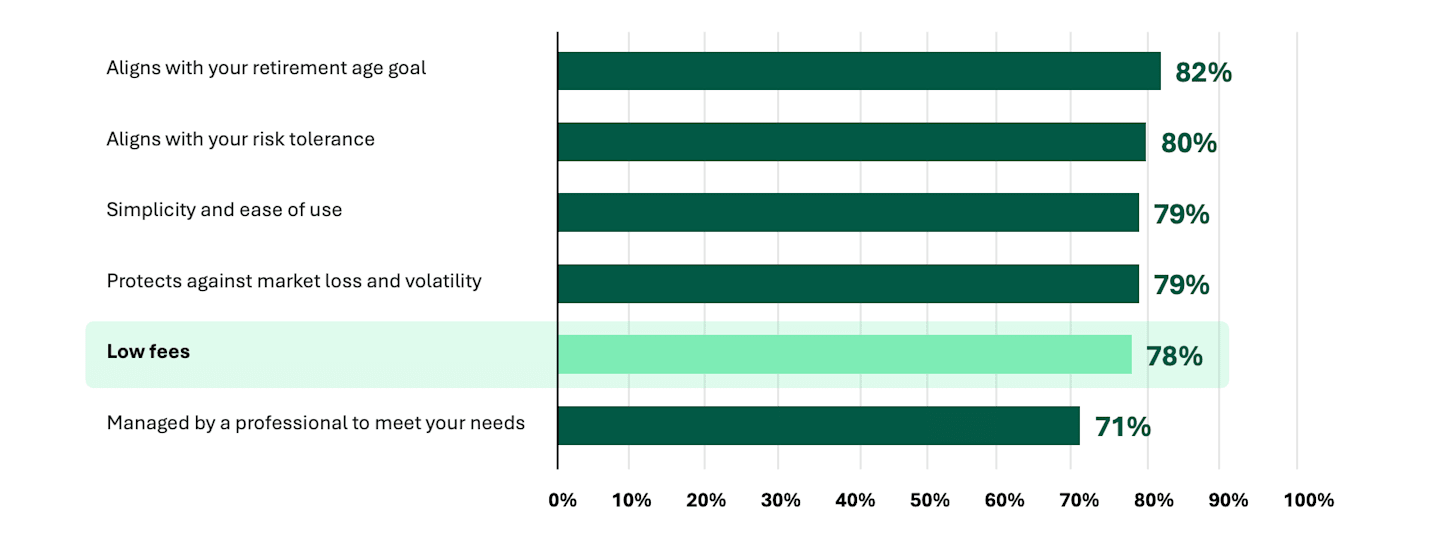
Choosing retirement investments is a whole-fund judgment, not only a fee comparison. Use our Target-Date Blueprint tool to help find TDFs that align with a plan’s demographics, risk profile and preferences.*
TRANSITIONING
Participants Need Help Planning for More Than the Retirement Date
Participants aren’t simply focused on a single point in time; they’re considering life events that could derail them. Though it ranks lower than other risks, transition risk is real, and plan sponsors are on the same page. Neither is confident that participants are prepared, both financially and non-financially.
Even fewer feel their employees are prepared for the possibility of being unable to find work in retirement or of retiring earlier than planned. For participants, preparedness is lowest for retiring earlier than planned or being unable to find "second act" work.
Financial and non-financial planning for the retirement transition could help participants feel a greater sense of readiness.
GENERATING INCOME
Participants Need Help Converting Savings Into Income
Retirement income is the new retirement benchmark, making it last is the ultimate goal for participants. And they know they need help. In fact, two areas where they have the greatest need for education are generating income from their retirement savings and managing their finances in retirement.
Decumulation Is Still the Great Unknown
Plan sponsors agree, believing the finish line is the hardest part for participants. A large majority also believe it’s important to help, yet fewer than half say they provide those resources, and only 36% say their decumulation education efforts are effective.
The Future: Protected Retirement Income
So far, plan design has addressed participation risk with autoenrollment, contribution risk with automatic escalation, and investment risk with qualified default investment alternatives (QDIAs). However, market risk, transition risk and longevity risk threaten retirement readiness. Both plan sponsors and participants believe it’s critical for the entire balance of participants’ retirement savings to be protected.
Discuss retirement income options with your clients. Our wholesalers can help you identify solutions that may best suit your clients.
The Next Opportunity for DC Plans
At American Century Investments, we believe the industry can make the future of defined contribution (DC) plans even better than legacy defined benefit plans. There are many solutions available today that give employees what they want and offer the best of both worlds: lifetime income while maintaining control over their assets during retirement.
Get More Insights on Retirement Readiness
Download our full 2026 retirement survey results of plan sponsors and participants.
Authors
Let’s Connect
Call your American Century Investments Wholesaler to discuss in-plan options and for help identifying the right solutions for clients.
Methodology: The participant survey was conducted between June 2, 2026, and June 23, 2026. The survey included 1,521 full-time workers between the ages of 25 and 70 saving through their employer’s retirement plan. The data were weighted to reflect key demographics (gender, income, and education) among all American private sector participants.
The sponsor survey was conducted between May 21, 2026, and June 18, 2026. Survey included 500 plan sponsor representatives holding a job title of Director or higher and having considerable influence when it comes to making decisions about their company’s retirement plan (either 401(k), 403(b), or 457 plans). The data were weighted to reflect the makeup of the total defined contribution population by plan asset size.
Percentages in the tables and charts may not total 100 due to rounding and/or missing categories.
Greenwald Research of Washington, D.C., completed data collection and analysis.
You could lose money by investing in a mutual fund, even if through your employer's plan or an IRA. An investment in a mutual fund is not insured or guaranteed by the Federal Deposit Insurance Corporation or any other government agency.
Investment return and principal value of security investments will fluctuate. The value at the time of redemption may be more or less than the original cost. Past performance is no guarantee of future results.
American Century Investments does not guarantee the quality, accuracy or completeness of data entered by advisors. In addition, American Century isn’t responsible for any errors or omissions, or for the results obtained from the use of such data or information entered by the advisor.
This information is for educational purposes only and is not intended as a personalized recommendation or fiduciary advice. There are different options available for your retirement plan investments. You should consider all options before making a decision.
The opinions expressed are those of American Century Investments (or the portfolio manager) and are no guarantee of the future performance of any American Century Investments portfolio. This material has been prepared for educational purposes only. It is not intended to provide, and should not be relied upon for, investment, accounting, legal or tax advice.