How Rising U.S. Debt Could Affect Your Finances
Growing government debt may impact borrowing costs, inflation and your investments. Here’s what to know about the potential risks and why it matters.

Key Takeaways
U.S. federal debt has surpassed $39 trillion, which may fuel higher interest rates, higher borrowing costs and inflationary pressures.
While U.S. debt is generally the most trusted globally, further credit-rating downgrades and surging debt levels could weigh on investor confidence.
You can’t control fiscal policy, but you can keep diversification a key consideration during times of market uncertainty.
The federal government’s debt stands at $39 trillion and is growing. The U.S. Treasury estimates it will reach $64 trillion by the end of 2036.1 For fiscal 2026, officials peg the deficit — the difference between government spending and revenue — at $2.1 trillion, and it may reach $3.1 trillion by 2036.2
Publicly held debt has surpassed the total size of the U.S. economy for the first time since World War II.3 This milestone could impact borrowing costs, inflation and financial markets.
What’s Responsible for the Increase in Government Debt?
U.S. federal debt continues to rise as recurring budget deficits add to the amount the government must borrow. As shown in Figure 1, federal spending has exceeded revenue as a share of gross domestic product (GDP), reflecting a persistent budget gap. According to the U.S. Government Accountability Office (GAO), these deficits stem largely from three long-term pressures:
Government spending that exceeds tax revenue.
Higher Social Security and Medicare expenditures as the population ages.
Rising interest payments on previously accumulated debt.
Figure 1 | U.S. Debt Escalates as Spending Exceeds Revenue
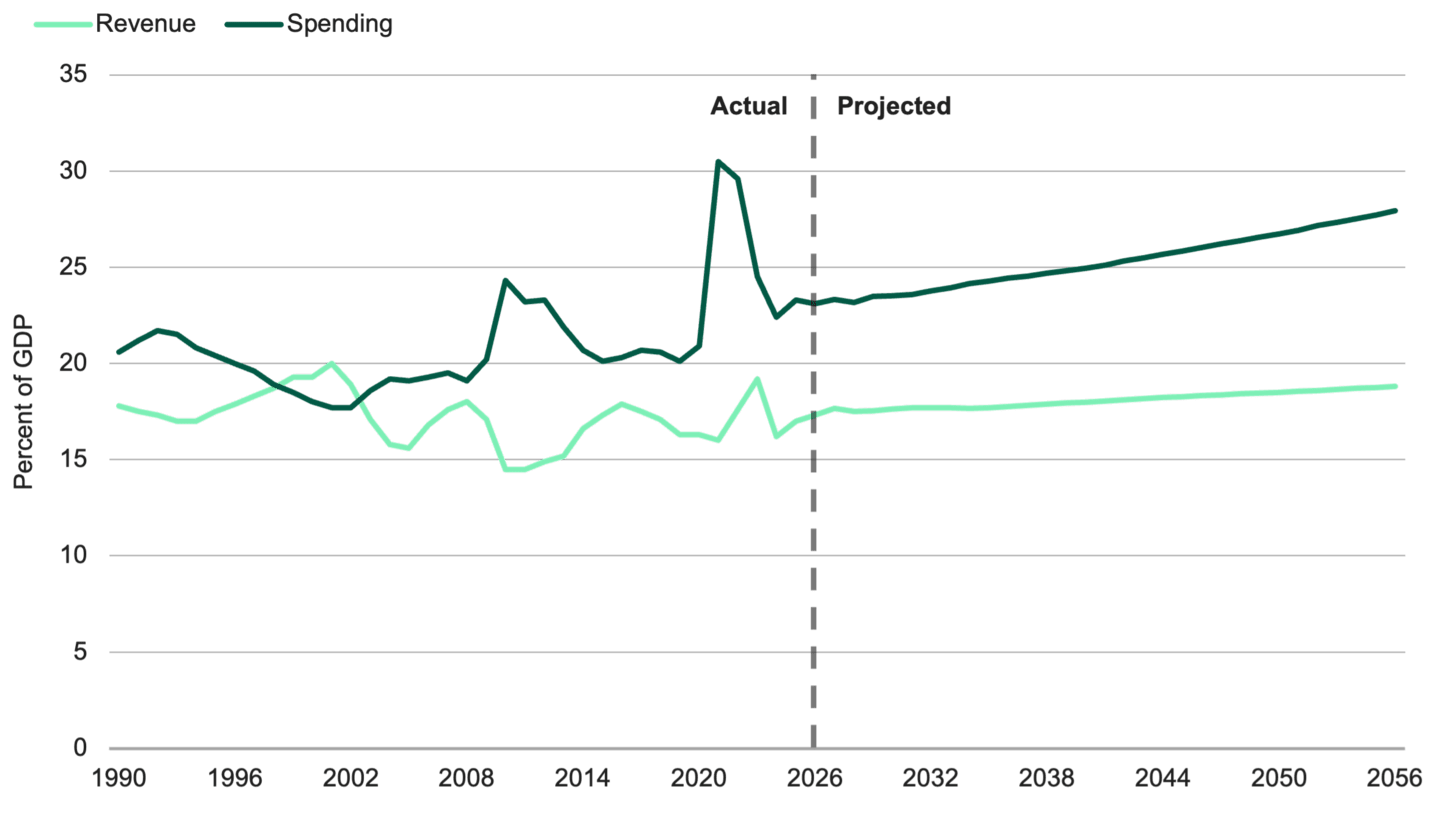
Data from 1/1/1990 – 6/30/2026. Projections as of 6/30/2026. Source: Congressional Budget Office, White House - Office of Management and Budget, and Peter G. Paterson Foundation.
How Federal Debt Can Affect Your Day-to-Day Life
Many Americans are paying closer attention to the federal debt and budget deficit. A recent Pew Research Center poll found that 64% of Americans view the federal budget deficit as a “very big” problem.4
Markets have historically absorbed rising levels of government debt. But today’s elevated levels are raising questions about what mounting debt could mean for interest rates, inflation and your finances.
Unease about soaring federal debt levels can weigh on investor confidence and contribute to uncertainty in financial markets. Growing fiscal pressures may also prompt debate about potential policy responses, such as higher taxes, reduced spending or changes to government programs.
High and rising debt levels also threaten the nation’s credit rating. Over time, this could raise concerns about the stability of the U.S. dollar and America’s role in the global economy.
We’ve already seen some effects of surging federal debt, as the U.S. no longer holds the highest sovereign debt rating at three major ratings agencies.5 In May 2025, Moody’s downgraded its U.S. credit rating by one notch, from Aaa, its highest rating, to Aa1. This followed earlier downgrades by Standard & Poor’s in 2011 and by Fitch in 2023.
Whether you’re borrowing money, buying products and services or investing for the future, rising federal debt can impact your finances in several ways.
Upward Pressure on Interest Rates
As government borrowing increases, the U.S. Treasury might need to issue more bonds at yields that are high enough to attract investors. There’s also a risk that the supply of government bonds could outstrip demand, further pressuring bond prices and yields.
When Treasury yields rise, borrowing costs may increase for consumers and businesses. Interest rates on many loans often move in sync with Treasury yields — so higher yields can trigger higher mortgage, auto and other loan rates. Higher borrowing costs can also cause consumers and businesses to spend less, thereby slowing economic growth.
Upward Pressure on Inflation
A ramp-up in government debt is a key driver of inflation.
Government borrowing leads to the issuance of additional government debt through Treasury securities. More debt securities in the market often prompt all bond issuers to offer higher yields to attract buyers, driving up interest rates across the board. Accordingly, this action may make borrowing more expensive for everyone — from homebuyers to businesses.
To help keep borrowing costs manageable, the Federal Reserve (Fed) may take steps to support the economy. But if more money is available while the supply of goods and services stays the same or shrinks, prices can rise. Over time, inflation can reduce your purchasing power and affect the value of your savings and investments.
What Higher Federal Debt Could Mean for Your Portfolio
Rising federal debt can influence interest rates and inflation, and those changes can impact different parts of your portfolio in different ways. That’s why it’s important to understand how cash, bonds, stocks and global investments may respond — and why diversification matters.
Cash and Savings
When interest rates rise, yields on short-term savings vehicles — such as savings accounts, CDs and money market funds — often rise as well. However, even as interest rates on these accounts rise, inflation can still erode the purchasing power of cash over time. Therefore, it’s important to understand whether those yields are keeping pace with rising prices.
Fixed Income
Fixed-income investments may traditionally offer higher yields when interest rates rise, but they can also experience more price volatility. Bonds you currently own may decline in value if their yields are lower than the yields available on newly issued bonds.
When bond yields rise, bond prices on existing securities generally fall. Prices of longer-maturity bonds are typically more sensitive to this dynamic. Meanwhile, this might create opportunities for investors seeking income, as newly issued bonds may offer higher yields than bonds issued when rates were lower.
Because rising inflation often accompanies rising rates, some fixed-income investors have also considered Treasury inflation-protected securities (TIPS) during such times. TIPS are U.S. Treasury securities designed to help protect against inflation, with principal values that adjust with changes in the Consumer Price Index (CPI). Their interest payments adjust as the principal value changes.
Stocks
Rising interest rates are typically a headwind for many stock prices. Higher rates increase borrowing costs for businesses, which can weigh on corporate profitability. They may also discourage companies from borrowing to invest in expansion, potentially slowing business growth.6
However, some stocks have remained resilient during periods of rising rates and inflation. Some companies have pricing power and/or strong earnings growth that help them navigate challenging market conditions.
Additionally, companies in different sectors respond differently to interest rates and inflation. For example, companies in the financial sector may benefit from higher interest rates. Elsewhere, rising inflation typically pushes commodity prices higher, which may boost revenues for energy and materials companies.
Global Investments
Global diversification may help reduce reliance on the U.S. market as U.S. debt rises. Spreading exposure across regions can provide access to different economies and sources of return, though international investments also carry political, currency and market risks.
How to Prepare for the Effects of U.S. Debt
While the path of U.S. government debt is outside your control, you can work with a financial advisor to help ensure your investment strategy reflects your goals, time horizon and risk tolerance.
In our view, these time-tested principles may help counter the effects of mounting government debt on investment portfolios:
Stay Diversified – A mix of stocks, bonds and other investments can help reduce dependence on any one part of the market.
Think Long Term – Market conditions change, but staying focused on long-term goals can help you tune out short-term market noise.
Review Your Portfolio Regularly – As interest rates and inflation change, it may be helpful to review whether your portfolio still fits your goals, time horizon and risk tolerance.
Consider Global Exposure – Investing outside the U.S. may provide access to different economies and sources of return, though international investments also carry risks.
Rising U.S. debt may create challenges through higher interest rates, inflation and market uncertainty. A diversified portfolio can’t eliminate risk, but it may help you pursue your long-term goals as economic conditions change.
Authors
Associate Client Portfolio Manager
Learn how our One Choice® Portfolios can help you diversify and manage risk.
U.S. Department of the Treasury, “What Is the National Debt?” Fiscal Data, accessed June 30, 2026.
Congressional Budget Office, "Monthly Budget Review: July 2026," August 10, 2026; Congressional Budget Office, “The Budget and Economic Outlook: 2026 to 2036,” February 2026.
U.S. Government Accountability Office, “The Federal Government's Debt Is Growing Faster Than the Economy: What Does That Mean for You,” Blog, June 11, 2026.
Shanay Gracia and Steven Shapiro, “Americans See Health Care Costs, Deficit, Inflation as Big Problems Facing the Nation,” Pew Research Center, May 11, 2026.
Kanan Mammadov, “The Downgrade Is Done; the Investor Response Is Just Beginning,” Enterprising Investor Blog, CFA Institute Research & Policy Center, May 22, 2025.
U.S. Government Accountability Office, “How Could Federal Debt Affect You?” accessed June 30, 2026; Board of Governors of the Federal Reserve System, “Why Do Interest Rates Matter?” July 19, 2024.
The opinions expressed are those of American Century Investments (or the portfolio manager) and are no guarantee of the future performance of any American Century Investments portfolio. This material has been prepared for educational purposes only. It is not intended to provide, and should not be relied upon for, investment, accounting, legal or tax advice.
Diversification does not assure a profit nor does it protect against loss of principal.
Investment return and principal value of security investments will fluctuate. The value at the time of redemption may be more or less than the original cost. Past performance is no guarantee of future results.